Grief and solace
Grief comes from within, sorrow inhabits us, lamentations convey our vulnerability, solace lightens the spirit.
Laurence Sterne’s 18ᵗʰ century creation, Tristram Shandy, recalls his father Walter meeting the news of the untimely death of his elder son and Tristram’s brother Bobby, and how he rid himself of this affliction1. The eccentric Walter took to abstract reasoning: “’Tis an inevitable chance,” in obtuse reference to the Magna Carta2. He speculated philosophically: “If my son could not have died, it had been matter of wonder, – not that he is dead.” He elaborated the rationale with heightening eloquence for all who would listen: “My son is dead! – so much the better; – ’tis a shame in such a tempest to have but one anchor.” In the tumultuous present, caught between the unchangeability of the past, and the unknowability of the future, the first thing that entered Walter’s head, after affairs were a little settled in the family, was to sit down coolly, and write ‘a Tristra-paedia … an Institute for the government’ of Tristram’s childhood and adolescence. ‘I was my father’s last stake’ – notes Tristram of Walter’s avowal to care so much the better for his now perilously precious younger son. After three years of spinning together scattered thoughts, counsels and notions, Walter had advanced to the knotted middle of his profoundly diligent opus.
Michel de Montaigne recounts how Pharoah Psamtik III, defeated and captured by Persian King Cambyses II at the battle of Pelusium in 525 BCE, showed no emotion on seeing his daughter put to work as a servant and his son led away to execution. But he wept at the sight of a household companion amongst the 2,000 condemned Egyptians. Cambyses asked Psamtik why he remained unmoved by the fate of his daughter and son, and yet cried out for his friend. Montaigne quotes Psamtik’s reply: “Only the last of these misfortunes can be expressed by tears, the first two are way beyond any means of expression.”3 Did Psamtik also pity himself for his own fall from prosperity? Perhaps not. While under house arrest, he tried to ignite a rebellion, which failed, whereupon he drank a fatal dose of arsenic-based ‘bull’s blood’4.
The earliest known civilisation, the Sumer, who worshipped Inanna, goddess of love and war – immortalising our human capacity for uniting passion with lust, rapture with glory, loyalty with brutality, conquests with casualties … the Sumer who developed the earliest writing and governance systems with the rise of Uruk, Mesopotamian city of 30,000 residents, and 1,000 years later the earliest codes of law, applying general principles to particular cases in the city of Ur; the Sumer who invented the earliest abacus, for multiplications, reciprocals and powers, and the earliest dictionary, for translating between Sumerian and Eblaic; the Sumer who wrote love poems of passionate ardour … this incomparable economic and cultural power eventually fell to a calamitous 200-year long drought, along with later-developing civilisations in Egypt, Greece and the Indus Valley. Around 2000 BCE, Sumerian poets recorded heartrending laments by the goddess Ningal for her city of Ur, overrun and destroyed by Elamite invaders. Ningal became a motif for sorrowful, tender and compassionate weeping for her ravaged and dispersed people. In the Lamentation Over the Destruction of Ur, Ningal pours out ‘the water of her eyes’ in supplication to the gods An and Enlil, pleading with them: “Let not Ur be destroyed! Let not its people perish!”5 But the gods remain steadfast in their merciless raising of Ur, unmoved by her distressed heart. In her tear-filled helplessness, Ningal tears out her hair like rushes and beats her breast like a drum as she berates those who have devastated her city out of hatred and without cause.
On a November morning in CE 1244, a 60-year old wandering dervish named Shams al-Dīn Tabrīzī arrived in the Anatolian city of Konya, where he met and forever transformed the life of the 37-year old scholar and poet Rumi6. They instantly discovered a brotherhood, each complementing and illuminating the other’s self. Rumi cherished his spiritual union with Shams so much that when Shams abruptly and permanently disappeared from his life in December 1247, as he had foretold that he would, Rumi endured an unbearable pain of mourning. An outpouring of thousands of poems, collated in Rumi’s Divan-i Shams-i Tabrīzī, laments the loss of his beloved mentor and pleads for Shams’ return.
A man possessed, I wander in the plain
crying, “where in the world d’our gazelle go?”7
I will give freely my sweet life as lawful to whomever brings me a sign of him, or even a veiled hint.8
You are my soul, and without my soul I know not how to live; you are my eyes, and without you I have not a seeing eye.9
After many years of fruitless search, Rumi resigned himself to the finality of his loss.
In this house thousands and more are dead; there you are seated saying, “Behold my household!”
A handful of dust says, “I was once a tress”; another says, “I am a bone.”
You become bewildered; then suddenly Love comes saying, “Come to me, for I am the one eternally alive.
Embrace my smooth breast to your breast, so that I may deliver you this very instant from yourself.”10
With acceptance finally releasing his spirit, Rumi discovered within himself the source of the wisdom he had so admired and missed in Shams. Rumi’s son Sultan Valad recounts11: He said, “Since I am he, who am I seeking? I am the same as he. His essence speaks! While I was praising his goodness and beauty I myself was that beauty and that goodness. Surely I was looking for myself.” Sultan Valad saw Rumi transformed by the revelation: A drop of his soul became as expansive as the sea. The degree of his love became even greater. Because he became like this, don’t ever say, ‘He didn’t find him’.12
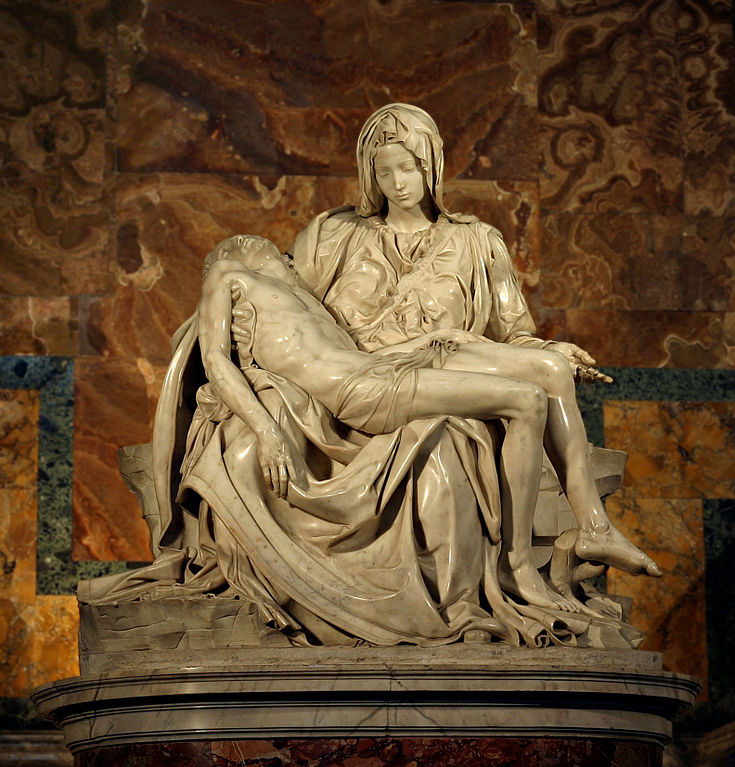
In 1498 Michelangelo began to sculpt the most perfect block of Carrara marble that he had ever used, for a Pietà to go in St. Peter’s Basilica in Rome13. In the biblical scene of a Pietà, the Virgin Mary sits alone holding the dead body of the crucified Christ, before his burial. Michaelangelo cast in stone her devastation at what has happened, her posture and gaze embodying pity, sorrow and lamentation, despair and resignation. Yet the repose of her hold and the sweetness of her expression, in harmony with the limp body that she supports on her lap, also suggest a graceful solace, now that he is beyond suffering.
C.P. Doncaster, Timeline of the Human Condition, star index