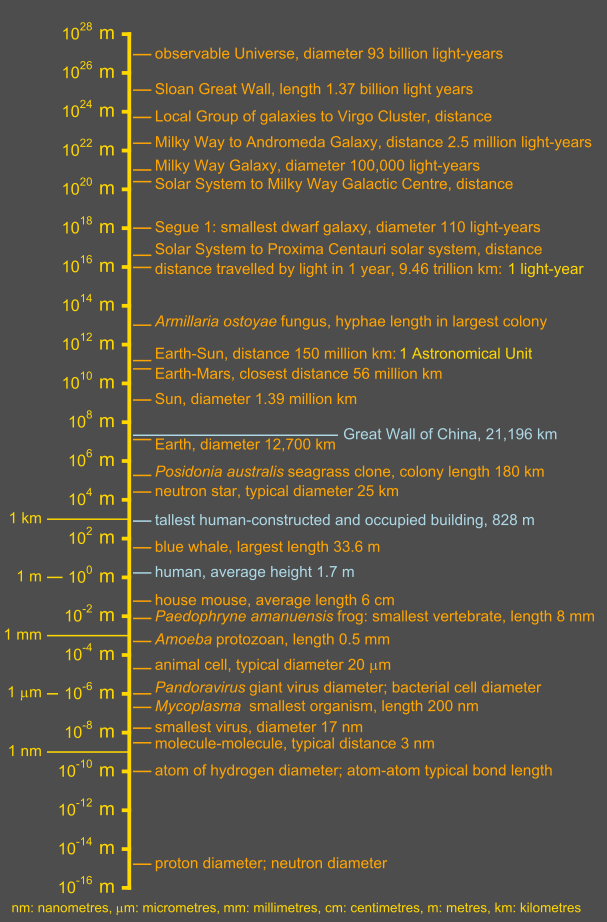
Size scales
The multiplicative scale below compares distances, lengths and diameters of structures by orders of magnitude. One order of magnitude corresponds to a 10-fold difference (an increment of 1 power of 10), two orders of magnitude correspond to a 100-fold difference (an increment of 2 powers of 10), and so on.
Galaxy clusters rank amongst the largest structures in the Universe, corralling galaxies by the force of their mutual gravity, the weakest of the fundamental forces. Our Milky Way Galaxy sits in the Local Group of more than 50 galaxies, and this group itself experiences a gravitational pull on and by our nearest neighbouring cluster of galaxies, the Virgo Cluster. These are just two amongst at least 100 groups and clusters that together form the Virgo Supercluster, one of millions of superclusters in the Universe. The largest superclusters form gargantuan walls of galaxies – in excess of 1 billion light-years long in the case of the Sloan Great Wall – that track filaments of dark matter whose gravity pulls galaxies into chains and strings of clusters.
At the other extreme of the magnitude scale, protons are the smallest and most enduring structures in the Universe, held together by the strong nuclear force. This strongest of fundamental forces binds quarks into protons and neutrons, and binds those particles within the atomic nucleus. Electromagnetic forces then join together atoms within molecules to construct the building blocks of life.
A dizzying 40 orders of magnitude separate the spacing of these structures, from the upper limits of the cosmic scale at 1025 m to the lower reaches of the subatomic scale at 10-15 m. Between these extremes, the macroscopic middle region contains some astonishing incursions of astronomical collapses down to organismal scales, and organismal constructions up to astronomical scales.
Neutron stars are collapsed massive stars, which typically measure just 20-30 km across. With a mass in the region of twice that of our Sun, they are phenomenally dense structures. The smallest observed black holes have similar diameters of the event horizon, the point of no return for all matter and electromagnetic radiation including light.
The Great Wall of China reached its maximum length of 21,196 km, equivalent to more than half the circumference of Earth, by the 17ᵗʰ century Ming dynasty. It remains to this day the world’s largest human-made military structure.
The world’s largest colony of the fungus Armillaria ostoyae has a combined length of interconnected hyphae in the order of 10 billion km. If the hyphae could be unbundled and strung out as a single filament, it would have more than enough length to reach from Earth to Neptune and back again. This ballpark estimate applies known hyphal densities of 1 to 10 m per gram of soil to an organism that has grown during some 2,000 years to cover nearly 10 km2 of Malheur National Forest in the North American Blue Mountains.
At subatomic scales, we see a uniquely vast gap in the sizes of matter, with five orders of magnitude separating the smallest atom from its atomic nucleus1. Here is the realm of the electron. This region contains the electron’s quantum probability cloud – the spread of its quantum state through space, existing in a stable tension between an electromagnetic attraction to its oppositely charged proton and the kinetic energy induced by quantum confinement.
The electron itself is an elementary particle, meaning that it has no substructure and can be treated as point-like and zero-sized in the Standard Model of particle physics. No evidence of finite size has yet been found, down to the smallest scales of empirical measurement around 10-18 m. An electron does have mass, nevertheless, equivalent to about 10-27 g, making it nearly 2,000 times lighter than a proton. As small as it is, it weighs a million times more than a neutrino, the lightest and most pervasive of all the elementary particles that hold mass.
C.P. Doncaster, Timeline of the Human Condition, star index