Carrying the Mantle: How Joseph Appleby is Leading Botley Mills into its Second Century
Featuring: Joseph Appleby, Managing Director, Botley Mills
Few business leaders inherit responsibility for an organisation that has been part of their family’s story for more than a century. Fewer still have the task of ensuring it remains relevant for the next hundred years.
For Joseph Appleby, Managing Director of Botley Mills, stewardship is as important as entrepreneurship. While many businesses focus on quarterly results or eventual exits, his perspective is different.
“There is no end game for us,” he explains. “The goal is to pass the business on to the next generation.”
That philosophy has shaped not only Joseph’s career but also the evolution of one of Hampshire’s longest-established family businesses.
Growing Up with the Business
Joseph’s connection to Botley Mills began long before he officially joined the company.
Born and raised in Botley, he grew up immersed in the rhythms of a family business. Holiday jobs, conversations around the dinner table and regular visits to company sites meant the business was never far away. Yet a career at Botley Mills was never assumed.
Like many students with strengths in maths and science, Joseph was encouraged towards engineering.
“My father studied engineering, my brother was studying engineering, my uncle had studied engineering. It seemed the obvious route.”
After leaving Seaford College, he enrolled at the University of Plymouth to study Mechanical Engineering. There was just one problem… He hated it.
“I realised very quickly that I wasn’t interested in the course. And if you’re not interested, you’re never going to succeed.”
It was a difficult realisation, but one that would prove pivotal.
Changing Course
Rather than spending three years pursuing a degree that did not inspire him, Joseph made a decision that many students find difficult. He changed direction.
A conversation with his father prompted him to think more carefully about the future he actually wanted.
“I said that one day I’d like to come back and work in the family business, but not immediately. I wanted to gain experience elsewhere first.”
That reflection led him to discover Plymouth’s Agriculture degree programme. Far from being limited to farming, the course combined science, business and practical problem-solving—precisely the blend that suited his interests.
“It really excited me.”
The decision transformed his university experience. He flourished academically, achieved a First in his dissertation, met his future wife during his first week on campus and was even encouraged to pursue a PhD. Instead, he chose a different path.
“I realised I only wanted a PhD because I liked the idea of being called Doctor. That probably wasn’t the best reason.”
Learning Beyond the Family Firm
Before joining Botley Mills, Joseph spent several years with Langmead Farms near Chichester. The graduate programme gave him exposure to large-scale agricultural operations and the opportunity to establish the company’s business information centre.
The experience provided something invaluable: perspective.
Like many successful family business leaders, Joseph believes it is important to gain experience outside the family firm before returning. Those early years helped him develop professionally, build confidence and learn how other organisations operated.
When he eventually joined Botley Mills, he brought fresh ideas as well as a deeper appreciation of the business he had grown up around.
A Business Built on Adaptation
.jpg)
The history of Botley Mills is, in many ways, a story of continuous reinvention. The Appleby family’s involvement in flour milling stretches back more than 300 years, while their connection to Botley Mills dates back to the early 1920s.
Originally, the business generated income from three core activities: flour production, animal feed manufacturing and coal distribution. None of those activities now form the heart of the business.
Instead, Botley Mills has evolved into a diverse commercial destination combining retail, property and specialist businesses. The lesson, Joseph says, is simple.
“You have to diversify.”
Today the business operates through three core income streams. The first is a thriving commercial property operation, with more than fifty tenants based across the site.
The second is the Botley Mills Country Store, supplying everything from pet food to specialist animal feeds for customers ranging from local residents to organisations such as Marwell Zoo and local authorities.
The third is perhaps the most unexpected. A specialist gun shop acquired from one of its tenants has grown into a highly successful retail operation and international media business, producing video content across Europe, Africa, the Caribbean and the United States.
It is a long way from flour milling. Yet the entrepreneurial mindset behind the diversification remains remarkably similar.
The Challenge of Family Leadership
Running any SME can be demanding. Running a family business adds another layer of complexity.
“It’s tougher than a non-family business because you have the family dynamic.”
Joseph speaks openly about the challenges of working alongside family members, particularly when he first joined the company and found himself reporting to his father.
“He was still my dad, but he was also my boss.” Like many next-generation leaders, he felt the need to prove himself. “You get treated differently. In many ways, you have to work harder.”
His route through the company reflected that belief. He worked across operations, sales, manufacturing, IT and production management before progressing through increasingly senior leadership roles. Those experiences provided a practical education that no classroom could replicate.
“You never stop learning.”
Leading Through Crisis
Few businesses survive for over a century without experiencing periods of uncertainty. Botley Mills has weathered world wars, economic recessions, changing industries and more recently, the COVID-19 pandemic.
For Joseph, one of the most significant leadership challenges came during the pandemic, when different parts of the business faced very different circumstances. Some employees worked from home. Others continued operating on-site. Some were furloughed entirely.
Meanwhile, more than fifty tenant businesses looked to Botley Mills for guidance and reassurance. Joseph invested significant time helping tenants understand rapidly changing regulations, access government support and navigate uncertainty.
The results were remarkable.
“We didn’t lose a single tenant and every tenant paid their rent throughout COVID.”
That outcome was not achieved through contracts or enforcement. It was achieved through communication, trust and relationships.
Building a Community, Not Just a Business
.jpg)
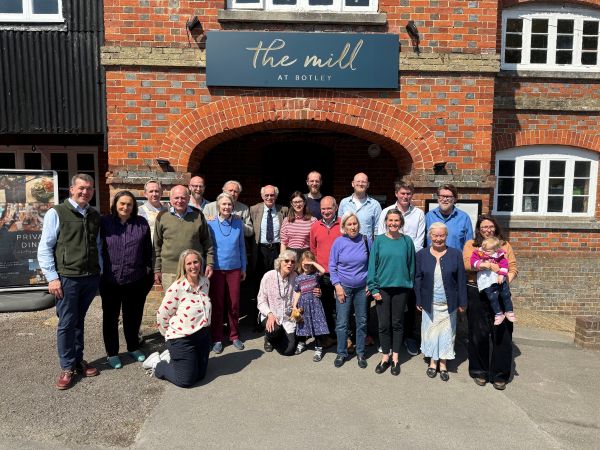
Perhaps what distinguishes Botley Mills today is that it operates as more than a commercial site. It functions as a business community.
With more than 200 people working across the various tenant organisations, Joseph sees value in understanding what each business does and what challenges they face.
Whether speaking to a florist, a recruitment company or a superyacht management firm, he believes there is always something to learn.
“You’ve got to listen, not just talk.”
That philosophy has also allowed Botley Mills to support the growth of many successful businesses. Several tenants have expanded from small start-ups into substantial enterprises before moving into larger premises of their own.
For Joseph, helping those businesses grow is one of the most rewarding aspects of the role.
Looking to the Future
As Botley Mills enters its second century, innovation remains firmly on the agenda. Joseph is actively exploring artificial intelligence, both to improve operational efficiency and to enhance customer experiences.
He sees AI not as a threat, but as another tool that businesses must learn to use effectively.
“You shouldn’t be frightened of it. You should use it.”
At the same time, he recognises that technology will never replace the importance of human relationships. After all, relationships are what have sustained Botley Mills through generations of change.
The bigger question is succession. Will the next generation continue the family’s stewardship? The answer remains uncertain. Like his father before him, Joseph is determined not to impose expectations.
“If they come into the business, it has to be because it’s their choice.”
Whatever happens, the focus remains the same: ensuring the business is strong enough for future generations to make that decision.
Lessons from a Century of Business
Reflecting on his own journey, Joseph offers advice that feels particularly relevant for students and aspiring business leaders. Rather than focusing solely on qualifications, he encourages young people to think carefully about the kind of work they genuinely enjoy.
“Work out where you want to be first, then decide what qualifications you need.”
It is advice rooted in personal experience. Had he remained on a degree course he disliked, his career might have looked very different.
Instead, he found a path aligned with his interests, his strengths and ultimately his family’s legacy.
Looking Ahead
At a time when many businesses focus on rapid growth or eventual exit, Botley Mills offers a different model. Its story is not about building a company to sell. It is about building something worth preserving.
More than one hundred years after the Appleby family became involved, the challenge remains the same: adapt, evolve and leave the business stronger than you found it.
For Joseph Appleby, that may be the most important leadership responsibility of all.