From Young Carer to Creative Agency Founder: Kayleigh Clover’s Journey with Little White House Marketing
Featuring: Kayleigh Clover, Founder of Little White House Marketing

For Kayleigh Clover, entrepreneurship was never part of a carefully mapped-out career plan. There was no business degree, no startup incubator and no moment at school when she decided she wanted to run a marketing agency.
Instead, her career has been built through work, relationships, resilience and an ability to learn as she goes.
Today, Kayleigh is the founder of Little White House Marketing, a Bournemouth-based social-first creative agency working across strategy, social media, photography, video, design, paid advertising and email marketing. Founded in 2022, the business has developed from Kayleigh working largely on her own into a growing team of employees and specialist freelancers.
Yet the foundations of that business were laid much earlier – during a childhood that required Kayleigh to grow up quickly.
Growing up with responsibility
Born and raised in Christchurch, Dorset, Kayleigh became a young carer after her mother developed a brain tumour when Kayleigh was 12. By 16, she was helping to run the household, caring for her mother and supporting her younger brother.
She began sixth form and studied business, but the competing demands of education, home life and being a teenager proved difficult to reconcile. After one term, she left and found an administrative job with a stationery company.
Then she discovered she could work evenings too. “I really wanted to earn money,” she remembers. She took a waitressing job in a pub alongside her nine-to-five role, saving her tips in a container in her bedroom and enjoying the simple satisfaction of counting what she had earned.
What emerges from those early years is a work ethic that remains central to Kayleigh's story. Work provided income, certainly, but it also brought independence, people and a sense of progress.
When her mother died shortly after Kayleigh turned 21, life changed dramatically. Grief was accompanied by the release from responsibilities she had carried throughout her teenage years. She travelled to Australia alone with only a modest amount of money, working in bars and restaurants for a few weeks at a time to fund the next stage of the journey.
It was an unconventional education in independence, adaptability and human relationships.
Finding marketing almost by accident
Returning home, Kayleigh met her future husband and spent almost a decade working for adventure travel company Camps International in Ringwood. Her role combined sales and marketing and took her around the UK presenting overseas travel opportunities to schools.
It also helped develop another skill that would later become important: photography. Kayleigh had bought a good camera and taught herself, taking advantage of the photographic opportunities that came with travelling. After having her daughter in 2016, however, the demands of a sales-focused role became increasingly difficult to combine with family life.
A few months before the pandemic, she decided to leave. There was no grand entrepreneurial plan. She wanted some time with her daughter before she started school and an opportunity to work out what she wanted to do next. The answer arrived close to home.
Her husband's refurbishment business was paying an external company more than £2,000 a month for marketing support. Kayleigh looked at what was being delivered and thought: I can do this. So she did.
She took over the marketing. Word spread through her husband's business network and other companies began asking for help. One client became another, and a freelance income gradually became a business.
Learning that you cannot do everything
Like many founders, Kayleigh initially tried to fulfil every role herself. Photography and social media management expanded into SEO, email marketing, videography, copywriting and design. Before long, she had effectively become an entire marketing department of one.
That created an important realisation. “I was a bit of a jack of all, master of none,” she recalls. As a self-described perfectionist, being busy was not enough; she wanted the work to be genuinely good.
Rather than continuing to stretch herself across every discipline, she began building a network of specialists. She retained the photography and videography she particularly enjoyed and brought trusted freelancers into areas such as design and copywriting. Many came through relationships she had developed locally – through networking, referrals and even the gym – rather than anonymous online marketplaces.
It is a model that has become central to Little White House. The agency's current proposition is effectively to become an outsourced marketing department, combining people with specialist skills rather than expecting one individual to do everything. Its website now presents a team covering social media, multimedia content, photography, design and strategy.
The business became a limited company in January 2025, and Kayleigh subsequently made another significant leap: employing her first member of staff. For someone accustomed to carrying responsibility herself, learning to delegate has been part of becoming a leader.
When business becomes personal
Perhaps the most powerful business lesson in Kayleigh's journey did not come from Little White House at all.
Her husband's company experienced a sudden and severe downturn when the budget attached to a major contract was dramatically reduced. Kayleigh describes what followed as devastating.
“It was heartbreaking. It was like someone had died.” The numbers changed frighteningly quickly: according to Kayleigh, turnover fell from around £600,000 in January to £200,000 the following month, leaving the business unable to reduce its cost base quickly enough.
The experience reinforced a lesson familiar to many SME leaders: concentration risk can be dangerous. In Kayleigh's words, there had been “too many eggs in one basket”.
But the setback also changed the dynamic at home. While her husband focused on another venture, Kayleigh doubled down on Little White House. During the following year, she says the agency grew its retained business by around 80%, supported by freelancers who had become an established part of the team.
Adversity did not produce an instant success story. It forced adaptation. And Kayleigh is clear about one of the uncomfortable truths of entrepreneurship: difficult periods often teach you more than easy ones.
Marketing built around people
That lesson perhaps explains something about Little White House's approach today.
Its website describes an agency that aims to operate as part of the client's own business rather than simply as an outside supplier. The emphasis is on learning the client's voice and business before creating the marketing around it.
It is also consistent with Kayleigh's own philosophy of marketing. In her writing, she argues that brands need human stories rather than marketing created simply to impress a boardroom, and that people tend to connect with people rather than logos.
That philosophy feels particularly fitting given her own career. Kayleigh's progress has repeatedly depended upon relationships – customers from her husband's network, people met through networking, trusted freelancers and referrals from previous clients.
For an entrepreneur working in the digital world, much of her business has been built in a very analogue way: by meeting people and earning trust.
Growth, but not growth at any cost
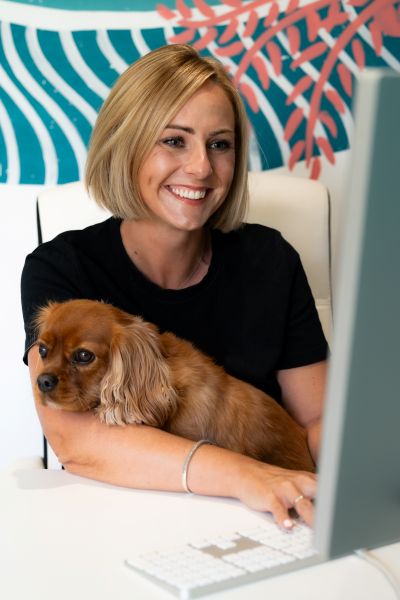
Little White House continues to evolve. Kayleigh has recently become a minority shareholder in another business through a marketing-related arrangement, giving her an opportunity to experience entrepreneurship from a different perspective. She is also interested in developing her own profile through speaking and podcast opportunities.
There is ambition, but also realism. After strong growth, 2026 has brought a tougher trading environment. Some clients, particularly in hospitality – a sector Kayleigh has a strong affection for – have reduced or stopped marketing expenditure. She would like to expand the team again, but wants the client base to support that decision first.
It is a useful counterpoint to simplified stories of entrepreneurship in which growth follows a smooth upward curve. Running an SME means continually balancing ambition against cashflow, opportunity against risk and work against the rest of life.
For Kayleigh, that last balance matters. Being her own boss provides flexibility, although she readily admits to being a workaholic. Family holidays still happen, school holidays still require improvisation, and her daughter has already had some unusual work experience – including helping on photography projects.
“Life's a juggle,” Kayleigh says. “Especially when you've got children and responsibilities.”
Key lessons from Kayleigh's journey
Kayleigh's story offers a few particularly useful lessons for aspiring entrepreneurs. Careers do not have to be linear: leaving sixth form, hospitality work, travelling, sales and photography all contributed skills to a business that did not yet exist. Specialisation can be a strength: recognising that she could not deliver every aspect of marketing brilliantly led Kayleigh to build a team around complementary expertise. Relationships compound: networks, referrals and trusted collaborators have repeatedly created opportunities. And perhaps most importantly, resilience is practical rather than abstract: when circumstances changed, Kayleigh kept adapting.
That last point brings the story back to the 16-year-old in Christchurch who could not imagine what life beyond her immediate circumstances might look like. Asked what she would tell that younger version of herself, Kayleigh's answer is strikingly simple:
“Just keep going. Just keep going… keep working hard because it's going to turn out all right in the end.”
Little White House Marketing may be the business Kayleigh is building today, but the capabilities behind it have been accumulating for much longer: responsibility learned early, confidence gained through work, independence strengthened through travel, creativity discovered through photography, and the judgement to know when doing everything yourself is no longer the answer.
For students and aspiring entrepreneurs, that may be the most useful lesson of all. Your first job does not have to reveal your destination. Sometimes a career only makes sense when you look backwards and see how apparently disconnected experiences have quietly prepared you for what comes next.