From Scientist to Entrepreneur: Cerys Baigent’s Journey of Reinvention, Resilience and Finding Balance
Featuring: Dr Cerys Baigent, Founder of Yoga with Cerys

What connects a scientist, a business improvement specialist, a sustainability consultant and a yoga teacher? For Dr Cerys Baigent, the answer is a career built around curiosity, learning and a willingness to explore new opportunities.
Based in Andover, Hampshire, Cerys has followed a professional journey that has taken her from scientific research into the commercial world, through business leadership and consultancy, and more recently into teaching yoga and supporting community wellbeing.
Her story challenges the assumption that successful careers must follow a carefully planned route. Instead, it illustrates how experiences that initially appear unrelated can eventually come together to create something distinctive.
And perhaps most importantly, it raises a question that many entrepreneurs eventually confront: what does success really look like when you are building a business around the life you want to lead?
An Early Introduction to Business
Cerys's working life began unusually early. At just 14, she started helping in an insurance brokerage where her stepfather was a branch manager. Initially, her responsibilities involved filing, making tea and coffee, and helping with the administrative tasks that kept the business running.
This was before the widespread computerisation of office processes, so much of the financial administration involved manual calculations and record-keeping. By 15, she was answering customer telephone calls and taking on greater responsibility.
It was an early education in how businesses operate, the importance of customer relationships and the confidence that comes from being trusted to do a job. Entrepreneurship was also present in her family. Following redundancy, her mother and stepfather invested in property and developed their own business.
Yet Cerys is quick to acknowledge that she did not inherit quite the same appetite for risk. She describes herself as considerably more risk-averse than her parents, an observation that helps explain some of her subsequent career decisions.
Her father, meanwhile, worked in financial management for major international businesses. His experience of continuous improvement methodologies would later influence Cerys's interest in making organisations more effective.
These different family influences provided an early introduction to two important aspects of business: the courage to create opportunities and the discipline needed to manage them.
A Scientist Without a Career Plan.
Despite her early commercial experience, Cerys's real passion at school was science. Unfortunately, the careers advice available to her was less than inspiring.
As a young woman who enjoyed science, she recalls being encouraged to consider nursing, with little discussion of the wider opportunities available.
With no scientists in her immediate family, she largely had to discover those possibilities herself. She studied chemistry, biology and mathematics at A-level, initially considering forensic pathology.
However, investigating the training required and the limited number of available positions made her question whether this was the right direction.
As she recalls: "I didn't like the odds." Rather than committing prematurely to a specialist career, she chose to study Natural Sciences at the University of Bath. It was a pragmatic decision. The degree allowed her to continue exploring different scientific disciplines without closing off opportunities too early.
That instinct to preserve options, gather information and make considered decisions would become a recurring feature of her professional life. Her subsequent academic journey included doctoral research at the University of Reading, providing the scientific foundations for a career that would eventually extend well beyond the laboratory.
From Scientific Expertise to Business Improvement.
Scientific training develops more than technical knowledge. It teaches people to question assumptions, examine evidence, solve problems and recognise when an established approach is no longer working.
For Cerys, these capabilities proved transferable to the commercial world.
Her professional experience has included working in technically demanding environments where scientific understanding must be combined with organisational effectiveness, customer support and commercial judgement.
One example was her work with NanoSight, where she helped establish a framework for international technical support. Supporting sophisticated scientific products across different countries, time zones and distribution channels required more than an understanding of the underlying technology.
It demanded systems, processes, communication and the ability to bring people together around shared objectives. Her interest in continuous improvement also developed through exposure to the Danaher Business System, building on ideas she had first encountered through her father's professional experience.
The underlying principle is straightforward: organisations improve when they understand how work is actually done, identify unnecessary complexity and create better ways of operating. For Cerys, this combination of scientific thinking and practical business improvement became an important part of her professional identity.
Learning Never Stops.
One distinctive feature of Cerys's career is her continued commitment to professional development.
In 2025, she completed the Help to Grow: Management programme, demonstrating that even experienced business professionals can benefit from revisiting their assumptions and developing new perspectives.
The programme, delivered through business schools, is designed to help SME leaders strengthen their management capabilities and develop plans for business growth. For Cerys, participation also reflects a broader philosophy: expertise is not something acquired once and then simply retained.
Markets change. Technologies develop. Customer expectations evolve. Successful business owners need to remain curious and open to learning. This is especially relevant for students and aspiring entrepreneurs who may believe they need a complete career plan before taking their first professional steps.
Cerys's experience suggests otherwise. A career can develop through a series of informed decisions, being open to new opportunities, and skills accumulated along the way.
Finding Another Kind of Balance
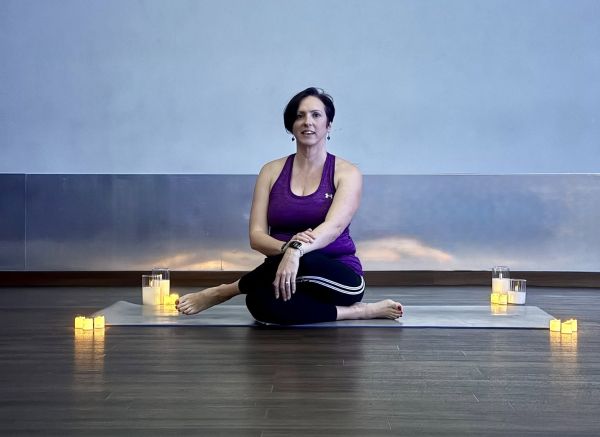
Alongside her scientific and commercial career, yoga has been part of Cerys's life for almost 20 years. What began as a personal practice has developed into another professional activity through Yoga with Cerys.
She now teaches community classes around Andover, including sessions in Abbotts Ann, alongside relaxation events, individual sessions and workplace yoga. Her teaching also extends into the wider community through organisations including Sport in Mind and BeActive Hampshire, as well as local fitness and hospitality venues.
Her approach emphasises mindful movement, breathing and creating an environment in which people feel comfortable participating regardless of their experience. There is an interesting connection between this work and her business background.
Both involve understanding individual needs, recognising that people start from different positions and helping them make progress. Her yoga teaching philosophy also leaves room for something that can sometimes be overlooked in professional environments: laughter, curiosity and imperfection.
Rather than treating wellbeing as an abstract ambition, Cerys focuses on giving participants practical tools they can use in everyday life. Her involvement in local wellbeing activities, including an Andover women's wellbeing event in May 2026, demonstrates how a small enterprise can contribute to community life beyond its immediate commercial activities.
Redefining What Business Success Means
Cerys's career brings together several different identities. She is a scientist by training, a business improvement professional through experience, an entrepreneur through choice and a yoga teacher through personal interest and professional development.
These activities might appear disconnected. Yet each draws on common strengths: curiosity, problem-solving, communication and a desire to help others develop.
Her journey also illustrates that entrepreneurship does not necessarily require abandoning everything that came before. Sometimes the most distinctive business opportunities emerge from combining experiences that others might regard as unrelated.
Scientific training can inform commercial decisions. Corporate experience can strengthen independent consultancy. A longstanding personal interest can develop into a community-focused enterprise.
The challenge is recognising the value of those connections. There is also a broader lesson about growth. For some entrepreneurs, success means employing more people, opening additional premises or achieving rapid increases in turnover.
For others, it involves creating a sustainable business that provides independence, meaningful work and the flexibility to pursue different interests. Neither definition is inherently superior.
What matters is understanding the kind of business — and the kind of life — the entrepreneur wants to build.