Neomodernisms Salon | Session III: Authoritarian, Nationalist, and Populist Returns Event
- Time:
- 10:00 to 11:30 EDT | 15:00 to 16:30 BST | 16:00 to 17:30 CEST
- Date:
- 2026-05-07 15:00:00
- Venue:
- Online on Zoom
Event details
From pro-Putin cultural policy to the roaring twenties parties of MAGA, contemporary authoritarian, nationalist, and populist movements abound with returns to - or of - modernist aesthetics, figures, and ideologies. What does this mean for contemporary understandings of modernism? How is modernist heritage shaped by geopolitical forces? What is the valency of historical modernism in contemporary political economy?
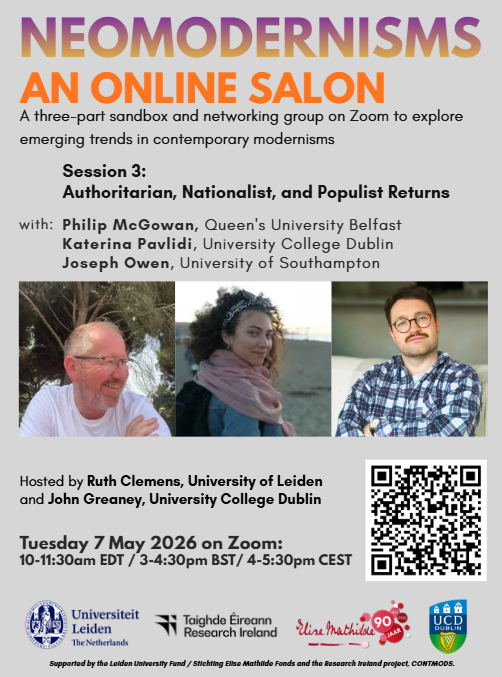
Making Gatsby Great Again? - Philip McGowan, Queen's University Belfast
To celebrate Hallowe’en in 2025, a Great Gatsby -themed party was held at Mar-a-Lago, Donald Trump’s Palm Beach, Florida resort. What it possibly tells us about F. Scott Fitzgerald’s modernist text as well as contemporary appropriations of it in Trump’s America is the focus of this talk.
Philip McGowan is a Professor of American Literature and Associate Dean for Internationalisation at Queen’s University Belfast. He served two terms as the President of the European Association for American Studies, from 2016 to 2024 and holds research interests in twentieth- and twenty-first-century American poetry and fiction.
Who owns Russian Modernism? - Katerina Pavlidi, University College Dublin
In this talk, Katerina Pavlidi explores how Russia’s authoritarian turn since 2012 has engulfed Russian modernism and postmodernism within a neo-conservative and traditionalist ideological framework. Particularly, she focuses on how Russia’s 2014 State Cultural Policy has reframed the history of Russian modernism and reshaped the meaning of ‘contemporary art’. A key focus of her talk is a 2016 Moscow exhibition – Forever Contemporary: Art of the 20th-21st Centuries – which defanged Russian modernism and rebranded it as a precursor to a new idea of contemporary Russian art. Through this lens, Pavlidi examines how claims to the legacies of Russian modernism have become a primary battleground in the broader struggle over Russia’s political and cultural future.
Katerina Pavlidi is a Postdoctoral Fellow at University College Dublin, working on the Research Ireland-funded project Imaginative Literature and Social Trust, 1990-2025. She is co-editor of Dis/Trusting the Digital World in Imaginative Literature, forthcoming with Edinburgh University Press.
Schmitt on Google Alert - Joseph Owen, University of Southampton
Online citations of "Carl Schmitt" proliferate in times of crisis. The Catholic Church is in "a state of exception"; the MAGA movement advocates for using "extra-legal power" against decadent cosmopolitan elites; the modern rhetoric of terrorism is defined by its distinction between "friend and enemy"; and the war with Iran is explained by Israel and America's need to subjugate "zones of influence". In all these instances, Schmitt provides conceptual shorthand for articulating contemporary conservative and neofascist imaginaries. Yet the routine, surface deployment of Schmitt’s ideas obfuscates the dubious blend of aesthetics, expediency, ideology, and power in his philosophy. I argue that Schmitt’s navigation of modernism—threaded through his fiction, literary criticism, legal treatises, and political writings—illuminates his aphoristic misuse in the present.
Dr Joseph Owen is a Research Fellow in English at the University of Southampton. His research examines modernist literature, film, and political theology. He is writing a book on Carl Schmitt and literary modernism for Bloomsbury.