3 March 2025
I'm Nat Easton, an early career, transdisciplinary researcher at UoS. Currently I hold joint positions as a Postdoc in the Faculty of Medicine and as the Specialist Policy Officer supporting the Faculty of Environmental and Life Sciences in Public Policy Southampton (PPS). I am also one of the recipients of the 2025/26 SRI Early Career Colleague Fellowships using tree bark to explore how pollution sources vary across Southampton and Winchester.
My research background centres on characterising air pollution, working in interdisciplinary teams to investigate the potential health effects and spatial distribution of different pollution sources. Increasingly, I have dedicated my time to knowledge exchange, and in particular supporting knowledge mobilisation for policy impact.
One of our key roles as Policy Officers in PPS is to screen consultations and support researchers in their submissions to inquiries or calls for evidence. A fantastic opportunity arose to submit proposals to the Environmental Audit Committee on what their next Parliamentary Inquiry should be on. The topic area was fairly broad, requesting submissions on any topic in the areas of “climate change, the environment and nature”. From those proposals up to 10 individuals were to be invited to pitch their proposal to MPs themselves, with just one forming the basis of the new inquiry.
I supported a total of four submissions, with my SMMI colleague in PPS supporting a further two. In total there were over 200 proposals submitted to the committee. We were delighted to discover that the submission authored by Prof Matt Loxham and myself on air quality was selected by the committee to pitch!
As such a key environmental challenge, it was unsurprising to discover we were not the only air quality submission. We were invited along with the other proposal authors to join a one-hour meeting to agree on a strategy, turn our 12 individual submissions into a new one-pager and decide on two people to represent the group. This was a very interesting group of people, mostly from NGOs - many of whom had worked extensively with each other before. There was only one other academic, and one representative from local government, as well as people representing the professional bodies of The Institution of Environmental Sciences (IES) and the Institute of Air Quality Management (IAQM).
The group decided that my positions jointly as an air quality researcher and policy officer, as well as my recently awarded Honorary Fellowship from the IAQM, placed me well to represent the coalition. Alongside me, we elected Jemima Hartshorn, who is the founder and director of Mums for Lungs - an NGO campaigning for cleaner air to protect children’s health.
The pacing of this became very rapid. We first met as a group for that one-hour meeting on a Wednesday lunchtime. We had 24 hours to finalise our new one-pager, despite many of us juggling other commitments. By the Monday lunchtime we had to submit our PowerPoint slides to the committee, with the actual pitch on the Wednesday just 7 days on from learning we were the ones delivering it!
Somewhat fortunately both Jemima and I were at the Royal Society of Chemistry both attending the Air Quality in the 21st Century conference (and in my case also delivering an entirely different oral presentation on the toxicology of port emissions in Southampton!). We briefly slipped out to make some final edits and got the file submitted.
.png)
Over a string of calls we practiced our 10-minute pitch over and over, with some respite on Tuesday morning to attend my daughter’s nativity play!
On the Wednesday, after another quick briefing and run through in a coffee shop we made our way to Portcullis House for our session.
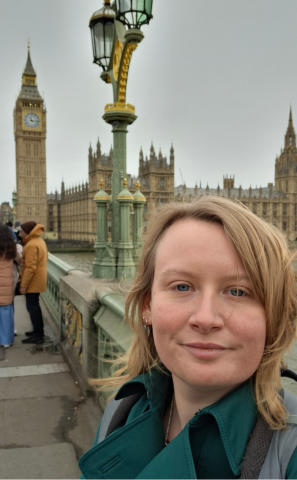
There were five total pitches each with a 10-minute pitch, followed by 10 minutes of questioning by the MPs:
- Ancient Woodlands and Peatlands (Plantlife & the Woodland Trust)
- Data Centres (UG student at UCL)
- Air Pollution (UoS and Mums for Lungs)
- UK-EU cooperation on the environment (IEEP UK)
- Climate and multi-hazard weather risk (RHUL & Loughborough University)
We pitched our talk around the 70th anniversary of the first clean air act which occurs in 2026, and on how high the health, economic and environmental burden from air quality is. As a duo, we had great synergy, with Jemima able to emphasise that it was people who ultimately pay the price for poor air quality, and myself there backing up the evidence. As we were representing a coalition, we were well placed to highlight the challenges, across the sectors and mutual desire for further action.
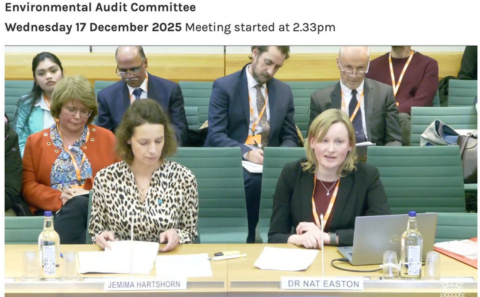
Thankfully, we didn’t have to wait long too for the outcome, receiving the news the following day that from that initial over 200 submissions, down to five pitches, ours was the winning pitch and will form the basis of the new inquiry!
It was a fascinating, stressful and rewarding experience which has led to a very positive result – allowing 2026 to start with optimism. Perhaps the most reassuring aspect as a female early career academic with a young child was that we, as two women both juggling childcare, life and other work commitments, were able to bring this together at such short notice and secure such a positive outcome.
The full pitch can be viewed on Parliament TV here and the outcome video from the Environmental Audit Committee is here.
Thank you to all members of the coalition:
Clean Air Fund; Clean Air in London; Global Action Plan; Mums for Lungs CIC; London Borough of Camden, Hackney, Islington, Hammersmith & Fulham, City of London Corporation, City of Westminster, the Institution of Environmental Sciences (IES) & IAQM, the Healthy Air Coalition, Impact on Urban Health, University of Southampton, and Royal Holloway, University of London.