From Manorial refuse to Mesolithic cattle: fieldwork on two sites at Avebury
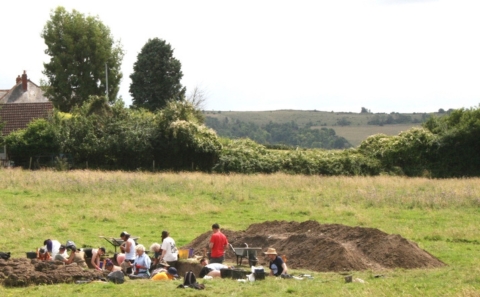
Inscribed as a World Heritage Site, the Avebury landscape in north Wiltshire is famed for its remarkable complex of later prehistoric ceremonial monuments. Dating to the Neolithic (4000-2400 BC), these include the Avebury henge itself (which incorporates the world’s largest stone circle) and the giant mound of Silbury Hill. If you haven’t already visited, you should! Over a number of years, Southampton has been actively engaged in fieldwork within the Avebury landscape, on sites ranging in date from the Mesolithic (9500-4000 BC) to Roman, and beyond. This summer, fieldwork took place on three sites: two with a prehistoric focus (Avebury Manor Parkland and Cherhill) and one Roman (Springfield).
Situated between the henge and manor, our investigations in the Manor Parkland concluded work begun last year which was designed to detect traces of Neolithic settlement in the environs of the henge. The big surprise was how little evidence of Neolithic activity was present, suggesting this was a ‘reserved’ (even sacred?) space at the time the monument was in use, and not an appropriate place for settlement. We did, though, encounter traces of a much earlier human presence, shown by scatters of Mesolithic worked flints; and by much later activity, linked to the Medieval village and post-1550 manor. The work will help elucidate the development of Avebury village from the Early Saxon period to the point when this space was changed into a formal parkland c.1700.
The second site was in the village of Cherhill c.4km to the west of Avebury; the fieldwork representing a collaboration between Southampton and Newcastle Universities, with undergraduates from both institutions taking part, alongside local volunteers. Here we continued work on a landscape that was an important focus for several millennia, spanning the Mesolithic and Neolithic. Earlier soils or ground surfaces lie buried in a series of deposits up to a metre deep. In one trench we have traces of a tufa spring, where calcareous deposits built up during the later Mesolithic, about 8-7000 years ago. Animal footprints were found embedded in what were soft muds – wild cattle and deer especially – while a human presence was indicated by abundant flint tools, butchered animal bones and antler (including antler tools). The level of preservation here is unusual for Mesolithic sites in the UK.
It may be that people continued to visit and occupy this site across the critical transition from hunter-gatherer (Mesolithic) to farming (Neolithic) lives. In a second trench thick deposits of dark soil had formed in a natural hollow, that soil containing refuse deposits rich in worked flint, animal bone and pottery of Middle Neolithic date. This must relate to settlement by pastoralist communities living at a time close to when the first phases of Stonehenge and Avebury were built. Did some of those Neolithic communities living at Cherhill take part in these great monumental ventures? Next year we will search for traces of houses/shelters that might go with those refuse deposits.