Trip to Iron Age-Roman Avebury
Inscribed as a World Heritage Site, the Avebury landscape in north Wiltshire is famed for its remarkable complex of later prehistoric ceremonial monuments. Dating to the Neolithic (4000-2400 BC), these include the Avebury henge itself (which incorporates the world’s largest stone circle) and the giant mound of Silbury Hill. If you haven’t already visited, you should! Over a number of years, Southampton has been actively engaged in fieldwork within the Avebury landscape, on sites ranging in date from the Mesolithic (9500-4000 BC) to Roman, and beyond. This summer, fieldwork took place on three sites: two with a prehistoric focus (Avebury Manor Parkland and Cherhill) and one Roman (Springfield).
Just to the north of Avebury henge are a couple of completely unremarkable fields, used for pasture as the Winterbourne stream that runs south past Avebury floods often (as was the case this year, with the heavy winter rains). Geophysics revealed that beneath the surface of these unassuming, biodiversity-rich fields, however, are three Roman-period parallel ditches that enclose an area about 80m by 40m, with an entranceway opening onto the marshy area of the meandering Winterbourne stream. Inside the enclosure, excavations over the past four years have revealed a large aisled building (20m x 12m) which was constructed in the early period of Roman occupation, and two 9m-deep circular-cut springheads or ritual shafts.
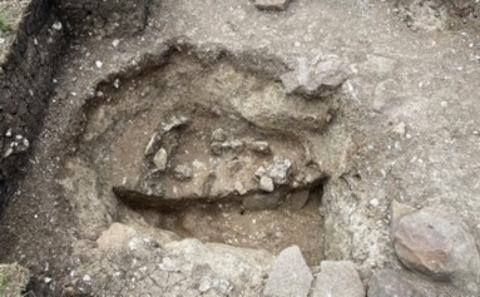
This summer, the team were keen to clarify the purpose of a smaller rectangular structure in the top north-west corner of the enclosure. The discovery of a clipped Roman coin fragment and some pieces of folded lead in the area around the building’s foundations suggest that this was likely a small Roman shrine—made more intriguing by the discovery of yet another well head right next door, built into the bottom of a natural sinkhole in the limestone. This site starts to build up a picture of how the Avebury landscape continued to be used, reflected on, and revered long after the initial period of monument building was over. Next year we will be back to see if we can situate this shrine complex within the broader landscape of Middle Iron Age-Roman period activity in this area, and to have a look into the ‘sacred spring’ – perhaps this was an important place for votive deposition?