iDx Lung early diagnosis study highlighted in CRUK Lung Cancer Awareness Month campaign
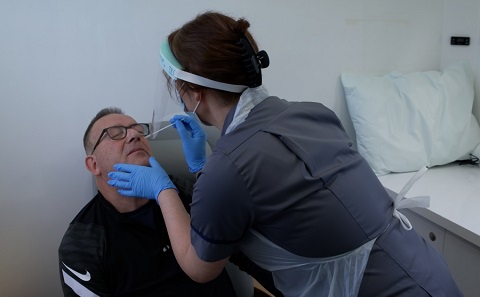
People across Hampshire have united to help Southampton scientists try to find new ways to diagnose lung cancer earlier – the biggest cause of cancer death in the UK.
Father-of-two, Adam Jackson, from Portsmouth, is one of 7,000 people who has taken part in the iDx lung study run by Cancer Research UK’s Southampton Clinical Trials Unit (SCTU).
By giving a simple nasal swab and blood sample to researchers, alongside an NHS Targeted Lung Health Check scan, it’s hoped experts can unlock key information that can help to detect the disease sooner, when it’s more treatable.
Today as part of Lung Cancer Awareness Month, according to new analysis by the charity, 5,100 lives are now saved every year in the South East from lung cancer thanks to research and improvements in prevention, diagnosis and treatment – that’s around 15 lives every day.*
After losing his own mum to cancer, former smoker, Adam, 61, has been helping researchers go one step further and said: “I was asked if I would like to take part in the study whilst I was having an NHS Lung Health Check scan and I was happy to.
“If I can help save somebody in future go through the heartache of losing someone to cancer, it’s the right thing to do. It was pain free, took just ten minutes and could help save someone’s life.”
Lung cancer is the third most common cancer in the UK and currently only 1 in 10 people will survive for 10 years or more. That’s why the Early Diagnosis team at the SCTU are keen to tackle it as soon as possible and Cancer Research UK is backing their iDx Lung Study.
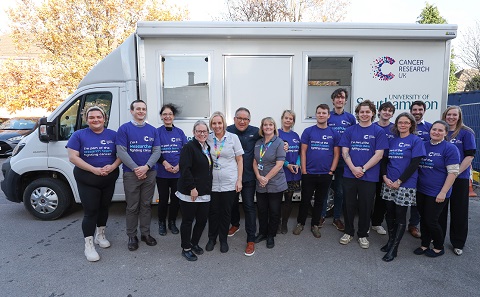
Victoria Goss, Head of Early Diagnosis and Translational Research at the CRUK funded Southampton Clinical Trials Unit said: “We’ve been working alongside NHS England’s Targeted Lung Health Checks pilot programme where people at higher risk of lung cancer are invited to attend a CT scanning unit across Hampshire, Yorkshire and Manchester. We then invited the people attending those scans to hop into the mobile sampling van and give a nasal swab and blood sample.
“We hope to determine if using simple tests alongside the NHS Targeted Lung Health Check programme will help diagnose more people in the very early stages of lung cancer so they can be treated sooner when it’s far more likely to be successful.
“The samples taken have been tested by a number of companies using the latest technologies and diagnostic techniques to see if they may pick up a protein or biomarker. If someone flagged as having one of these markers is also confirmed as having lung cancer on their NHS CT scan, it may reveal an early indicator of the disease.
“It’s hoped the study will ultimately identify much simpler, more cost-effective tests that highlight the cancer sooner so that more people survive the disease.”
The data is currently being collected and analysed by Victoria’s team at the SCTU. With NHS England’s Targeted Lung Health Checks now being rolled out across the country, the team is working to develop a second phase of the study using a different variety of diagnostic techniques.
The iDx Lung study was a huge collaboration between researchers at the SCTU, the University of Southampton Tissue Bank, the Wessex Investigational Science Hub (WISH) Laboratory and several leading industry partners. The study was the first ever recipient of the ‘Further, Faster, Together’ award for outstanding industry-academia collaboration at the Cancer Research Horizons Innovation and Entrepreneurship Awards in December 2022.
Primarily funded by Innovate UK, Cancer Research UK has invested £750,000 into this study and its scientists have been at the forefront of advances against the disease. More than 4 in 5 people with lung cancer who are prescribed cancer drugs in the UK, receive at least one drug that the charity has helped to develop. And in the last decade, it has invested over £231 million in lung cancer research**. Since the 1970s, around 94,700 deaths in the region have been avoided from the disease***
Video credit: Cancer Research UK
The South East has also supported the charity in its calls on the UK Government to take action that will help to save even more lives in this hard-to-treat cancer. Nothing would have a bigger impact on reducing the number of preventable deaths in the UK than ending smoking for good. That’s why the charity is calling for the swift implementation of legislation that will increase the age of sale for tobacco products and properly fund stop-smoking support for people trying to quit.
Cancer Research UK spokesperson for Hampshire, Elisa Mitchell, said: “From uncovering the causes of lung cancer to pioneering drugs to treat it and campaigning for change, the figures show we’re powering progress for lung cancer patients in the region and across the UK. But our work isn’t done.
“Preventing lung cancer, as well as stopping it in its tracks will give people many more precious moments with their loved ones. That’s why we’re urging the public and politicians alike to help play a part in beating the disease.
“The recently tabled Tobacco and Vapes Bill puts us on the path to ending lung cancers caused by smoking in the UK. People across the South East can get involved by emailing their MP to vote in favour of this historic legislation that will create a future free from the harms of tobacco.”
“We want to bring about a world where everybody lives longer, better lives, free from the fear of cancer – no matter who they are or where they’re from.
“So, this Lung Cancer Awareness Month, we hope people will do what they can to show their support - whether that’s backing our Smokefree UK campaign or donating to help fund vital research. It’s regular monthly donations to the charity that keep our scientists researching month in, month out, to find the next big breakthrough.”
Notes to editor:
* Calculated by the Cancer Intelligence Team at Cancer Research UK, September 2024. Lung cancer (ICD-10 C33-C34) deaths avoided is calculated by subtracting the number of observed lung cancer deaths from the number of expected lung cancer deaths. Expected lung cancer deaths is calculated by applying age and sex-specific lung cancer mortality rates from the year in which age and nation-specific lung cancer age-standardised mortality rates peaked, to corresponding population figures. Regional figures are calculated by applying the proportion of England’s total lung cancer deaths in 2019-21 contributed by each region, to England total lung cancer deaths avoided.
** Estimated based on Cancer Research UK analysis of England data
*** The figure for total deaths avoided is calculated between the peak year in the 1970s and 2021.
https://crukcancerintelligence.shinyapps.io/CancerStatsDataHub/
****Calculated by the Cancer Intelligence Team at Cancer Research UK, October 2024. Based on National Lung Cancer Audit data for 2019, 2021 and 2022.
About Cancer Research UK
- Cancer Research UK is the world’s leading cancer charity dedicated to saving lives through research, influence and information.
- Cancer Research UK’s pioneering work into the prevention, diagnosis and treatment of cancer has helped save millions of lives.
- Cancer Research UK has been at the heart of the progress that has already seen survival in the UK double in the last 50 years.
- Today, 2 in 4 people survive their cancer for at least 10 years. Cancer Research UK wants to accelerate progress and see 3 in 4 people surviving their cancer by 2034.
- Cancer Research UK supports research into the prevention and treatment of cancer through the work of over 4,000 scientists, doctors and nurses.
- Together with its partners and supporters, Cancer Research UK is working towards a world where people can live longer, better lives, free from the fear of cancer.
For further information about Cancer Research UK's work or to find out how to support the charity, please call 0300 123 1022 or visit www.cancerresearchuk.org . Follow us on Twitter and Facebook
About The Southampton Clinical Trials Unit (SCTU)
The SCTU is a Cancer Research UK (CRUK) core-funded CTU with expertise in the design, conduct and analysis of interventional, multi-centre clinical trials. The CTU is based within the University of Southampton with offices at the University Hospital Southampton NHS Foundation Trust Southampton General Hospital site. The unit is part of the NIHR Research Support Service University of Southampton Hub and partners in the NIHR Southampton Biomedical Research Centre. For more information, visit the SCTU website.