A trial of a new test to spot the early signs of 10 different cancers reaches a major milestone
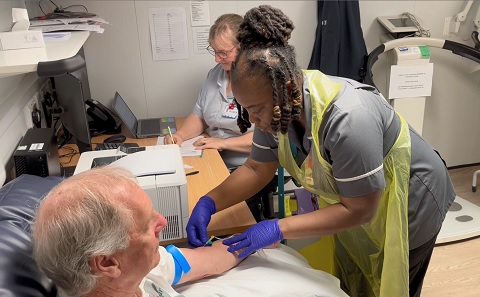
A trial to evaluate a new blood test that aims to identify multiple cancers in their very early stages has now recruited over 450 patients.
The MODERNISED study is examining ground-breaking technology not currently being used in any other multi-cancer detection tests under investigation.
The test looks for signals in the blood that suggest the immune system is launching a response to the first signs of cancer developing and is also being evaluated to see if it can identify which type of cancer it is.
The trial is being run by researchers from the University of Southampton in partnership with the Southampton Clinical Trials Unit and biotech company Proteotype Diagnostics Ltd. It is funded by the National Institute for Health and Care Research (NIHR) Invention for Innovation (i4i) programme and the Office for Life Sciences, and is recruiting from five hospitals across the country*.
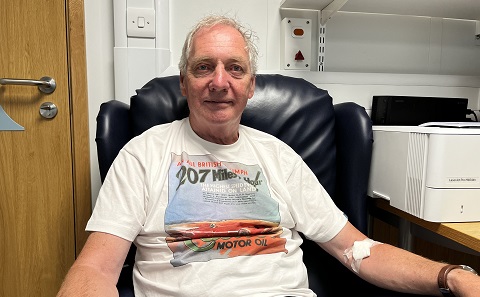
Ian Robinson, a 72 year-old grandfather from Fawley in Hampshire, is one of those who has taken part in the trial after he was diagnosed with colorectal cancer following routine screening.
“I was sent the NHS bowel cancer screening kit. I think I had done four of these, normally with a negative result, but the most recent one indicated that there was a chance of cancer which was confirmed with a colonoscopy. There were no symptoms, no pain, nothing, so you would never know until it was much more advanced and therefore much more difficult to treat.”
Ian was invited to take part in MODERNISED at University Hospital Southampton, which involves a short appointment where a blood sample is taken.
“Obviously the team here is helping me, so I’m delighted to participate and hopefully help improve the way things are done.”
“My mother died from cancer. I now have children and five grandchildren, so yes, research is absolutely vital. The more cancers that can be identified as early as possible, that can benefit future generations, then it’s obviously the right way to go.”
Approximately 385,000 new cancer cases are diagnosed every year in the UK**. But some cancers can be hard to detect in the very early stages of the disease when they have relatively few symptoms or symptoms that can be mistaken for other things.

“When cancers are diagnosed later, there are often fewer treatment options available to patients,” says Dr Victoria Goss, Associate Professor and Head of Early Diagnosis Research at the Southampton Clinical Trials Unit. “Detecting cancer early means that treatment can begin sooner, increasing the chances of successful outcomes for patients.
“Improving early diagnosis is therefore a priority for us as researchers and for the NHS. But currently there are only 4 screening programmes in the UK and screening is only for one cancer at a time, so we are aiming to develop simple tests that can potentially pick up the signs of multiple cancers, giving the best possible chance of early, successful treatment.”
The MODERNISED study is being led by Professor Andy Davies, Director of the Southampton Cancer Research UK and National Institute for Health and Care Research Experimental Cancer Medicine Centre.
“Most current research into multi-cancer blood tests is focussed on detecting abnormal DNA that has been released into the blood stream by cancer cells,” says Professor Davies. “But this circulating tumour DNA cannot always be detected in the very early stages of cancer.”
“We are instead looking at levels of certain proteins found in blood. We know that even in the earliest stages of cancer, the body’s immune response can lead to higher levels of these proteins being released, and we believe these may be a good way to test for early signs of the disease”.
The trial will see samples taken from 1000 patients with newly diagnosed cancer who are currently being treated on the NHS***, as well as 350 control samples from patients with similar symptoms that are not cancer, and also healthy volunteers.
“Preliminary studies have already shown that our test, which is called Enlighten®****, because it measures coloured light signatures from proteins, has high levels of accuracy for picking up cancer in its very early stages,” says Dr Emma Yates, co-founder and Chief Scientific Officer of Proteotype Diagnostics Ltd. “We are now working with Professor Davies and the team at the Southampton Clinical Trials Unit to test it in a much larger group of people to see whether it may be a useful early diagnostic tool.”
Ian Dickerson, who lives near Romsey in Hampshire, has twice been diagnosed with two different types of cancer, both of which were caught early.
“When you’re told that you have cancer, the bottom drops out of your world,” says Ian. “It is awful. I like to think of myself as a pragmatic person but when I was told, I did not know which way was up.
“But I’ve been very lucky. Because of my early diagnosis I have not had to have chemotherapy or radiotherapy. If you can get that early diagnosis and get that treatment, hopefully minimal treatment, then life can carry on. I have a good life, and I’m lucky to be able to live it.”
“It means everything to know that early diagnosis research is happening. I think it’s absolutely brilliant that we’re looking at early diagnosis for a range of cancers. The focus is often on the biggest cancers, but we’re now starting to look at early diagnosis for other cancers, as we should. I’m just an ordinary bloke and I’ve had two, apparently fairly rare cancers. It can happen to anyone and the earlier the diagnosis the better.”
Professor Mike Lewis, NIHR's Scientific Director for Innovation, said: “We are proud to be funding this important trial in partnership with the Office for Life Sciences. This innovative test has the potential to improve early cancer detection simultaneously across a range of cancers, giving people a better chance of detection and then successful treatment. It's a great example of how research is supporting the government's mission to reduce the number of lives lost to the biggest killers.”
MODERNISED is currently running at five hospital sites in Hampshire and Dorset, and is soon to open in Manchester. The trial is funded by the Office for Life Sciences, part of the Government’s Department of Health and Social Care and Department for Science, Innovation and Technology, and the National Institute for Health and Care Research i4i programme (project identifier NIHR207538). It is sponsored by University Hospital Southampton.
Watch a our animated explainer video about the MODERNISED study
* MODERNISED is currently recruiting at University Hospital Southampton NHS Foundation Trust, Portsmouth Hospitals University NHS Foundation Trust, University Hospitals Dorset NHS Foundation Trust (Poole Hospital and Royal Bournemouth Hospital sites), and Dorset County Hospital NHS Foundation Trust. It is due to open soon in Manchester.
** Figures from Cancer Research UK – Cancer Statistics for the UK webpage.
*** The MODERNISED trial involves patients with 10 solid tumour types - Bladder, Breast, Colorectal, Lung, Melanoma, Oesophageal, Ovarian, Pancreatic, Prostate, and Renal.
**** For more information on the ENLIGHTEN test developed by Proteotype Diagnostics, see this recent article .
Notes to editors
The Southampton Clinical Trials Unit (SCTU) is a Cancer Research UK (CRUK) core-funded CTU with expertise in the design, conduct and analysis of interventional, multi-centre clinical trials. The CTU is based within the University of Southampton with offices at the University Hospital Southampton NHS Foundation Trust Southampton General Hospital site. The unit is part of the NIHR Research Support Service University of Southampton Hub and partners in the NIHR Southampton Biomedical Research Centre. For more information, visit the SCTU website and follow us on social media, @SouthamptonCTU.
University Hospital Southampton NHS Foundation Trust i s one of the largest acute teaching trusts in England with a turnover of more than £1 billion in 2020/21. UHS provides hospital services for 1.9 million people living in southern Hampshire and specialist services – including neurosciences, respiratory medicine, cancer, cardiovascular, obstetrics and specialist children’s services – to more than 3.7 million people in central southern England and the Channel Islands. UHS is consistently one of the UK's highest recruiting trusts of patients to clinical trials and in the top ten nationally for research study volume as ranked by the NIHR Clinical Research Network. In partnership with the University of Southampton, UHS has £27 million of NIHR infrastructure dedicated to bringing the latest treatments to patients . Visit the UHSFT website .
About the NIHR - The mission of the National Institute for Health and Care Research (NIHR) is to improve the health and wealth of the nation through research. We do this by:
- Funding high quality, timely research that benefits the NHS, public health and social care;
- Investing in world-class expertise, facilities and a skilled delivery workforce to translate discoveries into improved treatments and services;
- Partnering with patients, service users, carers and communities, improving the relevance, quality and impact of our research;
- Attracting, training and supporting the best researchers to tackle complex health and social care challenges;
- Collaborating with other public funders, charities and industry to help shape a cohesive and globally competitive research system;
- Funding applied global health research and training to meet the needs of the poorest people in low and middle income countries.
NIHR is funded by the Department of Health and Social Care. Its work in low and middle income countries is principally funded through UK international development funding from the UK government.
Proteotype Diagnostics - Proteotype is a pioneering diagnostics company dedicated to the development of advanced multi-cancer early detection and personalised medicine tests that measure the host response to tumour development. By leveraging cutting-edge technologies and comprehensive research, Proteotype aims to revolutionize cancer diagnostics and improve early detection, ultimately enhancing patient outcomes and survival rates. For more information, visit https://www.proteotype.com
Southampton Experimental Cancer Medicines Centre (ECMC) is core funded by the National Institute of Health and Care Research/Cancer Research UK is one of 17 adult centres and 12 paediatric locations across the UK that bring together world-leading scientists and clinicians to drive the discovery, development and testing of new approaches to combat cancer. The Southampton ECMC is hosted by a partnership between the University of Southampton and University Hospitals Southampton. More in formation is available on our website (https://www.ecmcnetwork.org.uk/centres/southampton)
The University of Southampton drives original thinking, turns knowledge into action and impact, and creates solutions to the world’s challenges. We are among the top 100 institutions globally (QS World University Rankings 2023). Our academics are leaders in their fields, forging links with high-profile international businesses and organisations, and inspiring a 22,000-strong community of exceptional students, from over 135 countries worldwide. Through our high-quality education, the University helps students on a journey of discovery to realise their potential and join our global network of over 200,000 alumni. www.southampton.ac.uk