Could a tampon help improve the early diagnosis of ovarian cancer?
.jpg)
A new trial is testing whether a specialist medical tampon could be the answer to the low rates of early diagnosis of ovarian cancer.
A team of researchers in Southampton has launched a study which will use the tampon, plus other methods of sample collection, to look for the earliest clues that cancer may be present, particularly in women at a higher risk of developing the disease.
The trial is being led by Dr Jemma Longley, Consultant Medical Oncologist at University Hospital Southampton alongside colleagues from the Southampton Clinical Trials Unit and the Centre for Cancer Immunology at the University of Southampton.
It is funded by a grant from The Eve Appeal with support from the Southampton Experimental Cancer Medicine Centre and biotechnology company Daye.
The need for better diagnosis
Ovarian cancer is the 6th most common cancer in women in the UK and, on average, 21 people a day are diagnosed with the disease. But only around 27% of cases are diagnosed in the early stages, meaning many cases are only picked up when the cancer is more advanced and there are fewer treatment options available.
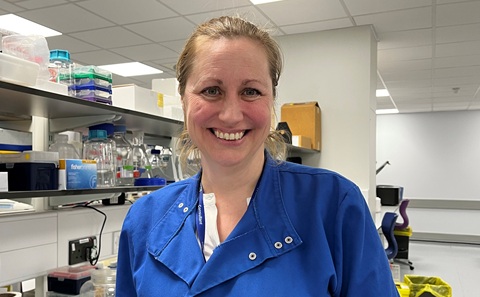
Women with a mutation in specific genes, including the BRCA gene, are also at a much higher risk of developing ovarian cancer.
“There is currently no screening programme available for ovarian cancer, and women with recognised genetic mutations, such as BRCA, may opt to have surgery to remove their ovaries and fallopian tubes to reduce their risk of developing the disease,” says Dr Jemma Longley, chief investigator for the trial. “However, this can have significant long-term health effects by putting younger women into a surgical menopause.
“In the VIOLET study, we will take samples of vaginal fluid from women who are undergoing surgery to reduce their ovarian cancer risk using the diagnostic tampon and vaginal swabs. We will also take tissue samples from the removed ovaries and fallopian tubes and compare the samples from women with the earliest signs of ovarian cancer to those without cancer. If we find changes to biomarkers called microRNAs, tiny biological signals that are present in both the ovarian cancer cells and the vaginal fluid, this could indicate a way to predict ovarian cancer in the future.”
“I don't want other women like me being in this position”
Mum-of-two Charlotte Stehr, 35, was diagnosed with a BRCA gene mutation in early 2020. She had a double mastectomy later that year, as BRCA is also associated with an increased risk of breast cancer, and underwent gene testing to ensure she didn’t pass the mutation on to her children. But Charlotte knows she is still at risk from ovarian cancer.
.jpg)
“I had some complications after my C-section for my son’s birth, and they found that I have cysts on my ovaries. And I was just terrified because, with ovarian cancer, there's a lower survival rate and the symptoms can be misdiagnosed. I am under the care of the oncology team since my mastectomy, but I’m just so scared that I will just slip through the cracks. And at the moment I am not recommended for preventative surgery to remove my ovaries because I'm under 40.”
Charlotte, a project manager from Romsey in Hampshire, believes that a screening programme that could pick up the early signs of ovarian cancer could be a lifeline for people like her, and other women whose symptoms may not be obvious.
“I don't want future generations, or other women like me with a known risk factor, being in this same position. Or someone losing their mum at 40 because cancer wasn’t picked up in time.
“I think this sort of research is amazing. Women have been using tampons for years, so why would you not want to use one that could actually help you? And for people who are working or have busy family lives or are scared of going to the doctors, then you could do it without really impacting your day-to-day life.”
65-year-old Dr Alison Farmer knows only too well the importance of early diagnosis. Alison, a retired psycho-oncology nurse from Southampton, was diagnosed with ovarian cancer when she was 40 after experiencing unusual bleeding.

“I immediately went to see the GP but was told that many women get unexpected bleeding. Perhaps due to my background and my job, I asked to see a gynaecologist and a cyst was found which turned out to be a cancer. It was a surprise to pretty much everybody, partly because of my age. I think if I hadn't been a nurse and pushed for further tests, I probably wouldn't be here today.”
Thankfully, Alison’s cancer was caught at an early stage and she underwent surgery to remove her ovaries and had chemotherapy to treat the cancer. But she is very aware that too many cases of ovarian cancer are diagnosed late.
“I think a lot of women have mild, subtle symptoms and think ‘it's nothing’, or ‘I haven't got time to go to the doctors’. I also think there's a lack of awareness about the typical symptoms of gynaecological cancers, such as bloating, feeling full, frequency of urination and discomfort.
“Research into screening and earlier diagnosis is absolutely vital. Far too many women are still diagnosed too late. I've lost friends, sadly, who were diagnosed at stage 3 and 4. So, something like this new study with the tampon is very exciting.”
.jpg)
Dr Victoria Goss, Head of Early Diagnosis and Translational Research at the Southampton Clinical Trials Unit and co-investigator on the VIOLET study, said: “This is an exciting trial in an area where better diagnosis is desperately needed. It aligns with the Government’s recent announcement on the Women’s Health Strategy to help overcome gender inequalities in healthcare, and we see our research as a vital part of efforts to improve outcomes for women with ovarian cancer.”
Finding the evidence
The VIOLET study has recently started recruiting participants who are undergoing risk-reducing surgery at University Hospital Southampton, working with consultant gynaecological oncology surgeon Mr David Constable-Phelps.
“The ability to detect the earliest signs of ovarian cancer, with a relatively non-invasive test such as the Daye tampon, would be a complete gamechanger for women with ovarian cancer,” says Mr Constable-Phelps, a co-investigator on the study. “Ovarian cancer commonly has non-specific symptoms in its early and late stages, so the tumour can spread to other organs silently. We are really optimistic that we will find interesting biological signals in the vaginal fluid of women with early-stage tumours, meaning more women can expect to be cured. This study will pave the way towards further translational work to allow us to understand more about the biology of these cancers”.

Athena Lamnisos, CEO, The Eve Appeal, adds: “We are delighted to be supporting this important research. Anyone with an altered BRCA gene faces very difficult decisions around their health and family planning. Research to increase their options to monitor their risk and give individualised information to help them make the right decisions at the right times. We hope that this research could lead to a simple and easy to use test that could give information to provide personalised information to anyone going through the decision-making process. It could both help them reduce their risk of ovarian cancer development or pick it up in the earliest stages, when it is most treatable.”
Valentina Milanova is the founder and CEO of Daye, the company behind the diagnostic tampon. She said: “We are proud to support the VIOLET study and the Southampton research team in exploring novel approaches to earlier diagnosis. Advancing women’s health requires collaboration between clinicians, researchers and technology developers, and we hope this study contributes meaningful insights into improving outcomes for women at high risk.”
Dr Longley concludes: “Our hope is that this study will identify potential biomarkers that pick up early signs of ovarian cancer in vaginal fluid. If successful, it would lead to a much larger trial to develop a community-based screening test in women at high risk of ovarian cancer to catch more cancers in their earliest stages.”
The VIOLET study is funded by a grant from The Eve Appeal, with support from the Southampton National Institute for Health and Care Research/Cancer Research UK Experimental Cancer Medicine Centre. The diagnostic tampons used in the study are supplied by Daye. The trial is sponsored by University Hospital Southampton.
Watch a video of Dr Victoria Goss, Associate Professor of Early Diagnosis and Translational Research at the Southampton Clinical Trials Unit, talking about the VIOLET study
Watch a video of Dr VJemma Longley, Clinical Medical Oncologist at University Hospital Southampton, talking about the VIOLET study