“I want to be of help” – great-grandfather takes part in trial to improve early cancer diagnosis
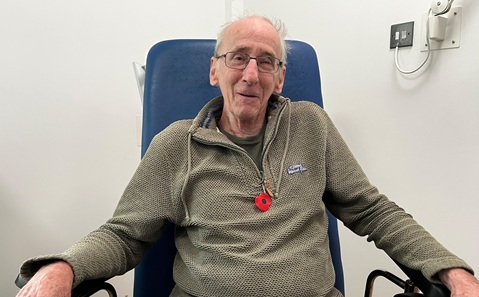
A great-grandfather, recently diagnosed with lung cancer, says he’s delighted to be among more than one thousand people who’ve so far taken part in a trial to improve the early diagnosis of cancer.
The MODERNISED study is evaluating whether a new blood test can identify multiple cancers in their very early stages.
The trial is being run by researchers from the University of Southampton in partnership with the Southampton Clinical Trials Unit and biotech company Proteotype Diagnostics Ltd. It is funded by the National Institute for Health and Care Research (NIHR) Invention for Innovation (i4i) programme and the Office for Life Sciences.
David Harrington, 75, was invited to take part after he began treatment for lung cancer at Dorset County Hospital, one of five hospitals across the UK taking part in the study.
“We had a letter from the local health service, and it invited me to have a scan, because I used to be a smoker,” says David. “Between my wife and I, we discussed it and said, ‘it’s costing us nothing, go for it’. Then I had it and then my life went pear-shaped because, yes, I did have a cancer.”
David, who’s worked his whole life in the building and labouring industry, says he was not shocked with the diagnosis.
“Honestly, I was surprised it took so long to show, being a smoker of 60 plus years, a packet a day. I’ve been subjected to tanalised sawdust, brick-dust, plaster dust, pulling down ceilings. My working life has been exposed to a lot of substances, so I wasn’t surprised I got it.”
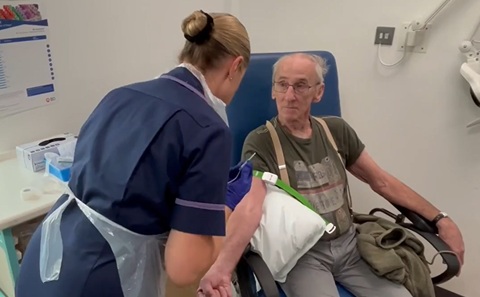
The MODERNISED study is examining ground-breaking technology not currently being used in any other multi-cancer detection tests under investigation.
The test looks for signals in the blood that suggest the immune system is launching a response to the first signs of cancer developing and is also being evaluated to see if it can identify which type of cancer it is.
Dr Melanie Harvey is a consultant medical oncologist and lead for the MODERNISED study at Dorset County Hospital.
“We know that prevention and early detection of cancer is the key to improving outcomes,” says Dr Harvey. “We hope that if the study is successful it will result in us being able to target those patients who are at risk and to improve survival.
“It’s actually very easy to deliver because we have a very proactive and supportive research team who I think support the patients very well. The patients are given information about the trial and asked if they would be prepared to take part, and if they agree they sign the consent paperwork and then a blood test is taken.”
Approximately 385,000 new cancer cases are diagnosed every year in the UK*, but for some cancer types the rates of early diagnosis, in stage one or two, remain low.
“When cancer is diagnosed later, there are often fewer treatment options available and therefore poorer outcomes for patients,” says Dr Victoria Goss, Associate Professor and Head of Early Diagnosis Research at the Southampton Clinical Trials Unit.
“Improving early diagnosis is therefore a priority for us as researchers and for the NHS. There are only 4 screening programmes in the UK and screening is only for one cancer at a time, so we are aiming to develop simple tests that can potentially pick up the signs of multiple cancers, giving the best possible chance of early, successful treatment.”
The MODERNISED study is being led by Professor Andy Davies, Director of the Southampton Cancer Research UK and National Institute for Health and Care Research Experimental Cancer Medicine Centre.
“Most current research into multi-cancer blood tests is focussed on detecting abnormal DNA that has been released into the blood stream by cancer cells,” says Professor Davies. “But this circulating tumour DNA cannot always be detected in the very early stages of cancer.”
“We are instead looking at levels of certain proteins found in blood. We know that even in the earliest stages of cancer, the body’s immune response can lead to higher levels of these proteins being released, and we believe these may be a good way to test for early signs of the disease”.
As well as patients with newly diagnosed cancer, the trial is also looking at control samples from patients with similar symptoms, but who do not have cancer, and from healthy volunteers. And with over a thousand samples already being processed the team need just over 300 more people to take part.
Dr Harvey at Dorset County Hospital says recruitment has been going well.
“I think it’s really important to make sure that all cohorts of the population are represented in clinical research trials. In Dorset, we’re a good example of a very varied population across an urban and rural area and I think will represent the population very well in this trial.
“We really thank our patients. All cancer research relies on the courage and the participation of willing patients, and I think our patients are pleased to take part.”
And David echoes this.
“It hasn’t been burdensome at all, it’s totally ok. I’m pleased to be of assistance and I’m willing to help as much as I can.”
“I would have thought most people would want to assist in making treatment better in the future. Otherwise, how do we get the treatment we have now for all manner of things. Anything that anyone can do to help, I’m up for it!”
Watch a video of David taking part in the MODERNISED study
MODERNISED is currently running at five hospital sites in Hampshire, Dorset and Manchester. The trial is funded by the Office for Life Sciences, part of the Government’s Department of Health and Social Care and Department for Science, Innovation and Technology, and the National Institute for Health and Care Research i4i programme (project identifier NIHR207538). It is sponsored by University Hospital Southampton.
*Figures from
Cancer Research UK