Dr Colleen Deane appointed to the ESA Life Sciences working group
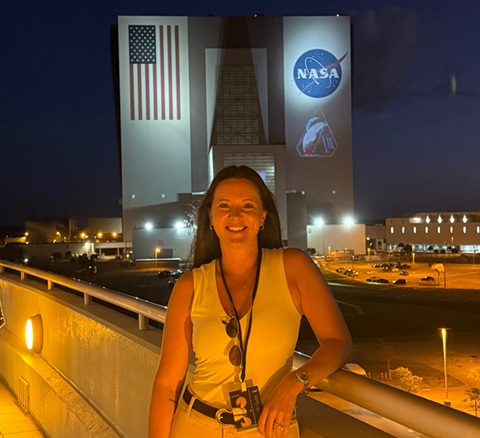
It will be a year in June since Dr Colleen Deane, a Lecturer in Muscle Cell Biology in the Department of Human Development & Health, in Southampton’s Faculty of Medicine, was appointed to the European Space Agency’s Life Sciences Working Group (ESA LSWG).
The LSWG comprises 10 leading European scientists across all life science specialities and is the senior advisory body to Daniel Neuenschwander, ESA’s Director of Human and Robotic Exploration. The working group advises him on all scientific matters concerning life sciences research disciplines in space. The main remits include: advising on scientific priorities and planning in life sciences research; supporting the selection of studies and flight opportunities; providing recommendations on peer review groups, science teams, and strategic directions in human and exploration-related life sciences.
The group meets every 3 months, twice in person alternating between ESA European Space Research and Technology Centre (ESTEC) (Netherlands) and ESA European Astronaut Centre (Germany), and twice remotely.
At the most recent of the meetings at ESTEC in Noordwijk, the discussion focused on the outcome of the 2025 Ministerial Council held in Bremen last November, and what this means for life sciences research for space going forward.
Colleen is thoroughly enjoying the role and said:
“It is a pleasure and privilege to be a part of the ESA LSWG, which really does have a significant role in helping to shape the future of human exploration within the framework of ESA's Explore 2040 strategy. We are currently in a very exciting time for spaceflight, with the surgence of commercial growth and push for human presence on the Moon and so being able to contribute to the scientific foundations that will support safe, sustainable human missions beyond Earth is both inspiring and deeply rewarding”.
Colleen is a Lecturer in Muscle Cell Biology, particularly interested in how exercise, nutrition, ageing and spaceflight and disuse impact skeletal muscle health. As a postdoctoral researcher, Colleen has been investigating the mechanisms of, and countermeasures to, spaceflight-induced muscle decline. The research for this involved sending worms to space as part of the first UK-led experiment to the International Space Station (ISS) – the Molecular Muscle Experiment (MME, 2018). Colleen has since been involved in two additional spaceflight experiments to the ISS, MME2 (2021) and FDSPP (2026), respectively.
New spaceflight paper just published by Colleen and her research colleagues: MAPK/PMK-1 innate immune signaling protects the nematode Caenorhabditis elegans from increased intestinal colonization in an animal host-pathogen model in space.
.jpg)