In memoriam: Edgar Feuchtwanger (28 September 1924 – 22 August 2025)
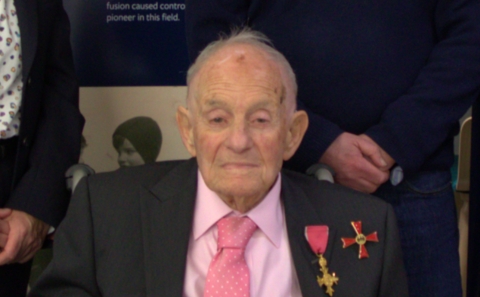
It is with great sadness that we announce the death of our former collleague, Edgar Feuchtwanger. Here, Professor Tony Kushner (Parkes Institute and the Department of History) reflect’s on Edgar’s life.
The son of professionals, and the nephew of the great German Jewish writer, Lion Feuchtwanger, Edgar was born and spent most of his childhood in Munich (the family home neighboured that of Hitler). Following the Nazi rise to power in 1933, Edgar’s education was impacted through the antisemitism instituted at his school. In 1938, following the violence of the Nazi pogrom in November, and the imprisonment of his father Ludwig in Dachau concentration camp, the family looked for places to find safety as refugees. They were able to get permission to come to the UK in 1939 and Edgar gained a scholarship for young refugees at Winchester College. After war service, Edgar trained to be a historian at the University of Cambridge and in 1959 started teaching at the University of Southampton. He published fourteen books that continue to be widely used by students, ranging from those at schools to universities. In later life, Edgar’s autobiographical writings, including I Was Hitler’s Neighbour (2015), have reached a popular and appreciative audience. Reflecting his remarkable Anglo-German contribution, he was awarded a Federal Cross of Merit in Germany (2003) and an OBE in the 2021 Honours in the UK for ‘services to Anglo-German understanding and histor
Edgar’s death marks the end of an era. I was extraordinarily lucky to have Edgar as a colleague in the History Department at the University of Southampton when I started there in the mid-1980s, over thirty years after he had started teaching there. He was a rare species – an expert on both British and German history with a phenomenal memory for detail. Co-teaching with him on a survey course of British political history was somewhat scary. Edgar would turn to me mid-seminar for confirmation of who the particular under-secretary of state was for home affairs in the mid-nineteenth century – answering his question before the embarrassment of my ignorance became too obvious.
Students loved his old-world charm and natural curiosity and especially to have someone who was ‘there’ reflecting on their experiences. Generations of Southampton history students benefited from his wisdom and kindness. I remember a particular moment in the History office when his fellow historian and former child refugee John Grenville were reuniting their friendship in the 1990s. Their laughter and giggling were making up for an adolescence that both of them lost through Nazi persecution. It was a joy to see Edgar and John so happy in each other’s company.
Edgar was also a generous contributor to the Parkes Institute for the study of Jewish/non-Jewish relations and related his refugee experiences to our public events, including Holocaust Memorial Day. The last time I saw Edgar was earlier this year when Edgar was publicising with his son Adrian his book of refugee family letters and helping launch the University of Southampton’s status as a ‘university of sanctuary’. He was dapper as ever wearing his British and German honours with pride.