Some of the world’s least polluting populations are at much greater risk of flooding
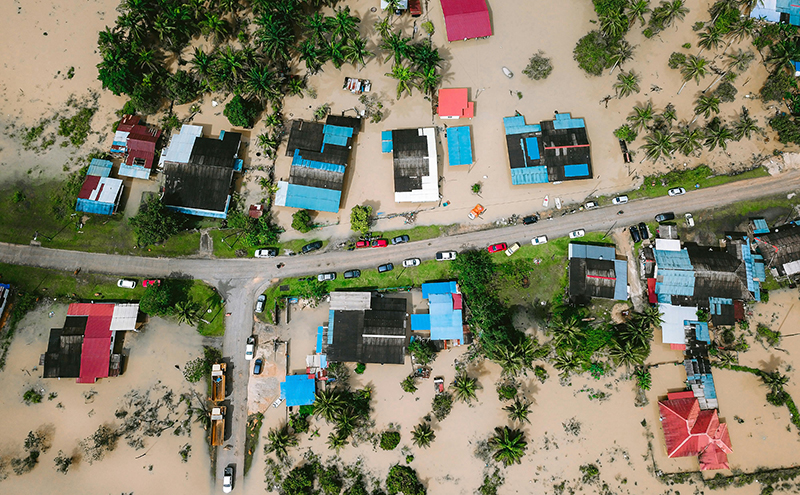
A new study has exposed for the first time how inhabitants of the smallest countries globally, contributing least to climate change, already bear the brunt of its devastating consequences and the burden is likely to worsen.
The research, led by the University of Bristol – working in partnership with the University of Southampton – showed on average nearly one in five people (20 percent) in Small Island Developing States (SIDS) – totalling some 8.5million – are now exposed to coastal and inland flooding.
For three of the 57 countries concentrated in the Pacific, Caribbean, Indian Ocean, and South China Sea, namely the Bahamas, Guyana, and Tuvalu, this proportion trebles to more than 60 percent of the population, according to the findings published in the journal Environmental Research Letters .
Lead author Leanne Archer, Research Associate at Bristol’s Cabot Institute for the Environment, said: “Flooding is now an alarming real-world threat for so many people globally. This study demonstrates that the often-overlooked Small Island Developing States are already subject to a disproportionate level of flood exposure, despite contributing the least to climate change.”
Professor in Physical Geography at the University of Southampton, David Sear , who co-authored the paper said: “Small Islands are often portrayed as under threat from sea level rise. This study highlights that they also face threats from increased rainfall and storm surges, which together put high proportions of their population at risk. This collaboration forms part of a wider research programme at the University of Southampton, exploring the exposure of small island populations to multiple hazards.”
Projections also showed that in future, even in the least-worst global warming scenario considered, the number of people affected by rising sea levels, storm surge and extreme rainfall events, including tropical cyclones, will significantly grow. For comparison, the scale of people likely to be affected dwarfs the level of flood exposure in developed nations such as the US and UK, where around 13 percent and 8 percent of the population are impacted respectively.
Leanne Archer said: “The findings should be a call to action to support these nations in adapting to and mitigating against these extreme repercussions, even under the lowest emissions scenario, which put life and livelihoods in peril.”
SIDS are group of island nations and territories, with smaller populations ranging from around 1000 to 7,000,000 people, identified by the United Nations (UN) as being especially exposed to the effects of climate change. Coastal flooding is a major driver of flood risk as the populations are often most concentrated along coastlines. But findings showed inland flooding is in fact a huge issue for SIDS, accounting for the vast majority of overall population exposure at 81 percent.
Leanne, who conducted the research for her PhD in flood risk, said: “Previous studies have only focused on coastal flooding, representing a significant underestimation of exposure. This is also the very first time a comprehensive picture of flood risk has been mapped across all 57 Small Island Developing States because the populations are so small, they haven’t met the minimum catchment size of previous major global studies.
“The modelling provides striking evidence demonstrating that climate change has an unjust and unequitable impact on the places and people, who have contributed least to the greenhouse gas emissions, fuelling the problem.”
Climate change is compounding the risk of flooding across SIDS by increasing the magnitude of many factors, including rainfall, river flow, extreme wave heights and water levels, storm surges, and sea level rise.
Even if global warming is limited to a 1.5⁰C increase by 2100, findings project more than a fifth (21 percent) of SIDS populations will be exposed to flooding. In a worst case scenario of more than 4⁰C warming this figure could rise to nearly a quarter (23 percent), according to the study. A UN report last month warned the world faces as much as 3.1⁰C warming if governments do not take more action to reduce carbon emissions.
Irrespective of how much the world warms, countries anticipated to be at most risk remained the same in the projections, including Belize, Turks and Caicos Islands, and the Maldives.
The study used water risk intelligence firm Fathom’s Global Flood Map ; a high-resolution global hydrodynamic flood model combined with worldwide population datasets.