Largest collection of Roman cave inscriptions discovered
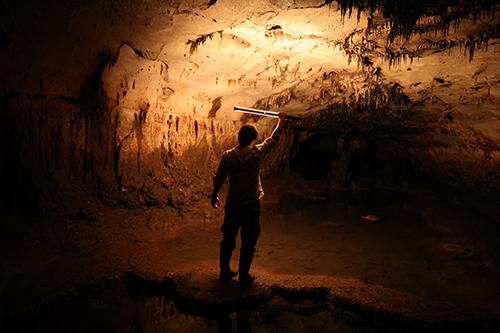
Archaeologists have uncovered the largest collection of Latin cave inscriptions anywhere in the Roman Empire.
Early analysis of the inscriptions discovered at Cova Dones reveals that a female deity was worshipped at the site and that women had a prominent role in rituals there - highly unusual in Roman society.
At least 120 Latin inscriptions have been discovered, most of which are believed to date to the 1st and 2nd centuries AD. Only around fifteen were previously known about.
The work was carried out by the DONARQ project, led by Dr Aitor Ruiz-Redondo (University of Zaragoza and University of Southampton) and Dr Virginia Barciela (University of Alicante).
Cova Dones previously attracted international attention after the discovery of the largest assemblage of Palaeolithic rock art in eastern Iberia. In 2024, archaeologists then revealed the existence of a hidden Roman sanctuary more than 200 metres underground.
Dr Aitor Ruiz-Redondo said: "Each new discovery reinforces the idea that Cova Dones served as a landmark place for the communities inhabiting this region over thousands of years, perhaps because of its permanent water supply, the distinctive character of its underground landscape, or its easy accessibility.
“The succession of discoveries made over the past few years is the direct result of, and at the same time demonstrates, the value of continually incorporating new specialists and disciplines into the research team, allowing us to reveal entirely new dimensions of the site."
Women at the centre of ritual life
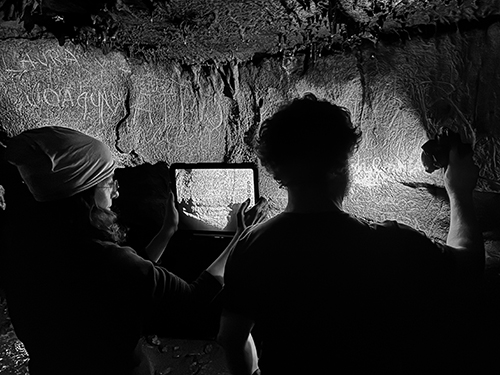
The epigraphic analysis carried out during May and June provide compelling new evidence for the prominent role of women in the underground sanctuary.
Dr Silvia Alfayé, Associate Professor of Ancient History at the University of Zaragoza, says: "Thanks to a group of five votive inscriptions, we can now state with certainty that, during the Roman period, worship was conducted inside the cave to a goddess reverentially referred to as Domina ('the Lady'), and that women played an active role in her cult. This goddess possessed a specific epithet, possibly connected with water, whose definitive reading is currently under study."
Dr Sergio García-Dils, lecturer at UNED-Seville and Director of the Spanish School of Speleology, adds: "The fact that at least five inscriptions are dedicated to the same Domina clearly demonstrates that this was not simply a cave visited for general religious purposes. It was the setting for the worship of a specific deity under a particular cult title. Moreover, the marked concentration of these inscriptions within a single sector of the cave strongly suggests the existence of a well-organised and structured cult."
Preliminary readings suggest that at least some women inscribed their own vows, rather than having them written by a mediator.
Until now, the Roman cave sanctuary with the largest known epigraphic corpus was La Griega, with 107 inscriptions. Among these, only one mentions a female name. Female names do occur at other cave sites, but they are comparatively rare when contrasted with the overwhelming predominance of male dedicants.
An exceptional underground sanctuary
The inscriptions are concentrated within a specific chamber of the cave that researchers have named the Roman Sanctuary. It is located more than 200 metres below the surface and first discovered in 2024.
The inscriptions are extremely difficult to see with the naked eye, so the team used high-resolution photogrammetric recording to identify previously unnoticed inscriptions and distinguish others that had previously been considered part of the same text.
The texts are preserved on both the walls and the ceiling of the chamber. The floor is characterised by a series of natural pools formed by mineral deposits, which retain water flowing through the cave system. These pools appear to have served as places where visitors deposited a wide range of ritual offerings.
As part of the latest work, archaeologists have documented several of these offerings in situ, including two rings, a bracelet, chalice-shaped vessels, spindle whorls, ceramic fragments, faunal remains, and other archaeological materials. These finds complement the Roman coin dating to the reign of Emperor Claudius, discovered in the sanctuary during the 2024 campaign.
The numerous spindle whorls within the sanctuary indicate the offering of spindles - a textile-working implement traditionally associated with women in Antiquity.
“This evidence fits remarkably well with the epigraphic data pointing to women's active participation in the sanctuary's ritual life,” explains Dr Barciela. “It also invites us to reconsider the earliest recorded name of the site, Cova de les Dones ('Cave of the Women'). It is possible that this name preserves the fossilised memory of a place long associated with women - or with female supernatural beings."
The preservation in situ of both archaeological materials and rock inscriptions within a Roman underground sanctuary is exceptionally rare.
A substantial part of Cova Dones still awaits detailed investigation and many inscriptions remain under study.
A major programme of conservation and public dissemination at the cave is also planned for this year. These will create powerful new tools for research and public engagement, including the possibility of immersive virtual visits to one of Europe's most remarkable archaeological caves.