SMMI Visiting Professor shares insights from consumer research on the factors affecting public uptake of climate engineering and decarbonisation
A visiting professor from New Zealand gives a talk on the effect climate engineering and decarbonisation.
Professor Malcolm Wright , SMMI visiting researcher from Massey University, New Zealand, gave a seminar on Monday, 17 June 2024 at the Boldrewood Lunchtime Seminar series, speaking on the “Factors affecting the uptake of climate engineering and maritime decarbonisation: insights from consumer research”.
“Effective responses to anthropogenic global warming require that technological solutions are not only developed but deployed at scale”, shared Professor Wright. “The history of scientific innovations has shown that deployment takes time and can be enabled or obstructed by social factors.”
His talk outlined the theoretical basis for predicting how quickly innovations diffuse and displace predecessor technologies, how this is affected by a dynamic process of social contagion, how trade-off analysis can be used to determine adoption potential, and how associative memory theory gives insights into likely public reactions that may affect regulatory response and adopter enthusiasm.
Based on quantitative survey data, he shared insights on public responses to climate engineering, decarbonisation through alternative shipping fuels, and carbon capture, transport and storage through ports, including research supported by the UKRI Industrial Decarbonisation Research and Innovation Centre (IDRIC) as part of the Southampton-led CO2Ports-to-Pipelines project. With regards to decarbonisation of shipping, he referenced their 2023 paper in which they found that respondents strongly dislike ammonia, prefer nuclear to heavy fuel oil, are somewhat positive about liquid natural gas, and clearly favour biofuels and hydrogen.
Speaking on the adoption of innovations, he highlighted that pure capability is not enough. According to Everett M. Rogers’ ‘Diffusion of Innovations’ (2003), the communication and uptake of innovations (or ‘diffusion’) through social systems depend on factors including: relative advantage, compatibility, complexity, trialability, and observability.
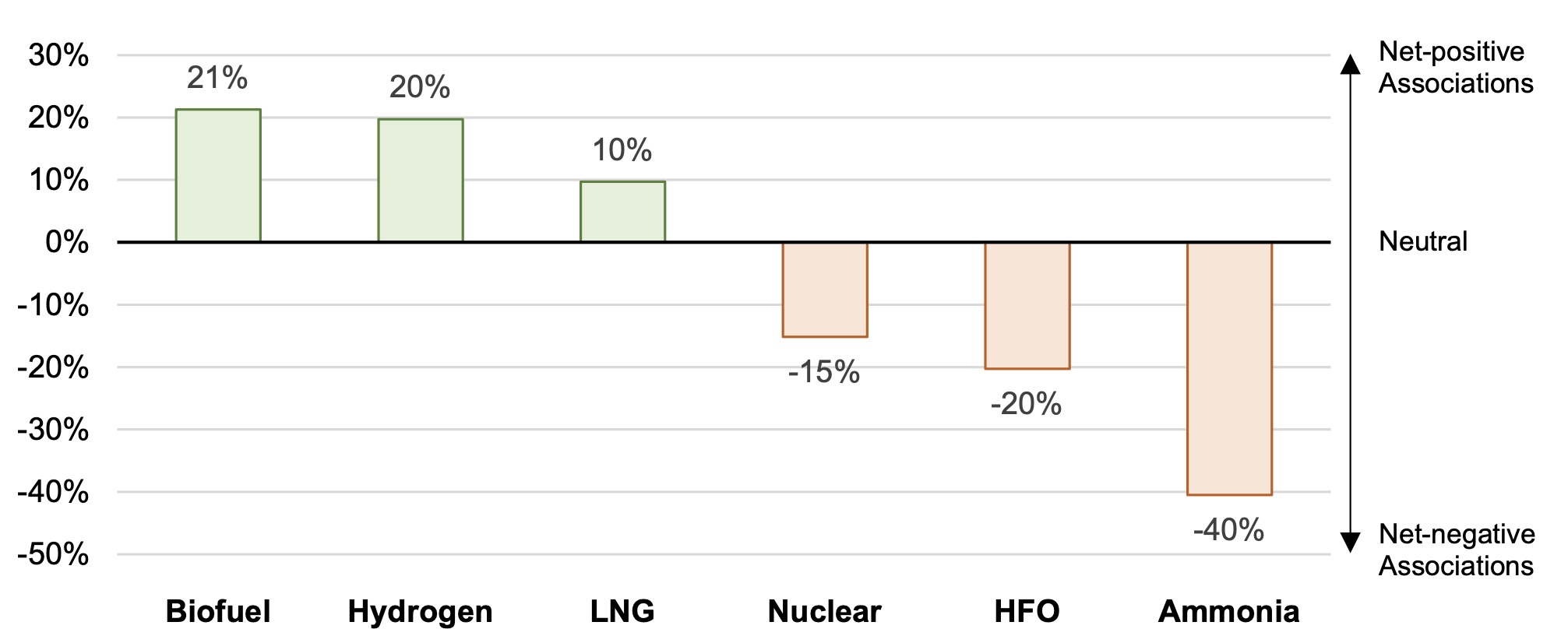
Public perception of alternative shipping fuels (Carlisle et al. 2023)
In line with the goal to reach net zero emissions by 2050, he projected the pathways for shipping fleet decarbonization using the Bass Model. From these projections, including both success and failure curves, he showed that diffusion is “driven by contagion rather than early adoption” and that it “starts with years of minimal progress, followed by take-off and then very rapid growth, and then finally, a slow approach to the asymptote.”
Download Professor Wright’s presentation slides here .
Related papers:
Wright et al., 2014, A quantitative evaluation of the public response to climate engineering. Nature Climate Change 4:106-110. https://www.nature.com/articles/nclimate2087
Carlisle et al., 2023, Public response to decarbonisation through alternative shipping fuels. Environment, Development and Sustainability, https://doi.org/10.1007/s10668-023-03499-0