Safeguarding Antarctic Krill: Inside the 2025 Whale Research Expedition
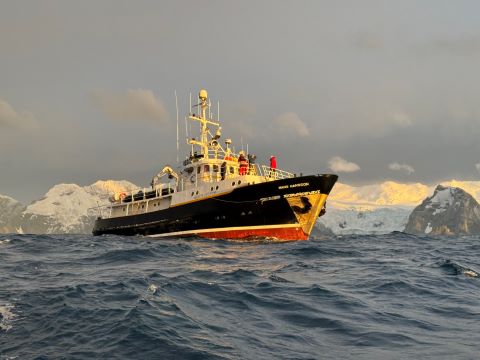
In March 2025, a team from the University of Southampton set out on an expedition to the Western Antarctic Peninsula aboard the Hans Hanson, to study fin whales and their interactions with krill fisheries.
From navigating the famously rough Drake Passage to deploying satellite tags and hydrophones near Elephant Island, the researchers encountered the full adventure of Antarctic fieldwork.
Their efforts are revealing new insights into whale foraging behaviour, krill distribution, and how this knowledge could support the sustainable management of Antarctic krill, a crucial food source for baleen whales.
The Safeguarding Antarctic Krill for Baleen Whales research project aims for a better understanding of the interactions between whales and krill fishing vessels within the Western Antarctic Peninsula. Catches have increased in recent years, and there is a growing concern about local krill depletion; as well as catching more krill, the fishery operates in increasingly concentrated hotspots. As a case in point, the krill fishing season ended prematurely in August 2025, as the fishing quota was reached for the first time ever.
Simultaneously, populations of some krill predators, like humpback whales, are increasing after historical overexploitation. The Commission for the Conservation of Antarctic Marine Living Resources (CCAMLR) manages krill fisheries and recognises the necessity of managing these fisheries at smaller spatial scales to ensure sustainable exploitation of krill.
However, the proposed Small-Scale Management Units, approximately 20,000 to 220,000 km 2 , have not yet been implemented, and the current krill catch limit is set at a very large spatial scale for one of the most heavily fished management units: Subarea 48.1 (approximately 660,000 km 2 ). This means that despite an existing fishing quota, krill depletion can occur locally if most whales and fishing vessels search for krill in a very restricted area ( Trathan et al., 2024 ).
In this context, a team from the University of Southampton, including principal investigator Dr Ryan Reisinger , postdoctoral fellow Dr Julie Mestre and PhD student Amy Feakes, headed to the Western Antarctic Peninsula in March 2025, to collect data on whales at their foraging grounds.
Research took place near Elephant Island, with a particular focus on fin whales, whose ecology is still poorly known in this region and at this time of year. From 1904 to 1976, more than 700,00 fin whales were killed by commercial whaling in the southern hemisphere, reducing their population to 1% to 2% of its pre-exploitation size. They are now recovering, with gatherings of sometimes hundreds of animals sighted feeding around Elephant Island in recent years, details in Herr et al. (2022) .
However, the overlap between krill fisheries and foraging fin whales, as well as the extent to which they may compete for krill, remains to be explored.
After a 2-day journey from the UK to the Falkland Islands, the team loaded and secured, mind the swell, their scientific equipment aboard the Hans Hansson for the crossing of the infamous Drake Passage to the Western Antarctic Peninsula. The boat set sail as soon as weather conditions enabled a safe departure from the Falklands.
However, in the relatively small boat (26m long) sailing in waves up to 8m, the entire research team and crew experienced a taste of seasickness, including the captain who had 40 years of experience sailing to Antarctica!
With no land in sight for days, the team was delighted to encounter a few dolphins and the largest birds in the world. Wandering albatrosses have an impressive wingspan, up to 3.5m, and fly mostly without flapping their wings. The team saw a few icebergs much bigger than the boat, reminding everyone of how tiny humans are in what is one of the most remote and pristine areas of the planet. The team finally reached the waters surrounding Elephant Island after 4 days of sailing.
The research team investigated the distribution and behaviour of fin whales using a range of tools, including visual observations, hydrophones, deployment of satellite tags. Skin biopsies were collected to perform genetic analyses and to assess to which population the sampled whales belong, to ultimately reveal their migration patterns and connectivity with breeding grounds.
Simultaneously, the boat echosounder was used to detect the presence of krill and obtain information such as the size, density and depth of krill swarms. The collected data will enable a variety of scientific studies and provide invaluable information on fin whale ecology within their Western Antarctic Peninsula foraging ground.
The upcoming results will be shared with the scientific community during national and international conferences and through the dissemination of research papers. They will also be shared with CCAMLR and the International Whaling Commission, organisations key to the sustainable management of krill fisheries. A hydrophone is still on site at Elephant Island, recording the presence of whales year-round; future work will involve deploying more satellite tags, to better understand the movements of whales and to what extent they may compete with krill trawlers.
Overall, the project will contribute to a better understanding of the structure and functioning of the Western Antarctic Peninsula ecosystems, to enable sustainable management of krill fisheries. It will provide scientific evidence supporting the need to rely on a smaller-scale management approach. By assessing where and when competition between whales and fishing vessels for krill is most intense, it will advise on the monthly closure of some Small-Scale Management Units, to enable krill and their predators to thrive.
This research project is funded by the UK Government through the Darwin Plus project ‘Safeguarding Antarctic Krill Stocks for Baleen Whales’ (DPLUS185). The research team is grateful to the Hans Hansson crew members for their support throughout the field trip. Thanks also to Kite Optics for the loan of binoculars to the team for spotting whales.
Author
Dr Julie Mestre is a Research Fellow within the Ocean Predator Ecology Lab at the School of Ocean and Earth Science, University of Southampton. Trained as a marine ecologist with an emphasis on the structure and functioning of marine ecosystems, she investigates the foraging and movement ecology of marine megafauna species to support conservation in the context of a changing environment and increasing anthropogenic pressures.
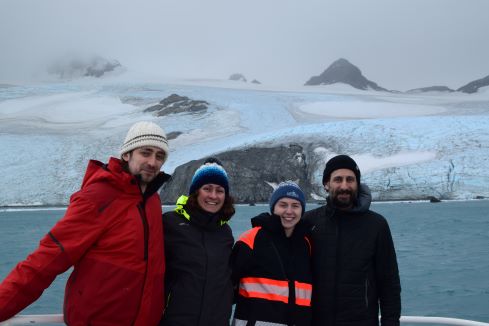
at Elephant Island
.png)
© Dion Poncet
.jpg)
that record the presence of vocalising marine mammals at Elephant Island © Julie Mestre
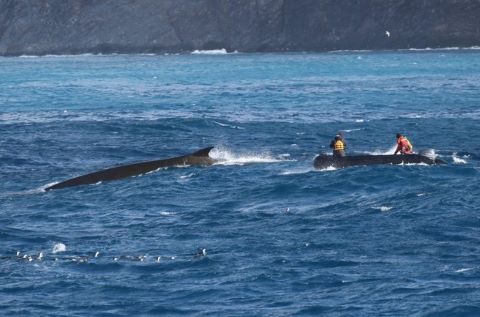
approaching a fin whale from a small RIB to biopsy-sample it © Julie Mestre
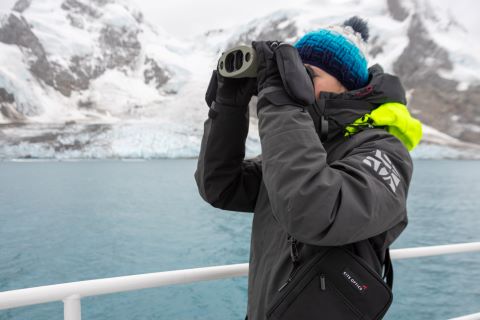
binocs courtesy of Kite Optics © Samuel Kinder