Reflections from the Frontlines of Carbon Removal at COP30
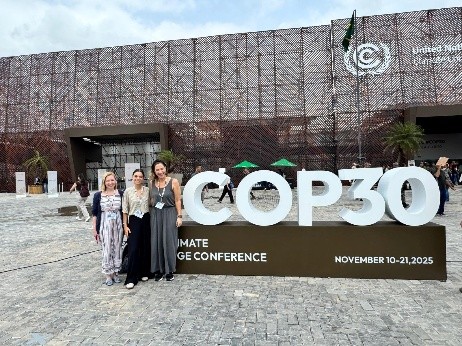
Dr Christina Larkin is a visiting researcher and former post-doctoral research fellow at the University of Southampton. She is currently the Vice President of Science and Research at InPlanet, a carbon dioxide removal company, deploying carbon removal with sustainable agriculture in Brazil. She attended COP30 in Brazil in November last year. In her reflections she offers her firsthand view of her time at the annual UN Climate Summit.
Attending COP30 in Belém for the full two weeks in November 2025 was both a privilege and a stark reminder of the task ahead. Positioned as the “Implementation COP”, marking a decisive shift from planning to implementation, the summit at the gateway to the Amazon felt like a tale of two halves.
While the setting underscored the urgency of protecting our planet, the lack of a unified statement on fossil fuel phase-out was a divisive reminder of the political hurdles we still face. However, away from the polarised headlines, a historic shift was occurring for the carbon dioxide removal (CDR) community.
For the first time in COP history, we had a dedicated CDR pavilion , led by the Negative Emissions Platform . It was exciting to be a part of this major milestone and to support the efforts on the ground in Brazil. This space served as a hub for a reality the IPCC has made clear: while rapid emissions reductions are our absolute priority, we cannot stay within 1.5 or 2 degrees warming without also removing billions of tonnes of carbon dioxide by mid-century.
During COP30, CDR was covered in a major article by The Guardian , with respected scientific voices such as Johan Rockström emphasising that CDR is necessary to avoid catastrophic climate tipping points.
I spent my time moving between panels and the negotiation rooms, where I followed the Article 6.4 discussions closely. These negotiations are critical for the CDR space, as they establish the Paris Agreement Crediting Mechanism (PACM), a centralized UN-governed system that sets the global rules for how high-integrity carbon credits will be created, verified, and traded internationally.
A highlight was witnessing the Singapore government’s leadership in this arena. Alongside Kenya and the UK, Singapore launched the "Shared Principles for Growing High-Integrity Use of Carbon Credits," a first-of-its-kind framework to harmonize standards and boost buyer confidence. They also expanded their network of bilateral Implementation Agreements under Article 6.2, signing a new partnership with Malawi to channel finance into high-quality projects. Seeing a government provide strong policy signals gives me hope that the capacity we are building today will allow the removal industry to scale.
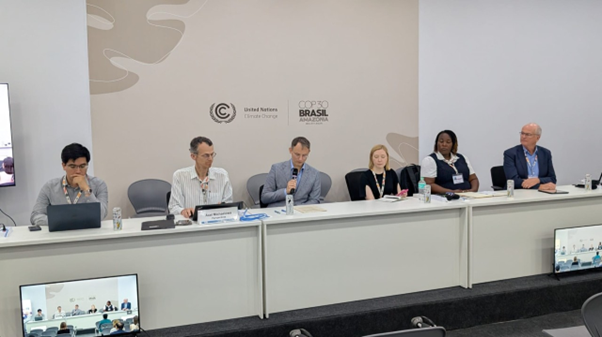
On the ground, I had the opportunity to be on a panel discussing the "tipping points" required to scale CDR solutions in tropical regions like Brazil, which is positioned to be a global leader in the space. I led an "ERW 101" session at the CDR pavilion demystifying Enhanced Rock Weathering (ERW), the core of our work at InPlanet .
By applying silicate rock to farmland, we enhance this natural weathering process where CO2 reacts with water and rocks to form stable dissolved bicarbonate. In the high temperature and rainfall of the tropics, this process removes carbon while improving soil health and providing co-benefits to local farmers. This synergy between climate science and agriculture resonated with the local stakeholders I met in Belém, emphasising that high-integrity removals should be built on local benefits.
The culmination of my time at COP30 was an official UNFCCC side event hosted by the GIZ and Perspectives Climate Group, where we tackled the pressing question of how carbon markets can unlock high-integrity removals . I emphasised that while the potential for novel CDR is vast, we must build trust through radical transparency and robust Monitoring, Reporting, and Verification (MRV).
For the Southampton Marine and Maritime Institute (SMMI) and the broader marine community, these developments at COP30 are particularly relevant as we are currently seeing the emergence of the marine CDR market. 2025 was a landmark year for ocean-based removals, with the issuance of the world’s first independently verified Ocean Alkalinity Enhancement (OAE) credits and significant offtake agreements in the marine CDR space from major global buyers.
While marine-based CDR offers vast scalability, it faces unique jurisdictional, environmental and societal challenges. My time in Belém, supported by the context of SMMI’s role as an official UNFCCC Observer, highlights how terrestrial and marine solutions must advance in tandem. Returning home, I am more convinced than ever that by combining rigorous science with a focus on high-integrity markets, we can turn the tide on atmospheric carbon dioxide.
Author
Dr Christina Larkin is a geochemist and climate scientist with research interests ranging from past climate reconstructions to natural and enhanced weathering studies. Her research has taken her across the globe, having completed fieldwork campaigns in Southeast Asia, Africa and the Arctic circle.
She previously worked on the world’s first large-scale field trials of enhanced weathering as a Research Fellow at the University of Southampton, and completed her PhD at the University of Cambridge, where she studied past and present climate change in the Arctic. She also holds a first-class integrated masters degree in Geological Sciences from the University of Cambridge. She is currently the VP of Science and Research at InPlanet, a carbon dioxide removal company operating in Brazil. Christina leads research and development as well as the company’s diverse and world-leading science team.