Chemical exchanges persist when the ocean meets the mantle
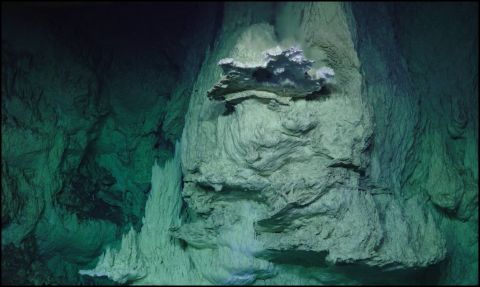
The Lost City Hydrothermal Field (Atlantis Massif, 30°N, Mid-Atlantic Ridge) provides a window into deeper Earth processes. Here, reactions with seawater pervasively alter dry mantle rocks to hydrous serpentinites and form hyperalkaline (pH up to 11) hydrothermal fluids that emanate from towering brucite-carbonate chimneys at temperatures of up to 116 °C.
Understanding the reactions that drive mantle-ocean exchange at the Lost City is fundamental to questions spanning the origin of life, natural hydrogen generation, and carbon sequestration.
New research, published in GEOLOGY , reveal that hydrothermally altered serpentinized mantle rocks exposed on the seafloor are not inert but continue to exchange elements with seawater, reshaping our understanding of interactions between the oceans and Earth’s deep interior.
Scientists at the University of Southampton used boron isotope analyses of <116°C hydrothermal fluids effusing from towering submarine chimneys, up to 60 m-high, from the Lost City Hydrothermal Field; a striking vent system perched atop the 4-km-high Atlantis Massif underwater mountain, ~10 km to the west of the Mid-Atlantic Ridge at 30°N.
Lead author, Dr Aled Evans, said: “The Lost City vent system was only discovered about 20 years ago in ~800 metres of water, and is a unique active natural laboratory for understanding interactions between seawater and mantle rocks. When mantle rocks are exposed by faulting on slow spreading ocean ridges, reactions with seawater produce hyperalkaline fluids with pH up to 11 that are unusually hydrogen and methane-rich that provides food for specialist microbial communities. Although Lost City remains the only large active seafloor system of its type discovered so far, this reflects our limited exploration of the ocean floor and similar processes should occur wherever mantle rocks react with seawater. Such reactions may have been important for the origin of life on Earth and are inferred to take place on extraterrestrial ocean worlds such as Saturn’s moon Enceladus.”
Dr Evans explained, “In these experiments, we used boron, an element that is abundant in seawater but virtually absent from the mantle, as a fingerprint to trace what happens to fluids as they pass through and react with the mantle rocks beneath Lost City. Our data show that the fluids undertake a two-stage journey. First, as seawater reacts with fresh mantle rock during serpentinization, boron is almost completely stripped from seawater into newly forming serpentine minerals. Then, as these minerals are later dissolved and reformed during ongoing alteration, some of that stored boron is released back into the fluid. It is this second step, serpentine recrystallisation, that produces the distinctive signature we measured at Lost City.”
Dr Evans added: “Once formed, serpentinites are not simply inert features of the ocean floor. They continue to exchange elements like boron through progressive fluid-serpentine interactions and recrystallisation.
The findings have broad implications. Mantle hydration reactions are of growing interest because they generate molecular hydrogen and are a target for natural hydrogen exploration. Understanding the full sequence of reactions, including the newly identified recrystallisation step, is essential for quantifying the role of these processes in the Earth system, estimating the size of potential hydrogen reservoirs, and understanding the conditions that may have given rise to life.
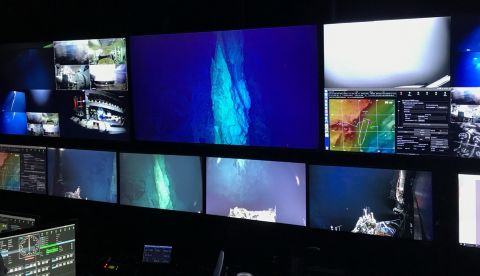
The hydrothermal fluid samples were collected during the ROV Jason II Return to Lost City Expedition aboard the R/V Atlantis in 2018. Dr Evans’ greatly appreciates the invitation to participate from Professor Gretchen Früh-Green (ETH Zürich) and Dr Susan Lang (Woods Hole Oceanographic Institution) and gratefully acknowledges the enabling support from the 2018 Southampton Harry Elderfield Memorial Award.
The research was supported by the Harry Elderfield University of Southampton Memorial Award, UK Natural Environment Research Council, The Royal Society, European Research Council, and the US National Science Foundation.