Protecting HMS Invincible’s rudder
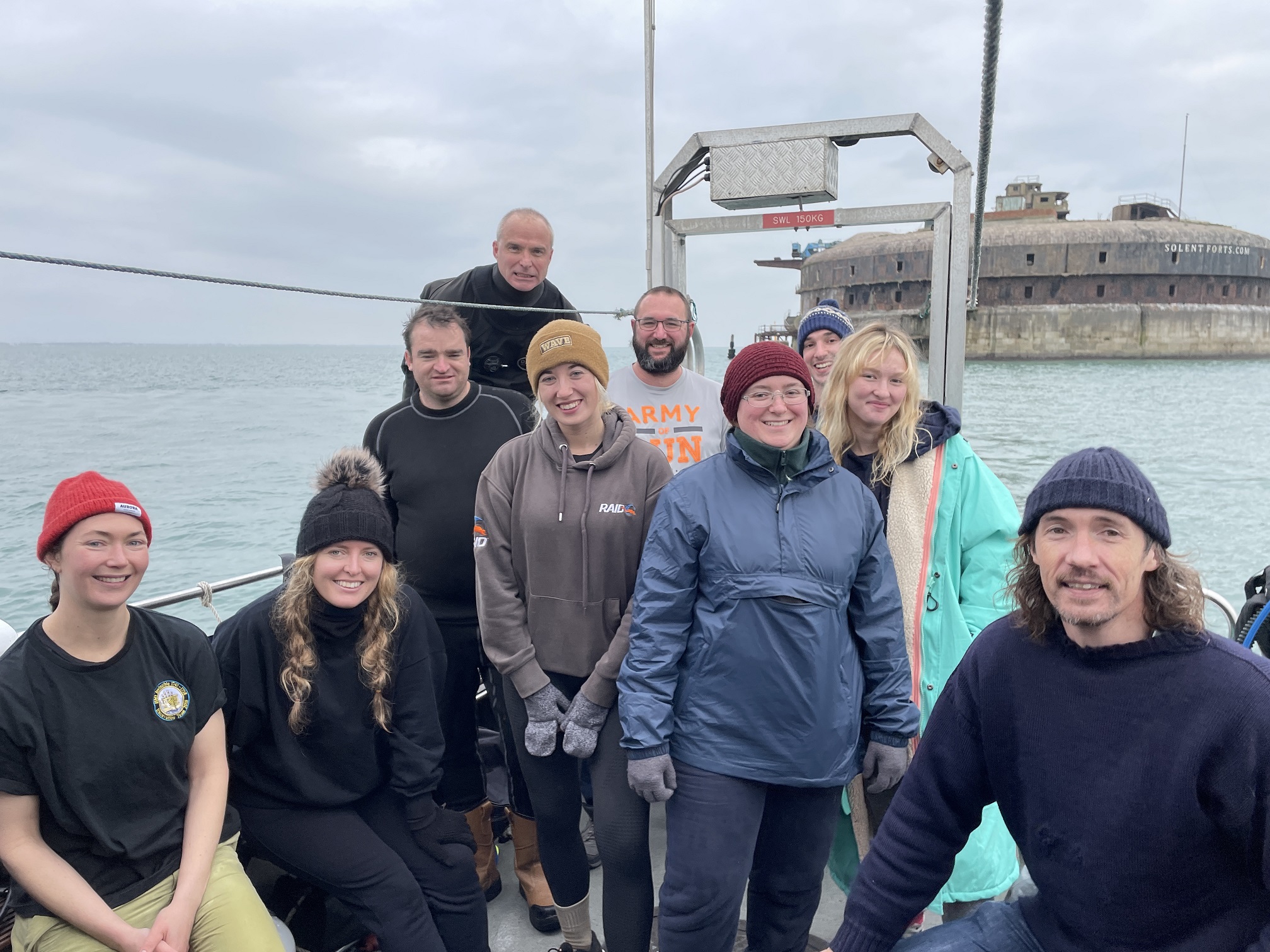
In November, a team of divers and students from the University of Southampton Archaeology department set out from Portsmouth harbour, onboard the Dive Support vessel Wight Spirit, to the wreck of the Royal Navy’s first HMS Invincible.
Lost in 1758, the wreck lies on a mobile sand bank in the eastern Solent. Invincible represents the earliest evidence of a 74-gun warship, a lineage that became the backbone of all the most powerful navies of the 18 th and early 19 th centuries. Recent archaeological investigations revealed that up to 70% of the hull survives, albeit in large coherent fragments. Included among the surviving hull structure, and the most recent discovery, is the rudder. The 12m-long rudder was found perfectly complete but detached, lying 60m away from the stern end of the wreck. Rudders from ships of this size and in this condition are extremely rare but with no funding to raise and conserve it, the decision was made to protect it in-situ by reburying it with several tons of sandbags. This was originally conducted in 2022 but routine inspection dives in 2023 revealed that further protection was required.
In September the author secured a £20,000 grant from Historic England for the University of Southampton to conduct urgent diving work to repair the in-situ protection. With winter and inevitable and sustained stormy conditions fast approaching there was only a short window to get the work done. Following a delivery of 5 tons of gravel, 240 empty sandbags, two shovels, and alongside two PhD students, we had 240 full sandbags ready for deployment. The sandbags were transported by road to Portsmouth harbour and craned onto a commercial work boat, which steamed out to site to place the sandbags on the seabed close to the rudder by late October.
From the 9 to 11 November a team of divers from the University set out from Portsmouth harbour to carry out the final task of moving the sandbags onto the rudder. Joining the professional divers were several of the new MA Maritime Archaeology cohort and PhD students; although not taking part in the working dives on the rudder they got to explore the main site of Invincible . This was a great opportunity for the students to experience diving one of the UK’s most significant shipwrecks and to see firsthand some of the heritage management issues and challenges involved in protecting vulnerable archaeological remains in dynamic shallow waters. Despite the cold, murky conditions everyone seemed to enjoy themselves. By the end of the three days the gaps in the in-situ protection were filled ensuring the protection of the rudder, at least for another year.
- Dan Pascoe