Could insects show us how to fly on Mars?
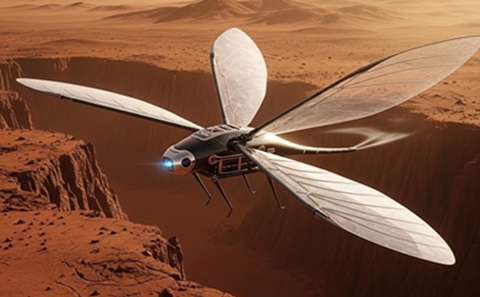
Scientists at the University of Southampton are developing a bold new concept for exploring Mars: a lightweight vehicle inspired by nature.
The project, funded by the European Space Agency (ESA), will investigate whether insect inspired flight could work in the thin atmosphere of Mars. Unlike conventional helicopters or fixed-wing drones, the concept uses rapidly flapping flexible wings to generate lift and thrust, mimicking the remarkable efficiency of natural flyers.
Operating airborne vehicles on Mars is a major challenge. Mars has variable gravity anomalies so vehicles would have to be large or heavy in order to fly safely in the rarified CO
2
atmosphere; and large heavy machines are power hungry.
The Southampton team believes that flapping-wing technology could offer a lightweight, energy-efficient alternative for future planetary missions.
The study will combine advanced aerodynamic modelling, novel compliant mechanisms, and environmental testing in Mars-like conditions. Experimental prototypes will be tested in low-pressure carbon dioxide environments to assess performance under realistic Martian conditions.
The researcher team comprises Professor Andrea Cammarano , Professor Bharath Ganapathisubramani , Dr Cristiano Martinelli and Dr Daniel Carlson. A new PDRA will be recruited to join the team shortly.
Professor Andrea Cammarano said: “The technology will enable a new class of small aerial scouts for Mars, capable of surveying terrain, accessing hard-to-reach areas, and supporting future robotic and human missions. This work represents an exciting step toward expanding how we explore other worlds, combining bio-inspired design with cutting-edge aerospace engineering.
Research Team member Dr Cristiano Martinelli said:
“The project brings together expertise in nonlinear dynamics, aeroelasticity, and experimental fluid mechanics. It builds on the University’s strong heritage in space engineering and previous ESA-funded research into adaptive mechanisms and planetary exploration technologies.”