Science Policy Secondment into the UK Civil Service Department for Energy Security and Net Zero (DESNZ)
Dr Katherine Kwa, a Royal Academy of Engineering Research Fellow within the Centre of Excellence for Intelligent & Resilient Ocean Engineering, and member of the SMMI community recently completed a 9-month Science Policy Secondment into the UK Civil Service Department for Energy Security and Net Zero (DESNZ).
It was a unique opportunity for Dr Kwa to gain first-hand experience on how scientific research can be used to inform the policymaking process and explore potential routes to accelerate and enhance research impact. Dr Kwa’s secondment was enabled by an EPSRC Impact Acceleration Account (IAA) award and support from SMMI and the Royal Academy of Engineering. Dr Kwa was inspired to pursue the secondment after attending the Royal Society Policy Primer , a residential course that aims to help researchers better understand the rapidly changing policy landscape in the UK, and how science research helps to shape and is shaped by Government policy.
Dr Kwa worked with the DESNZ Energy Engineering Team to enable scaling up of floating offshore wind (FLOW) around the UK, identifying ways to overcome barriers in FLOW commercial viability and supply chain pressures, by reducing costs and material requirements for the FLOW support structure. Deployment of farm scale FLOW around the UK is essential to achieve the UK’s 2040 offshore wind target of 34 GW of electricity generation, because FLOW unlocks access to more wind energy and ocean space further from shore, in deeper waters where fixed bottom offshore wind is not feasible. However, while the UK has a very high potential for floating offshore wind, the current levelized cost (LCOE) of floating offshore wind needs to decrease (from £0.15 per kwh) to be more comparable to commercially viable fixed bottom offshore wind (at £0.059 per kwh). The material cost of FLOW support structure components, which includes the tower, floater and mooring line chain components, is not commercially scalable, as it is 10 times more expensive per MW of generated electricity compared to fixed bottom offshore wind, and the steel material requirements for these components exceed current supply chain capacity.
Dr Kwa’s work on ‘Using artificial intelligence to optimise the capital cost of floating offshore wind’ involved creating a novel automated design optimisation framework that treats the design of the full FLOW support structure holistically, to capture beneficial coupled design optimisation between support structure components. The analysis identified an optimised FLOW support structure design that could save up to 18% in the capital cost and 10% in material requirements. This translates to a potential upscaled cost saving of £4.3 billion for future farm scale UK FLOW.
The secondment’s project findings were compiled into a report that Dr Kwa presented at the London Whitehall office to the Science and Innovation for Climate Energy (SICE) Directorate within DESNZ, which includes a number of teams with expertise in Energy Engineering, Policy and Innovation Delivery. The presentation was very well received, prompting lots of interesting questions and discussions.
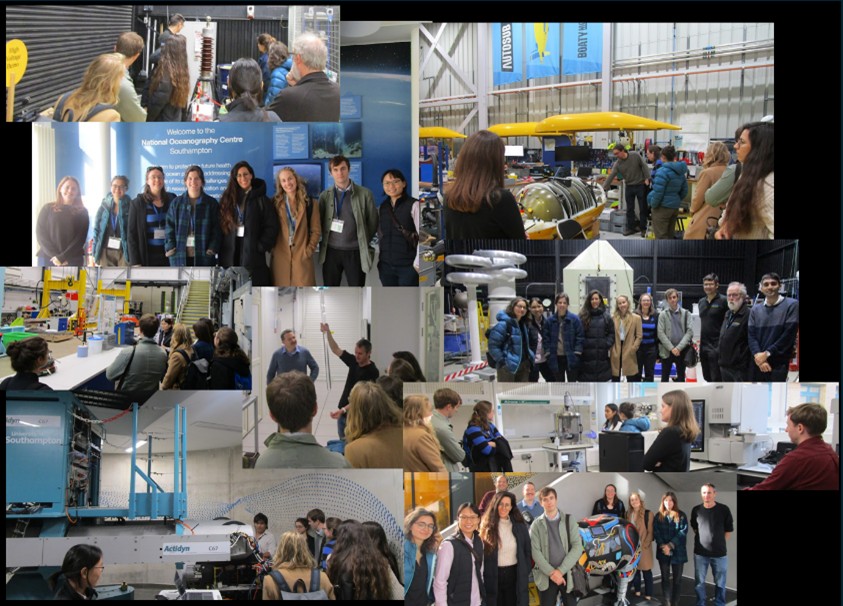
Dr Kwa has described her secondment as ‘an enriching and worthwhile experience. I learnt a lot and it has been an excellent opportunity to highlight the expertise we have at Southampton in the Energy Engineering space, through working with the DESNZ Energy Engineering Team and also from having them come to visit some of the University of Southampton laboratories as one of their Away Days .’ She is ‘happy to share (her) experience with others and connect SMMI colleagues who are interested in pursuing a secondment with DESNZ in the future.’