Collaborating for coral conservation: University of Southampton’s role in protecting UK overseas territories’ reefs
.jpg)
By: Professor Jörg Wiedenmann, School of Ocean and Earth Science
Many UK Overseas Territories (UKOTs) are home to large coral reef ecosystems. The Horseshoe Reef off the coast of the British Virgin Islands, for instance, is the fourth largest barrier reef in the world. These reefs represent valuable resources for the local communities as they attract tourists, enhance fisheries and protect the coastlines from erosion. However, over recent decades, climate change and anthropogenic impacts have led to a decline of healthy reef cover in several UKOTs, especially in the Caribbean region.
To halt and reverse this trend, UKOTs work with The Joint Nature Conservation Committee (JNCC) , a public body that advises the UK Government on nature conservation. This collaboration led to the establishment of the Coral Conservation in the Overseas Territories (C-COT) Working Group , who held their recent meeting at the Zoological Society London (27 th -30 th November 2024).
The aim of an associated workshop was to explore potential collaboration opportunities between the UK science community and UKOT partners, identifying key areas where partnerships can address scientific needs and enhance the impact of research, monitoring, and conservation efforts in the Overseas Territories.
The Coral Reef Laboratory of the School of Ocean and Earth Science showcased the coral reef expertise at the University of Southampton, including strategies to identify corals that can survive at higher-than-normal temperatures. Such corals will play key roles in adaption processes in reefs exposed to warming ocean temperatures.
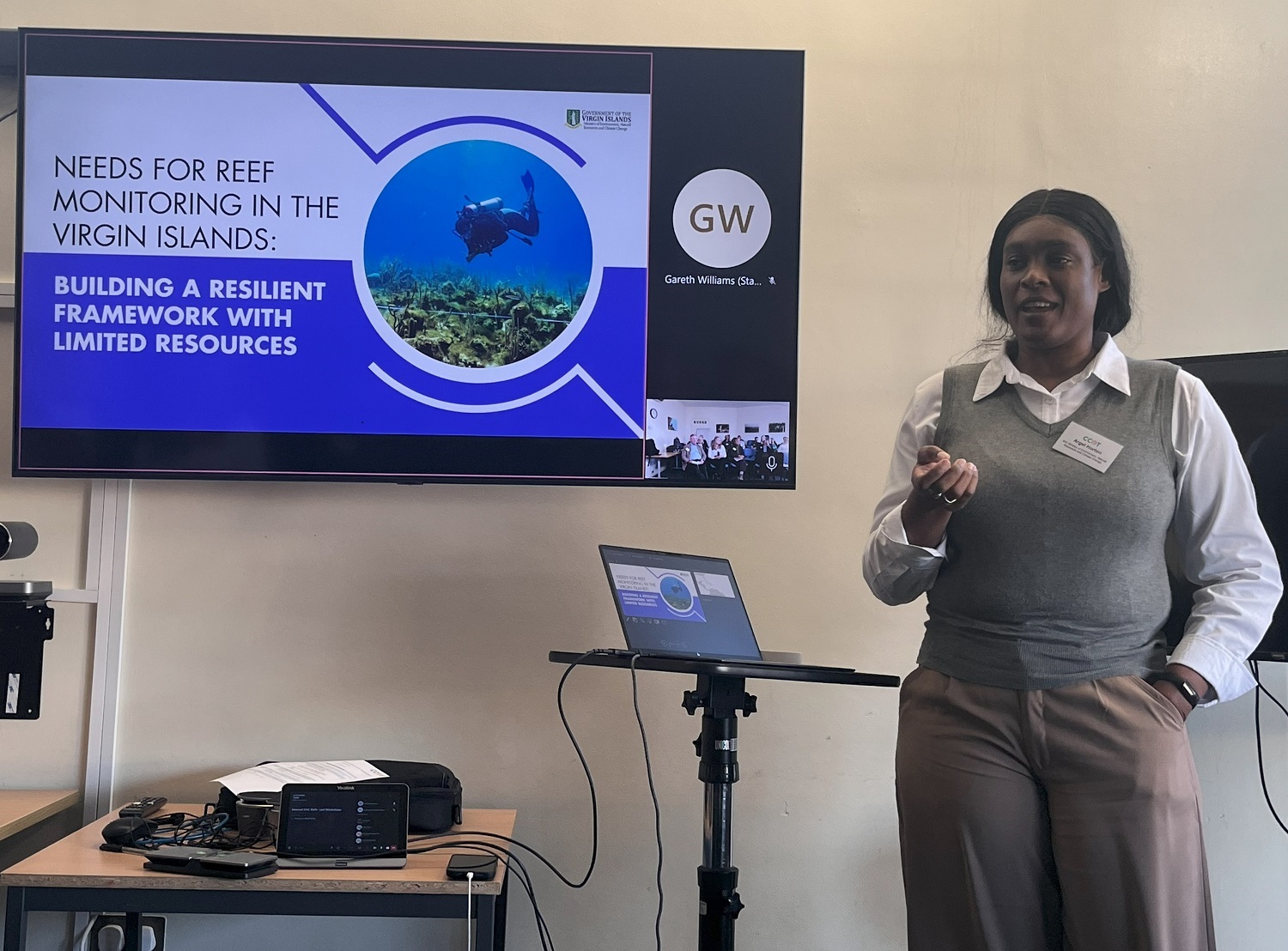
Environment Officer Argel Horton presenting the reef monitoring needs of the British Virgin Islands (Image credit: Jörg Wiedenmann )