Research Group: Magnetic Resonance
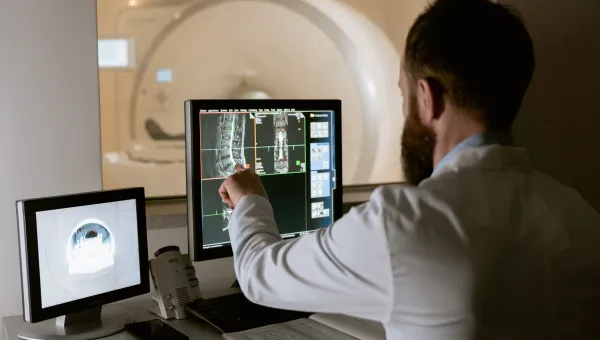
Magnetic resonance is a phenomenon that occurs when materials are placed in a strong magnetic field and exposed to radiowaves. It is often encountered in the medical context, where it is known as magnetic resonance imaging (MRI).
Currently Active: Yes
Magnetic resonance is the most widely applicable form of spectroscopy with applications ranging from materials science to clinical medicine. We employ quantum theory, numerical simulations, magnetic resonance experiments and chemical insights to design new magnetic resonance techniques, which are applied to problems in chemistry, biology, physics, and medicine. We have many local and international collaborations, including groups in Cambridge, Nottingham, Warwick, St Andrews, Copenhagen, Tallinn, New York, Philadelphia and Kyoto.
Our interests are:
- development of magnetic resonance methodology, especially at low temperatures
- the magnetic resonance of solid materials, including superconductors
- determination of biomolecular structures by magnetic resonance, especially in the solid state
- development of new methods for enhancing magnetic resonance signals; development of new agents and methods for magnetic resonance imaging (MRI)
Web links
- Levitt group: Research on nuclear magnetic resonance
- The University cannot accept responsibility for external web sites
Selected publications associated with this group from the University of Southampton's electronic library (e-prints):
Key Publications
Members of staff associated with this group:

Dr Marina Carravetta
Research Fellow
Professor James Emsley
Emeritus Professor
Dr Ilya Kuprov
Principal Research Fellow
Professor Malcolm Levitt
Professor