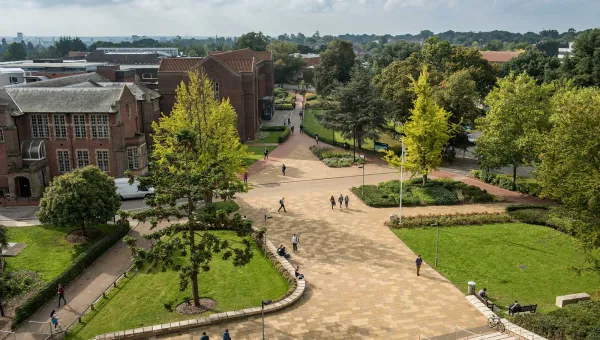
About Southampton Politics and International Relations
We teach our students to analyse global political issues. As expert educators we support them to become influential leaders and informed citizens.
We offer a supportive research and teaching culture, with a strong team of dedicated permanent staff. The department has recently undergone a period of expansion and consolidated growth in staff across key areas of politics and international relations.
Our research themes include public opinion and behaviour; democratic innovations; comparative politics; environmental justice; global health; migration; and development. We also explore new ways to carry out politics research.
Knowledge exchange and enterprise are key aspects of our departmental strategy. We offer consultancy, enterprise, and executive education, as well as social impact activities and policy engagement.
Our commitment to equality, diversity and inclusion lies at the heart of all our work.
Our growth strategy
We're making significant investments to expand our academic team and enhance our research impact.
We aim to:
consolidate our education and research excellence in the UK and globally
enhance our research activities from impact to income streams
foster an inclusive community supporting diverse research agendas, researcher backgrounds and research approaches
We'll do this by:
Enabling high quality teaching and education. For example, by developing specialist modules that link research with teaching and expanding our suite of postgraduate courses.
Producing excellent research that increases income, encourages knowledge exchange partnerships and influences civic, national and international agendas. Including: seed funding opportunities, with feedback to enhance work dedicated research support to develop funding proposals an agreed engagement strategy with the University's public policy unit
Embedding equality, diversity and inclusion practices in everything we do. For example, by improving career progression opportunities for all.
Research and teaching environment
Research environment
We offer a stimulating research community. We invite speakers from inside and outside the University to present at our weekly seminar series where we also encourage informal collaboration.
You can apply to the University, and our school and faculty for seed funding to cover expenses including:
direct research costs
workshops
interdisciplinary research sandpits
From small grant awards to larger projects and mid-career fellowships, funding allows us to conduct research like our work tackling health inequality in Central and South America. Our funding achievements include:
a UKRI Future Leaders’ Fellowship
a European Research Council Consolidator Grant
three large Economic and Social Research Council grants
two Leverhulme Fellowships
a Fulbright Fellowship
a Jean Monnet Chair
We host and work with a number of research centres including:
Behavioural Experimental Action and Research
Democratic Futures
English Identity and Politics
Political Ethnography
Teaching environment
We run 7 taught undergraduate and postgraduate degrees. Over 200 students study on the degrees we host with around 600 on joint honours programmes. The Master’s of Public Administration recruits over 100 students a year.
If you join us as an early-career academic, we support you with a reduced teaching workload for your first 3 years. You can gain a Postgraduate Certificate in Academic Practice with us. We support you to work towards fellowship of the Higher Education Academy.
We teach a range of modules across all subfields of politics and international relations. We encourage staff to develop specialist modules in their fields of interest.
Knowledge exchange and enterprise
Knowledge Exchange and Enterprise (KEE) is a key part of our strategy. It helps staff and students:
gain relevant KEE skills and experience
celebrate and promote KEE successes
develop and sustain relationships with external partners and stakeholders
Our work is supported by the University’s public policy unit which we co-founded. They help researchers:
connect with policymakers
embed impact throughout their work
attract ESRC Impact Acceleration Funding
In the 2021 Research Excellence Framework, the majority of our research was judged internationally world-leading or excellent. Examples of our research impact include:
working with young asylum seekers to improve processes for those seeking refuge
making policy recommendations to improve use of drones in warfare
pioneering new ways to restart democracy
Equality, diversity and inclusion
We're an inclusive department guided by principles of equality and diversity. Our bronze Athena Swan award shows our commitment to this. Athena Swan is a national charter recognising progression of gender equality in higher education.
Whatever your background, we'll help you:
flourish in your career
enrich your learning
gain an indepth understanding of global politics
The Athena SWAN Bronze Award shows our commitment to gender equality.
Discover the latest news, research insights, and upcoming events from the Department of Politics and International Relations (PAIR). Stay informed about our work at the forefront of political thought, global affairs, and public engagement.
Contribute to research in the field of politics and international relations, by completing a PhD with us.
Research and public policy
Get to know our research centres and groups, and find out about our impact. We also have close ties to the University’s public policy unit, which we co-founded.
Collegiality, inclusion, vision and leadership are at the core of everything we do. Our growth strategy will strengthen our thriving research, education, and knowledge exchange culture.
My research focuses on political economy and political behaviour with applications to public policy. Methodologically, I use experiments and
causal inference methods.
I explore psychological processes, mechanisms, and dynamics that explain political behaviour. My recent work focuses on resentful emotionality and reactionary orientations as determinants of anti-democratic and authoritarian political preferences.
My research focuses on Latin American politics. I investigate how poor people’s perception of politics affects their vote choice, the resilience of corrupt electoral practices, and the underrepresentation of candidates from marginalised groups.