
Key facts
Impactful research
We're ranked 4th equal in the UK for research power
One of the UK's strongest engineering schools
We recruit more than 1,000 undergraduate and postgraduate taught students every year
Outstanding national facilities
Including the National Infrastructure Laboratory, towing tank, wind tunnels and x-ray computed tomography centre
Overview
About the School of Engineering
We're part of the Faculty of Engineering and Physical Sciences. Our achievements in engineering span the last 3 centuries, with a history dating back to 1882.
In this time we have used sound science and creative engineering to help shape the world you know today.
The school is made up of 4 departments and 16 research groups. Our departments are:
- Aeronautical and Astronautical Engineering
- Civil, Maritime and Environmental Engineering
- Mechanical Engineering
- Institute of Sound and Vibration Research
Whether we’re leading the way in aircraft noise reduction or improving the sustainability of river infrastructure throughout the world, we play a key role in the UK's engineering research sector. We positively impact society and provide industry with innovative solutions to their problems.
We run more than 70 accredited undergraduate and postgraduate degree courses across our departments, as well as a 'year in industry' option and an engineering foundation year.
The school runs a number of research programmes and supervises more than 300 PhD students.
In parallel to our degrees we offer continuing professional development. Our intensive short courses help working professionals enhance their skills and career options.
We offer a full range of specialist engineering services to industry and the public sector. This allows us to share knowledge and provide exceptional testing facilities. We partner with businesses across the UK and have worked with organisations that include Rolls Royce, Network Rail, Airbus and Lloyd's Register.
Underpinning our business services is an outstanding collection of integrated teaching and research facilities. They include the largest towing tank in any UK university and a wind tunnel complex used by Formula One and elite athletes.
An important facet of our work in Engineering is our outreach programme. We collaborate with schools, colleges and the wider community to inspire the next generation of engineering scientists.
Sustainability awareness, design and thinking is embedded into all our teaching, in alignment with Engineering Council guidance.
Equality, diversity and inclusion (EDI)
The School of Engineering holds an Athena SWAN Bronze Award, which recognises our commitment to tackling gender inequality.
The School of Engineering endeavours to find solutions to many challenges. Living the principles of equality, diversity and inclusion is vital. It helps us consider the ways we work together, and consider those who will use the systems and products we develop.
We have held an Athena SWAN Bronze award since 2013. The Athena SWAN Charter is a global framework used to promote inclusive working practices and transform gender equality within higher education and research.
Our EDI initiatives include:
- a Deputy Head of School for EDI plus an EDI Champion in each department. These roles support staff needs and find ways to increase diversity in our staff and student cohorts, as well as in the school leadership.
- support for carers through core hours guidelines. These discourage meetings outside of 10am to 4pm. We also have a dedicated fund to help staff cover care costs for out-of-hours work.
- outreach events inspiring girls to consider science, technology, engineering and mathematics (STEM) subjects and careers
- a Senior Tutor providing dedicated support to students with disability
- a dedicated staff intranet for EDI information
We have our own EDI committee, and sit on the Faculty of Engineering and Physical Sciences' EDI and Athena SWAN forums. This allows us to share best practice across the faculty and the University.
Staff and students in Engineering have access to wider University networks and societies, such as Pulse LBGT+, the disability staff network, and the Race Ethnicity and Cultural Heritage network (REACH).
The University are signatories to a number of key equality charters. These include the Race Equality Charter and the Mental Health Charter Award.
Students have access to extensive services for student wellbeing and disability support.
Research
Our research focus
Our experts use science to generate engineering solutions to real-world challenges, from infrastructure to the climate emergency to biomedical applications.
We are motivated by current societal needs, meaning our research is aligned with UK Government priorities, as set out in the UK's Industrial Strategy.
Within our four departments, we have 16 research groups:
- Acoustics
- Aerodynamics and Flight Mechanics
- Astronautics
- Bioengineering
- Computational Engineering and Design
- Dynamics
- Energy and Climate Change
- Energy Technology
- Engineering Materials and Surface Engineering
- Infrastructure
- Maritime Engineering
- Mechantronics
- National Centre for Advanced Tribology at Southampton (nCATS)
- Signal Processing Audio and Hearing
- Transportation
- Water and Environmental Engineering
Our research impact
By tackling some of the biggest challenges facing modern society, our work is helping to improve lives worldwide. In the most recent Research Excellence Framework 2021, 100% of our research impact is recognised as world-leading or internationally excellent.
Examples of our real-world impact include:
- curbing the impact of aircraft noise
- using bubble acoustics to transform medicine
- improving cochlear implants for deaf people
- improving sporting performance
- improving transport infrastructure
- developing hip replacement products
- screening newborn babies for deafness
- tackling space debris
- improving sustainability of river infrastructure
- cleaner and safer ship design, and smarter seabed mapping
- driving down costs in the rail industry
Teaching and training
Our community comprises more than 3,500 undergraduate and postgraduate students in each. Among our education provision of over 70 industry-accredited courses, we offer courses in the following study areas:
- acoustical engineering
- aeronautical and astronautical engineering
- audiology
- biomedical engineering
- civil engineering
- maritime engineering
- mechanical engineering
Our courses include:
- Bachelor and Masters of Engineering degrees
- study abroad and industry placement options
- engineering foundation year
- specialist master's degrees
- doctoral research degrees
- continuing professional development courses
Our students benefit from industry links and extensive facilities including workshops and design studios.
The strong partnerships we have with organisations such as Leonardo, Airbus, Mercedes and Maserati MSC Racing feed into our programmes. This means our students graduate ready to take on roles in the field of engineering.
The Faculty of Engineering and Physical Science, including the School of Engineering, is to set out a framework for managing generative Ai in an education context. Our aim is to protect the value of students’ degrees and we hope our innovative approach will be adopted across the Faculty’s schools.
Short courses for engineering professionals
As well as degree courses, we offer a range of intensive short courses for industry professionals in the following areas:
- aeroacoustics
- noise control
- space systems engineering
We also contribute to the Maritime Technology Education Consortium, which offers a range of standalone continuing professional development (CPD modules).
We're also happy to discuss creating bespoke CPD courses.
Learn more about our short courses and CPD modules
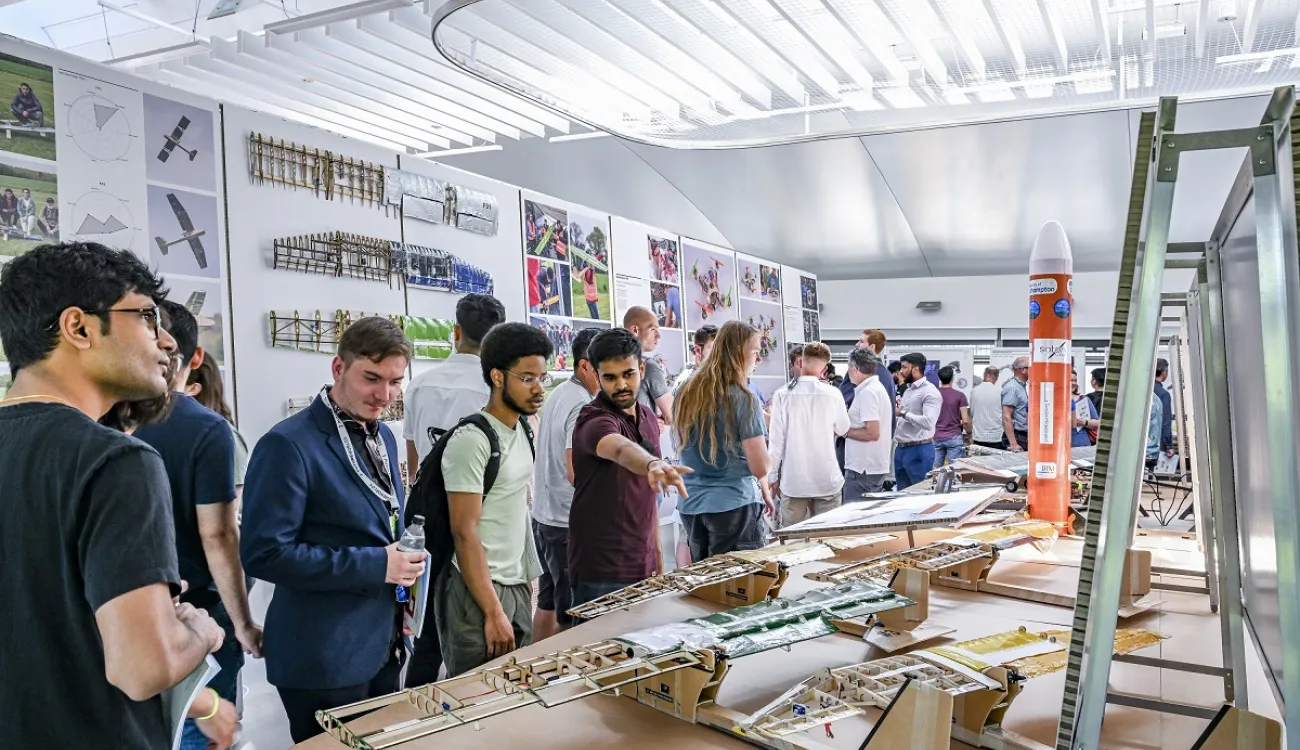
Annual Design Show
We also run an annual Design Show exhibiting the work of undergraduate engineering students.
It's a great opportunity for them to put their knowledge, skills and creativity to the test.
Facilities and enterprise
The School of Engineering is home to more than 10,000 square metres of specialist workshops, laboratories and testing facilities.
These world-class facilities are central to our research, education and business services. They include:
- National Infrastructure Laboratory
- national Centre for Advanced Tribology at Southampton (nCATS)
- μ-VIS X-ray Imaging Centre
- Boeing flight simulator
- towing tank
- wind tunnel complex including the RJ Mitchell Wind Tunnel
- bioengineering lab
- auditory implant clinic and laboratory
Visit our services page for a full list of facilities
Most of our facilities are spread across 2 neighbouring campuses, Highfield Campus and Boldrewood Innovation Campus. We also have some facilities at Southampton Science Park, in nearby Chilworth.
Enterprise units
Get in touch to discuss our facilities
Email us if you're interested in using any of our facilities: enghos@soton.ac.uk
Research and business services
Learn about our research activities and business services.


Our research community
Learn about our research groups, who use their expertise to share knowledge and solve problems.
-
Acoustics
-
Aerodynamics and Flight Mechanics
-
Astronautics
-
Bioengineering
-
Computational Engineering and Design
-
Dynamics
-
Energy and Climate Change
-
Energy Technology
-
Engineering Materials and Surface
-
Infrastructure
-
Maritime Engineering
-
Mechatronics
-
National Centre for Advanced Tribology at Southampton
-
Signal Processing, Audio and Hearing
-
Transportation
-
Water and Environmental Engineering

One of the largest and most diverse engineering schools in Europe, we provide a research-led education in world class facilities that equips and empowers our students to apply fundamental scientific understanding and knowledge to complex, real-world engineering challenges.

Design teaching runs as a connecting thread through all our engineering programmes. We focus on developing our students’ engineering and teamwork skills as well as offering cutting-edge engineering content taught by our internationally recognised staff.

The School of Engineering has world-class facilities spanning all spatial and discipline scales. From microscale for engineering sensors to large ocean scale ship science to space science. This mix of people and facilities makes it a wonderful buoyantly dynamic place to do research.

