Author: Prof. Mark E. Smith, Vice-Chancellor
This week your usual UEB Blog correspondent was taking some well-earned annual leave, requiring a substitute.
UEB initially held a discussion about our responsibilities, under the current circumstances and with many staff still working from home, to ensure the support and well-being of all our colleagues. It is clear through the informal correspondence that UEB members receive that there is some very good practice of teams being well led and staff feeling supported. However, we also recognised the need for all leaders and line managers to continually reinforce the message of ‘do what you can’, to be alive to the very different home circumstances people find themselves in, which can affect what colleagues are able to do, and check on how colleagues feel about things.
As the Active Campus Group developed its thinking, they were asked to consider how we might be able to enable a small number of colleagues whose home circumstances make it very difficult to function effectively to return to the campuses.
Encouraging colleagues to understand broader perspectives is also important and over recent weeks, the Black Lives Matter movement has brought this into sharp focus. To make the University a genuinely inclusive place, all line managers need to continually create space for constructive, even if sometimes uncomfortable, conversations that make it clear that if there are issues any colleagues have over feeling included, that these can be raised, and that if appropriate, actions will be taken. It was also pointed out that a manager’s briefing pack was recently issued on this subject. A series of safe listening spaces has also been established.
There was an extensive discussion about the NSS 2020, published last week, and our own Year 1 and 2 Southampton Student Survey (SSS). Both surveys provide a rich source of information. It was agreed there were key points arising from both surveys. However, the information is most usefully interpreted and assimilated at a local level, to ensure relevant action plans are rapidly put in place for the new term.
NSS 2020
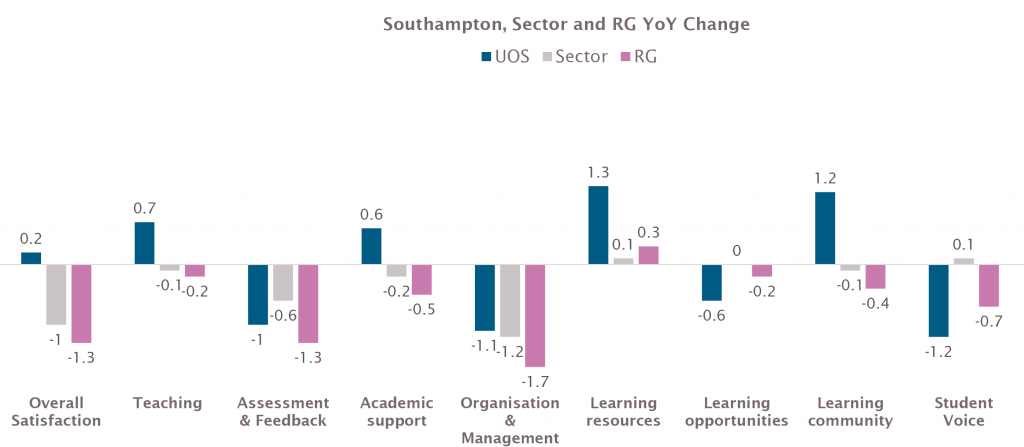
UEB concluded that Southampton had achieved a ‘good’ outcome in the NSS 2020 in the context of the sector and, in particular, relative to our direct competitor set. We recognised that, against a back drop of generally falling satisfaction in the sector, to have improved in several areas was a satisfying performance. We also recognised that this had required a concerted effort from many colleagues and we expressed our gratitude to all those colleagues who contributed to this.
You can see in the diagram below that in the eight headings directly concerning the University, we improved our performance in five of those areas, with our change of performance better than the sector in six. We only fell back relatively in Assessment and Feedback, Learner Opportunities and Student Voice. Looking across the eight universities most closely identified as our peers, there were only two universities that showed any improvement and for each it was only in a single category compared to our five areas of improvement! It is clear that Assessment and Feedback remains a challenge, with the timeliness of getting the feedback to students and the formative value of feedback being highlighted. UEB recognised that a significant effort had gone into this area, but this needed to be maintained.
UEB also noted that for the 26 institutional questions in the NSS, Southampton had nett two positive flags, placing us 5th in the Russell Group in this regard. We were one of only four RG universities with no negative flags. It was also noted that our NSS metrics this year are looking better than some institutions who were ‘Gold-rated’ in the TEF. UEB understood the information from the NSS could be very useful at local School/discipline level. Education Committee would provide central collation of views and actions and keep UEB apprised of thinking from colleagues as it emerged.
SSS 2020
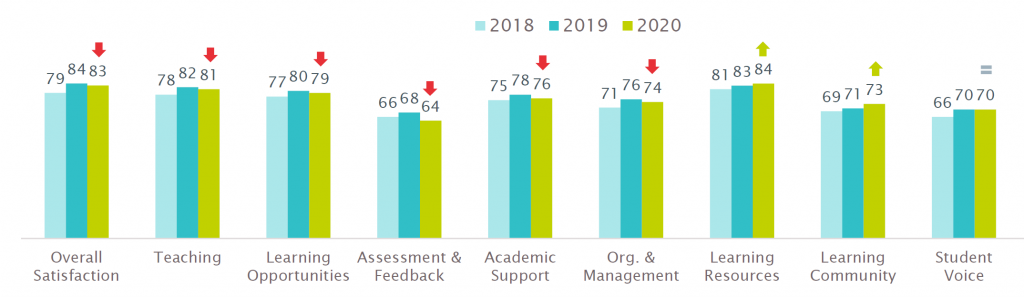
Similar trends were seen in the SSS where again Assessment and Feedback looked to be our weakest indicator. There was also a marked difference between Years 1 and 2, with Year 2 being significantly less satisfied.
Other Matters
UEB was updated on the encouraging progress of the COVID-19 Testing Pilot. The methodology was looking robust and there had been much positive comment on the slickness of the operation. We congratulated the project team for this great work and a discussion took place as to what might follow the pilot.
UEB noted the monthly Health and Safety incident report. In keeping with the Risk Register being a live and active document, it was decided to add a risk around reputation linked to COVID-19 and the developing political narrative around Higher Education.