nCATS has an excellent range of equipment and facilities for assessing corrosion and wear-corrosion. This includes access to seawater immersion site at the National Oceanography Centre (NOC) to laboratory-based Cyclic Corrosion Test (CCT) Chamber. Backing this up is an extensive range of electrochemical measuring equipment and polymer coating assessment tools.
Additionally, a number of tribological equipment can perform corrosion and wear-corrosion experiments.
Technical specification
Electrochemical measurements
Location: Building 7 room 2023 - Bay 2
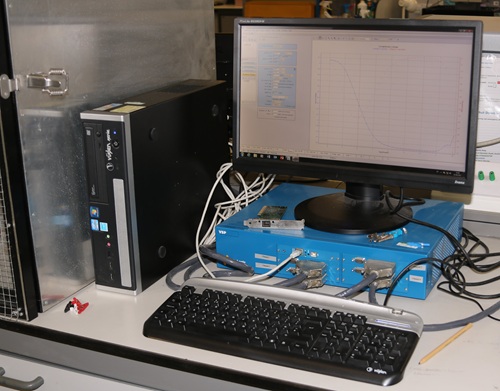
nCATS provides a comprehensive range of electrochemical equipment, including electrochemical workstations, Faraday cages and specialised specimen holders. These systems support a wide variety of electrochemical experiments, such as polarisation, impedance, noise analysis and zero resistance ammetry. Together, these techniques enable the study of corrosion and tribocorrosion behaviour, including the measurement of corrosion current and potential for single metals and coupled metal systems in different corrosive environments.
The electrochemical equipment supports a range of standard measurement techniques, including:
physical electrochemistry - techniques such as cyclic voltammetry, chronoamperometry, and chronopotentiometry and derivatives of these techniques
pulse voltammetry - techniques such as pulse voltammetry, square wave voltammetry, and associated stripping techniques such as anodic stripping voltammetry
DC corrosion - run standard DC corrosion tests such as polarization resistance, potentiodynamic, cyclic polarization, and galvanic corrosion in addition to a number of others
electrochemical signal analyzer - designed specifically for the acquisition and analysis of time-dependent electrochemical noise signals. Cell voltage and current are continuously monitored at rates from 0.1 Hertz (Hz) to 1 kilohertz (kHz). A full featured set of analysis tools provides powerful analysis features such as statistical analysis, detrending, impedance spectra, and histogram analysis
electrochemical frequency modulation - a non-destructive corrosion rate measurement technique. It allows for measurement of the corrosion rate without prior knowledge of the Tafel constants. In addition, the technique determines the Tafel constants and provides 2 internal validity checks
electrochemical noise - a more general form of electrochemical noise testing
electrochemical impedance spectroscopy - includes experimental scripts for potentiostatic, galvanostatic and hybrid impedance spectroscopy experiments in addition to single frequency techniques like Mott-Schottky. We also have our unique power-leveling multisine technique that improves signal-to-noise across the spectrum. On the analysis side, it provides tools for fitting spectra to equivalent circuit models, Kramers-Kronig transform for data validation and a graphical model editor. Our software even includes a script for EIS simulation.
ECWS1 electrochemical workstation
ECWS2 electrochemical workstation
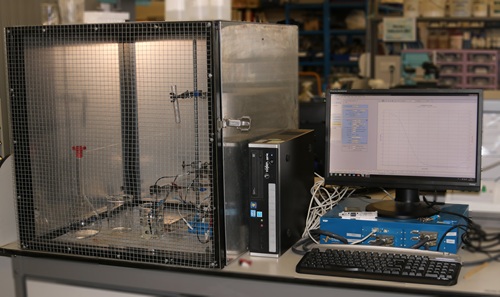
Cyclic corrosion test (CCT) chamber
Location: Building 7 room 2023 - Bay 2
The cyclic corrosion test chamber (CCT) combines traditional salt spray exposure with a range of controlled climates, including variable temperature and humidity. This enables accelerated simulation of real service-life conditions tailored to customer requirements, making CCT particularly well suited to predicting product service life expectancy.
They come with the ability to create 4 distinct climates:
salt spray
condensation humidity (wetting)
air drying
controlled humidity
These may be programmed to occur in any sequence and be repeated automatically.
The Ascott CC450G conforms to ASTM B117, SAE J2334 and ASTM G85 standards.
UV chamber
The QUV accelerated weathering tester reproduces material degradation caused by sunlight, rain and dew. Within days or weeks, it can simulate the damage that would normally occur over months or years of outdoor exposure. Testing is carried out using controlled cycles of ultraviolet (UV) light and moisture at elevated temperatures. Sunlight is simulated using fluorescent UV lamps, while dew and rain effects are reproduced through condensing humidity and/or water spray.
The QUV complies with most major international, national and industry standards, including a broad range of ASTM, ISO, EN, SAE, JIS and AATCC specifications.
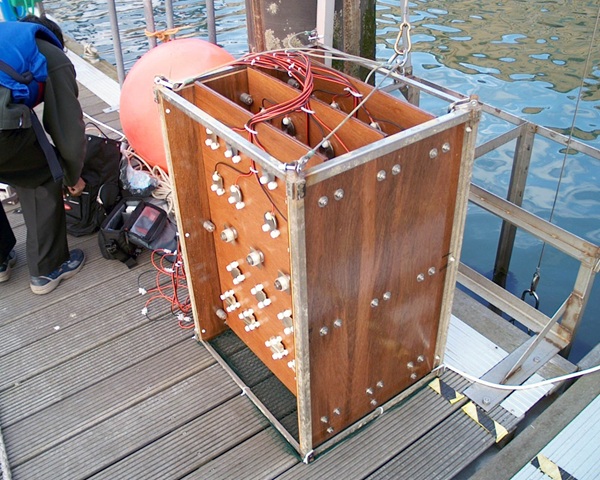
nCATS has access to seawater immersion sites at the National Oceanography Centre (NOC), enabling corrosion and biofouling studies that are representative of UK dockside environments. Access to a realistic marine environment is essential, as natural annual cycles—such as variations in temperature, oxygen content and seawater chemistry—have a significant influence on corrosion rates, corrosion mechanisms and biofouling life cycles.
The nCATS seawater immersion system comprises a stainless steel frame located in a stainless steel frame, the cage is used to locate marine ply boards with samples mounted on them, the samples are mounted away from the board surface to avoid anaerobic conditions or crevice corrosion conditions, nylon bolts are used to avoid unintentional bimetallic contacts.
To back up the corrosion equipment, nCATS also has equipment for surface finishing before and after testing - find more about lapping and polishing equipment.