
Our Global Talent Fund researchers
The University of Southampton has secured £4.35 million to attract leading researchers from around the world. This funding is part of the £54 million Global Talent Fund (GTF), launched by the Department for Science, Innovation and Technology (DSIT).
The fund supports innovation in key growth areas such as:
- advanced manufacturing
- digital technologies
- life sciences
- clean energy
This investment will strengthen the University’s role in delivering the UK Government’s industrial strategy. It will also support innovation in priority sectors and reinforce the UK’s globally recognised research base.
By attracting world‑class researchers, the initiative will help position the UK as a leader in international collaboration and scientific development.
Two GTF researchers share their career highlights and why they are choosing Southampton to pursue their ambitions.
Professor Dimitrios Angelakis
Professor Dimitrios Angelakis is an internationally recognised researcher in quantum computing, quantum simulation and quantum optics. His work focuses on developing quantum algorithms to solve complex scientific and industrial problems.
He has spent over 15 years at the Centre for Quantum Technologies (CQT) at the National University of Singapore. His career also includes roles at Imperial College London, the University of Cambridge and the Technical University of Crete.
He is the founder and Chief Scientific Adviser of AngelQ Quantum Computing, a company developing quantum algorithms and hybrid quantum-classical solutions for industry.
Career highlights
Professor Angelakis is a pioneer of "quantum simulation and many-body physics with light." His work has enabled new ways of using light-based systems to study complex physical phenomena.
He has published in leading journals, including Science and Physical Review Letters, and has worked with international and industry partners to apply quantum research to real-world challenges in areas such as logistics, finance and optimisation.
Professor Angelakis completed his PhD at Imperial College London and held a Junior Research Fellowship at the University of Cambridge. This role marks a return to the UK research environment that helped shape his career.
The University of Southampton offers strong opportunities to contribute to the UK’s globally connected quantum ecosystem and develop interdisciplinary collaborations. Support from the Global Talent Fund also reflects the UK’s commitment to advancing quantum technologies.
Future plans
Professor Angelakis aims to help move quantum technologies from research into practical use across industry and society. His work focuses on applications in areas such as logistics, energy, healthcare and advanced manufacturing.
He is also committed to supporting international collaboration, developing future researchers, and strengthening the UK’s role in the global quantum ecosystem.
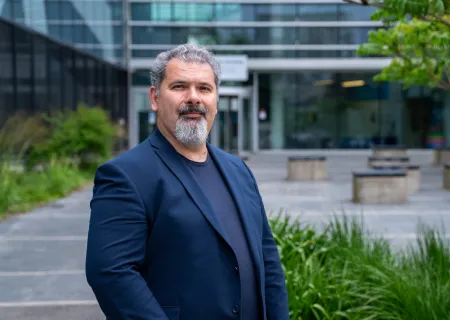


Joining the University of Southampton provides an exciting opportunity to help strengthen the university’s growing activities in quantum technologies while building new interdisciplinary collaborations across engineering, computer science, physics, and industry.
Dr Giorgio Adamo
Dr Giorgio Adamo works in advanced nanophotonics, studying how light behaves at the nanoscale to develop new technologies. His research focuses on metasurfaces, microscopy, and quantum and topological photonic systems, with the aim of improving sensing, communication and imaging.
He has an international background, having studied in Italy, Sweden and the UK. After starting his career in the UK, he spent several years in Singapore helping to establish a major photonics research centre at Nanyang Technological University. He now leads his own experimental research group in the UK.
Career highlights
His work focuses on delivering real impact. Key achievements include:
- “Light well” - a nanoscale, tuneable light source on a chip, seen as a step towards chip-based free-electron lasers
- Limited-size optical microscopy (LSOM) - a method for label-free super-resolution imaging beyond the diffraction limit, confirming long-standing theoretical predictions
The Optoelectronics Research Centre is one of the world's leading photonics centres providing an excellent environment for transforming fundamental research into tangible industry impact.
Support from the Global Talent Fund will also enable his return, helping to strengthen research and innovation in this area.
Future plans
He aims to deliver research with long-term impact across manufacturing, semiconductors, healthcare and environmental monitoring.
His goal is to develop technologies that improve imaging and diagnostics, support high-speed and quantum communications, and enable next-generation augmented and virtual reality systems, creating clear benefits for society.
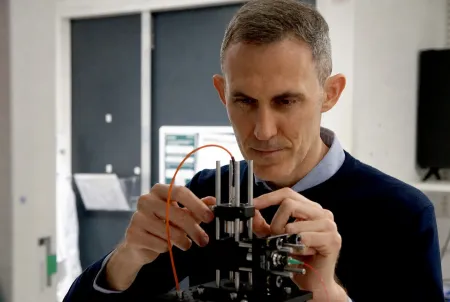
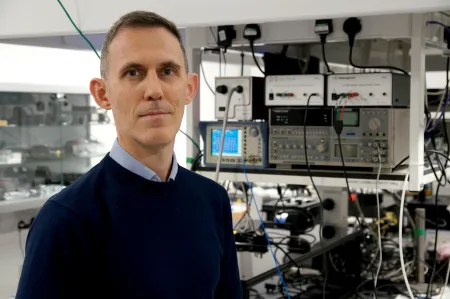
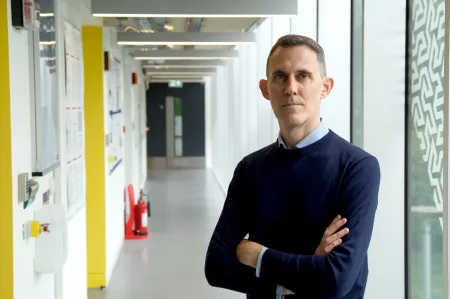
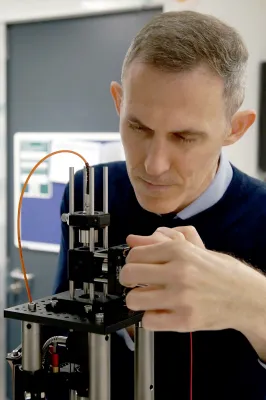
The opportunity to run my research within the unique photonic ecosystem of the Optoelectronics Research Centre at the University of Southampton was unmatched.
More about research at Southampton
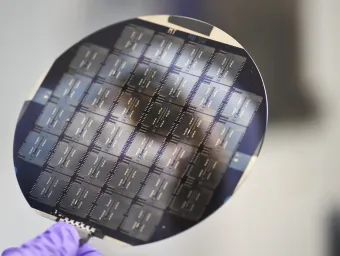
Optoelectronics Research Centre (ORC)
We are a research-intensive school with a world-leading reputation in photonics and optoelectronics.
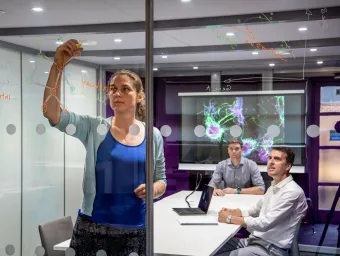
Interdisciplinary research
Our interdisciplinary institutes foster inspiring and innovative solutions to help solve our world's greatest challenges
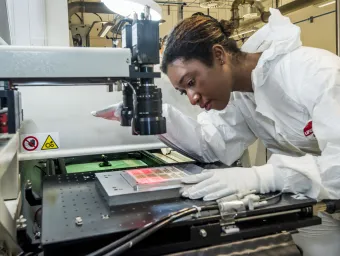
Research facilities
Our modern university research facilities, archives, and buildings give you access to the best equipment to advance your research.


