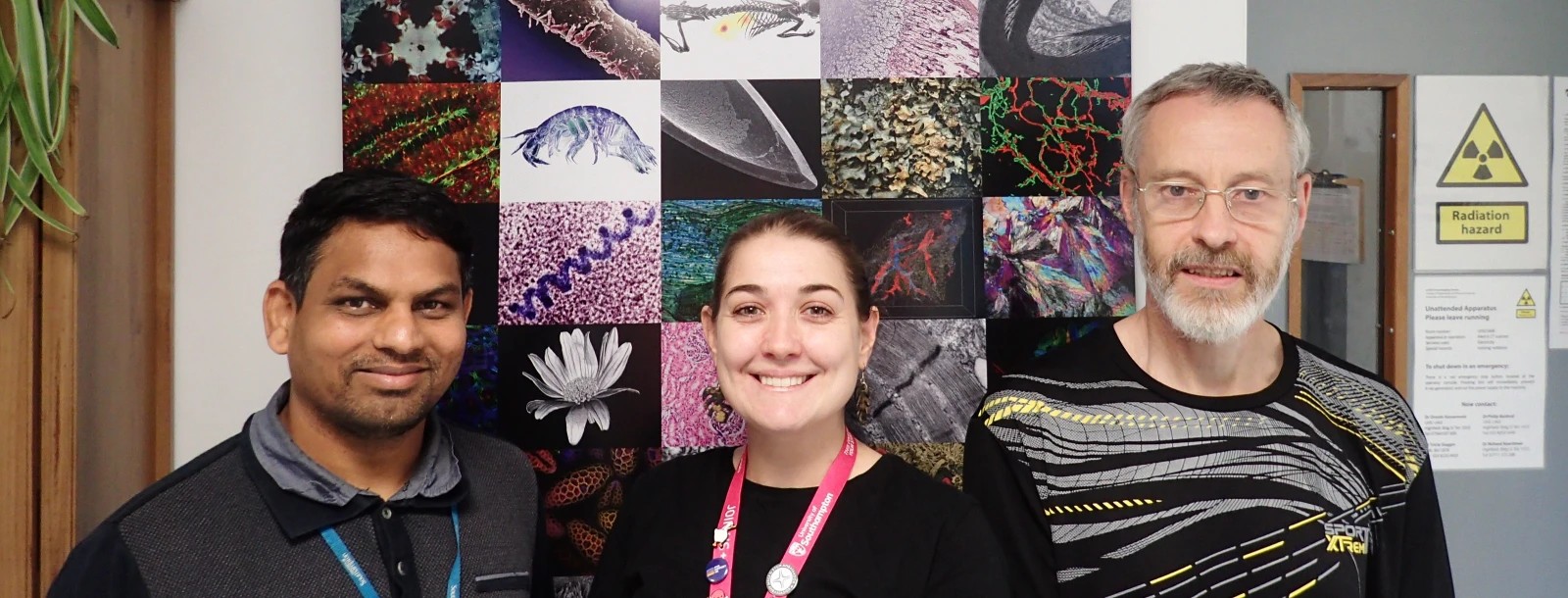
In a major boost for research, the Faculty of Medicine has secured over £1.6 million in funding from two successful grant applications. The investment will bring two state-of-the-art imaging platforms to the Biomedical Imaging Unit (BIU), the Faculty’s core imaging facility.
The awards, from the Biotechnology and Biological Sciences Research Council’s ALERT 2024 scheme, will introduce super-resolution light microscopy and cryo-fluorescence tomography to Southampton. It will expand the scale, scope, and resolution of imaging available to researchers.

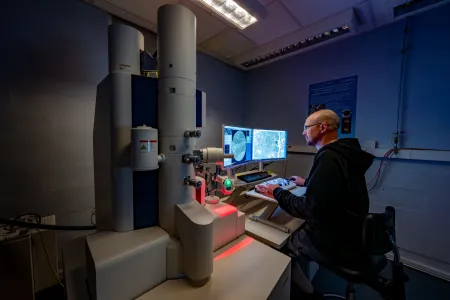
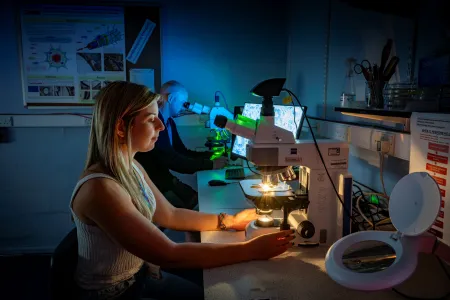
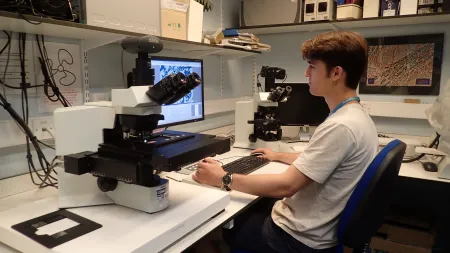
Securing two major grants in a single round is an exceptional achievement and a testament to the expertise of our Research Technical Professionals. These new imaging systems will transform biomedical research at Southampton and strengthen national and international collaboration.
Cryo-Fluorescence Tomography (CFT)
Lead researchers


The BIU will become home to one of only a dozen Cryo-Fluorescence Tomography (CFT) systems worldwide - and the first based in an open-access academic facility in Europe.
Dr David Johnston explains:
“This technology bridges a gap in the scale of imaging. Live-animal fluorescence imaging gives a whole-body view, but only at millimetre resolution. High-resolution microscopy gives fine detail, but in small areas. CFT combines the best of both – offering ‘big-picture’ 3D imaging with high-resolution.”
Dr Katie Dexter adds:
“CFT lets us see deep inside tissues and track complex biological processes – like how cancer spreads, how drugs are distributed, or how specific genes behave. You can’t get that kind of whole-organ perspective with any other fluorescence technique.”
This grant was supported by researchers from Portsmouth, Sussex, and Brighton, and Sussex Medical School. BIU’s open-access model ensures it will serve a broad range of scientific disciplines across the UK.
Super-Resolution STED Microscope
Lead researchers

The second award funds a Stimulated Emission Depletion (STED) microscope, offering unprecedented imaging resolution down to ~30 nanometres – more than six times better than conventional light microscopy.
“Researchers increasingly need to see what’s happening at the molecular level - how proteins organise, how structures interact, how diseases begin,”
Explains Dr David Johnston
“Unlike our existing microscopes, STED allows us to tag different parts of a cell with fluorescent dyes and observe them at nanoscale resolution. This doesn’t just show us where something is - it reveals what it’s doing, giving us critical functional insight into living systems.”
The microscope will support research in cancer biology, neuroscience, infection, immunology, and more. As with other BIU resources, it will be available to researchers across the University and beyond via BIU’s open-access framework.
“STED fills a key gap in our imaging pipeline between light and electron microscopy. It enables multi-colour nanoscale imaging, offering a fuller picture of complex biological questions.”
A first for Research Technical Professionals
These grants mark a first for the Faculty of Medicine. Both awards were conceived, written, and led entirely by Research Technical Professionals (RTPs).
Within the BIU, RTPs play a central role in supporting research, from experimental design and data acquisition to image analysis and publication. This success highlights the strategic value of RTP-led infrastructure and the pivotal role they play across the Faculty.
Work with the BIU
The BIU is an open-access facility, and its equipment is available to UK academia and industry. For access and collaboration enquiries, please contact biu@soton.ac.uk.
The two new systems ensure that researchers at Southampton and their collaborators have access to the latest, cutting-edge imaging platforms. Both instruments are expected to be operational by the end of 2025.