Combine your passion for creative art and design with digital technologies on this master's degree in creative technologies. Based at Winchester School of Art (WSA), we'll prepare you for a range of careers in the arts and technology sectors.
You'll develop your creative and technical skills in systems thinking and design. You'll learn through projects where you'll design and build immersive digital experiences. These experiences will go beyond digital screen formats to include fabrication, textiles and 3D printing.
You can choose to focus on:
programming skills
user experience design
physical fabrication
art and design practice
project management
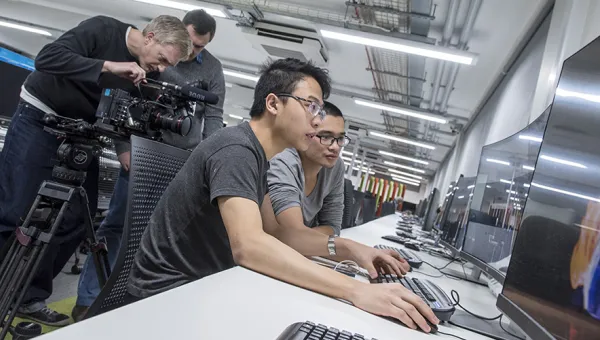
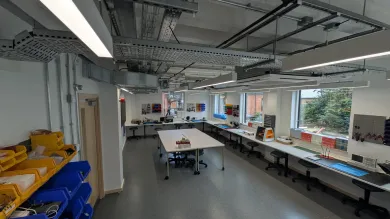
You'll use industry standard equipment including virtual reality and augmented reality systems. You'll learn to programme as well as look at robot design. At WSA, you'll be part of a creative community that makes it easy to collaborate across subject areas.
On this creative technologies course you’ll have the opportunity to:
plan, design and develop digital projects
develop computational cognitive and practical skills
visit museums, galleries, and industry events
take part in industry facing projects with partners such as IBM and Moving Brands
We regularly review our courses to ensure and improve quality. This course may be revised as a result of this. Any revision will be balanced against the requirement that the student should receive the educational service expected. Find out why, when, and how we might make changes.
Our courses are regulated in England by the Office for Students (OfS).
Course lead
Your course leader is Dr Seth Giddings. His interests include cultures, technologies and economics of games, toys, and play. He researches AI and robotics in art, games, and everyday life.
You’ll need a 2:2 degree or equivalent international qualification in any subject or relevant work experience in arts, humanities, design, music, languages, computing or technology. You should include your portfolio that articulates interest and practice in the sector of creative technologies.
English language requirements
If English is not your first language, you must show that you can use English to the level we require. Visit our English language pages to find out which qualifications we accept and how you can meet our requirements.
If you are taking the International English Language Testing System (IELTS), you must get at least the following scores:
IELTS score requirements
overall score
6.5
reading
6.0
writing
6.0
speaking
6.0
listening
6.0
If you do not meet the English language requirements through a test or qualification, you may be able to meet them by completing one of our pre-sessional English programmes before you start your course.
Pre-masters
If you don’t meet direct entry requirements, you can apply to complete a Pre-Master's programme through our partnership with OnCampus.
This is a full-time master’s course. You’ll study for 12 months, from September to the following September.
In the first 9 months (semesters 1 and 2) you’ll study the taught part of your course. This is made up of modules that everyone on the course takes, and optional modules.
In the first semester you'll be introduced to key technical skills and applications in creative technologies. The emphasis will be on programming for creative work.
Compulsory modules cover:
ideas in art and technology
collaborative practices
creative computing
In semester 2 you'll build on your skills. Compulsory modules cover:
creative technologies
creative industry research
Through an optional module you'll extend your specialism in one of these areas:
experimental publishing
visual culture
exploring the visual language of display
You’ll also prepare a research proposal for your final project and decide on the best approach.
In semester 3, you’ll work independently on your final project. You’ll have one-to-one meetings with your supervisor during this time to discuss your progress.
The modules outlined provide examples of what you can expect to learn on this degree course based on recent academic teaching. As a research-led University, we undertake a continuous review of our course to ensure quality enhancement and to manage our resources. The precise modules available to you in future years may vary depending on staff availability and research interests, new topics of study, timetabling and student demand. Find out why, when and how we might make changes.
As well as lectures and seminars led by subject experts you'll learn through:
workshops and demonstrations
interdisciplinary workshops
study visits such as to industry linked partners or design studios
industry related projects
Assessment
Assessment could include:
reports
digital portfolio
group and individual projects
design research and development
technical exercises
2D and 3D models and prototypes
Academic Support
We'll assign you a personal academic tutor, and you'll have access to a senior tutor.
Careers and employability
Employability skills
This degree will allow you to develop and evidence subject-specific and targeted employability skills. This includes the required skill set for a range of future careers, further study, or starting your own business.
The skills you can expect to focus on and gain from this course include:
Research
Critical thinking
Commercial awareness
Self-management
Confidence
Leadership
Communication
Teamwork
Creativity
Networking
EDI leadership
Adaptability
Problem solving
Resilience
The employability and enterprise skills you'll gain from this course are reflected in the Southampton skills model. When you join us you'll be able to use our skills model to track, plan, and benefit your career development and progress.
Choosing to do work experience is a great way to enhance your employability, build valuable networks, and evidence your potential. Learn about the different work and industry experience options at Southampton.
We are a top 20 UK university for employability (QS Graduate Employability Rankings 2022). Our Careers, Employability and Student Enterprise team will support you. This support includes:
work experience schemes
CV and interview skills and workshops
networking events
careers fairs attended by top employers
a wealth of volunteering opportunities
study abroad and summer school opportunities
We have a vibrant entrepreneurship culture and our dedicated start-up supporter, Futureworlds, is open to every student.
Your career ideas and graduate job opportunities may change while you're at university. So it is important to take time to regularly reflect on your goals, speak to people in industry and seek advice and up-to-date information from Careers, Employability and Student Enterprise professionals at the University.
Your tuition fee covers the full cost of tuition and any exams. The fee you pay will remain the same each year from when you start studying this course. This includes if you suspend and return.
Accommodation and living costs, such as travel and food, are not included in your tuition fees. There may also be extra costs for retake and professional exams.
Dean of Faculty of Arts and Humanities Global Talent Award
Up to 5 scholarships of £10,000 are available to first year international students starting an eligible full-time, on-campus, 1-year postgraduate taught programme in the Faculty of Arts and Humanities.
Winchester School of Art Inclusive Futures Scholarship
This scholarship supports talented students who face financial, social, or structural barriers to postgraduate study, helping ease financial pressure so they can focus on their creative work and bring diverse perspectives to our community.
Successful applicants will have 50% of their tuition fees paid for the duration of their course.
The deadline to apply for this course is Wednesday 18 August 2027, midday UK time.
We advise applying early as applications may close before the expected deadline if places are filled.
International students
The deadline to apply for this course is Wednesday 4 August 2027, midday UK time.
We advise applying early as applications may close before the expected deadline if places are filled.
Application assessment fee
There is no application assessment fee for postgraduate courses starting in 2027.
Supporting information
When you apply you’ll need to submit a personal statement explaining why you want to take the course.
You’ll need to include information about:
your knowledge of the subject area
why you want to study a postgraduate qualification in this course
how you intend to use your qualification
References are not required for this programme.
Please include the required paperwork showing your first degree and your IELTS English language test score (if you are a non-native English speaker) with your application. Without these, your application may be delayed.
You'll need to submit a portfolio of your work, as follows:
In a Word document or PDF, with your name clearly visible in the first page, include around 6 ‘sets’ of work that demonstrate your interests and experience across creative and technical practice.
If you have a creative background, show us your work in art, design or music, and give some evidence of your interest in technical practice such as computing, making or creative software use.
If you have a computing or technical background, include and explain your best and most innovative work. Also include evidence of creative interests and practice such as photography, drawing or music-making.
A set might be a sequence of photographs exploring a theme, or it could be a single developed work such as a painting, audio work, written work, Arduino experiment, piece of code or application.
Include preparatory materials in a set where appropriate, such as sketchbooks, prototypes, moodboards or models. You can include links to your work on online portfolios, blogs, coding sites, audio and video sites.
Annotate your sets by including short texts giving some context to your ideas and explaining anything that isn’t clear from your images and links.
What happens after you apply
You'll be able to track your application through our online Applicant Record System.
We will aim to send you a decision 6 weeks after you have submitted your application.
Unfortunately, due to number of applications we receive, we may not be able to give you specific feedback on your application if you are unsuccessful.