

About the six-axis motion simulator
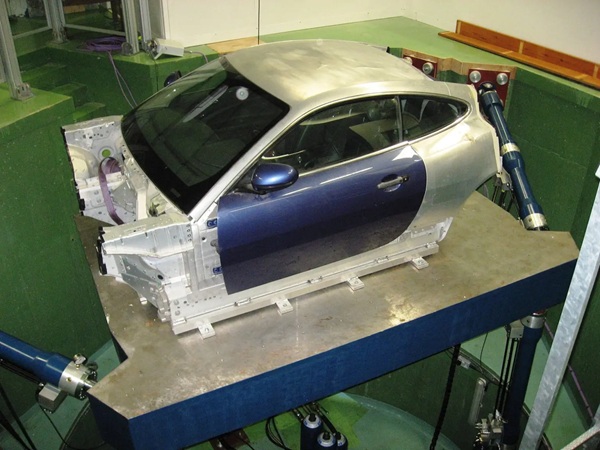
The human-rated six-axis motion simulator can generate motion in all three translation axes—fore-and-aft, lateral and vertical—and all three rotational axes—roll, pitch and yaw. Cabins can be attached to the platform to recreate passenger environments, including sound, thermal and visual conditions.
It can accurately reproduce motions in six axes with very low levels of background vibration, waveform distortion, and cross-axis motion.
The simulator allows faithful reproduction of vehicle motion environments recorded in road, off-road, rail, marine and aerospace vehicles. In combination with purpose-built cabins, the simulator provides a controlled environment for investigating passenger experience, including the interactions between motion, acoustics, seating, thermal conditions and other environmental factors.
The simulator is used to investigate the effects of vibration on passenger comfort, motion perception, seating dynamics and postural stability for seated, standing and walking subjects.
It is also used for commercial testing of seats, including suspension seats.
Watch a short video showing motion simulator in a sports car.
Specifications
Actuation: servo-hydraulic
Displacement
- 1 metre (m) in vertical direction
- 0.5 m fore-and-aft
- 0.5 m lateral
Maximum angle of rotation
- approximately 20° in roll and pitch
- approximately 10° in yaw
Maximum acceleration
- up to 10 metre per second squared (m/s²) translational motion
- up to 5 radians per second squared (rad/s²) rotational motion
Frequency range of motion
- 0 to 50 Hz
The moving platform
- dimensionsapproximately 3 metres (m) × 2 m
- payloads up to 1000 kilogram (kg)
- dynamic force approximately 10 kilonewton (kN)
Applications
The 6-axis motion simulator is used in the following applications:
Comfort
Experimental studies to investigate the effects of sinusoidal, random, and multi-axis vibration and shock on the comfort of seated and standing people.
Simulation of environments
The vibration and sound recorded in road, off-road, rail, marine and aerospace environments can be simulated to investigate aspects related to comfort, performance, or health. The thermal conditions (temperature and humidity) and the décor, controls and displays in transport environments can also be simulated.
Perception
Absolute thresholds and difference thresholds for the perception of whole-body vibration.
Postural stability
Effects of oscillatory motions on the postural stability of standing and walking persons.
Biodynamic studies
For each of the six-axes of vibration, the transmission vibration to the body and the mechanical impedance of seated, standing, and recumbent persons. Effects of posture, seating conditions, and other sources of variability on the transmissibility and impedance of the human body. The collection of data needed to develop biodynamic models.
Seat testing
Measuring the transmission of vibration through seats with human subjects or with anthropodynamic dummies. The simulator is capable of all standardised vibration tests for vehicle seats, including suspension seats. The measurement of seat dynamic responses required for seat modelling.