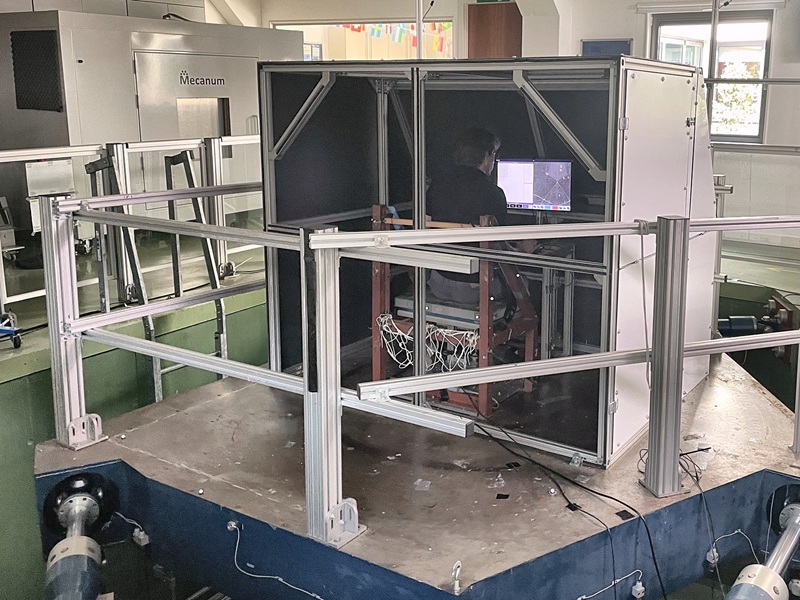
We reproduce measured motion from real vehicles, in all six axes (vertical, fore-and-aft, lateral, roll, pitch and yaw), on our laboratory simulators, for experimental study of how people respond to it and for simulation demonstrations.
Motion recorded in cars, buses, trains, aircraft and marine craft can be replayed faithfully, with very low background vibration, waveform distortion and cross-axis motion.
Fitted with a cabin, the simulator reproduces not just the motion but the environment around it, so an occupant experiences a complete recreation of the vehicle rather than movement alone.
What we study
Studies using the simulators cover comfort, task performance, motion sickness, physiological response, perception, seating dynamics and postural stability, for seated, standing and walking subjects.
The complete environment
A cabin fitted to the simulator platform allows the environment to be reproduced alongside the motion:
a 360 degree sound field
temperature and humidity
vision
seating configuration
lighting
This allows the relative contribution of each to overall comfort to be separated experimentally, rather than inferred.
Human subject research
Experimental programmes involving human participants are run by staff experienced in human-subject research, under the University's ethics procedures. Studies are reviewed through the University's Research Ethics and Governance framework and submitted via the University's ethics application platform, ERGO.