About this course
Combine civil engineering with architectural design, and explore their importance in developing sustainable, urban areas. If you're interested in a career in structural engineering design, this course is for you. You’ll specialise in architecture and urban design, as well as studying structural and geomechanical engineering. You’ll also develop key design and manufacturing skills.
The first 2 years of the MEng Civil Engineering and Architectural Design degree are the same as our other civil engineering courses. You'll cover mechanics, materials, thermofluids and construction management. In year 3 you’ll specialise in civil engineering with a focus on urban design.
In year 4, you’ll put architectural principles into practice through design projects. These are taught by structural engineers and architects, and include:
- an architectural group project, to design a complex building in an urban area
- an individual architectural engineering project of your choice
As part of this course you'll have the opportunity to:
- apply analytical techniques and problem-solving skills to engineering problems
- develop technical design skills, such as sketching, computer-aided design (CAD) and model-making
- develop surveying, construction practice and computer programming skills
- take part in the Constructionarium challenge, where you’ll get practical construction experience and build scaled-down versions of famous structures
- learn about the latest research developments as they happen, as part of your course
- be taught by practicing engineers and architects, as well as University academics
- apply to our SUCCESS scholarship scheme, with opportunities for work placements and an annual bursary
- showcase your work in our annual Engineering Design Show
Design is integral to civil engineering and architecture. You’ll take part in laboratory sessions and design projects throughout your degree to put your knowledge into practice. These are often based on the requirements of a real site and a real client.
Our Design Show blog has examples of our students’ design work.
You'll get hands-on experience in our modern facilities. This includes our £48m National Infrastructure Laboratory and our:
- testing and structures research lab
- geotechnics lab
- large structures testing lab
- hydraulic flumes
- dedicated student design studios and workshops
Year in industry
Enhance your employability by taking this course with a paid industrial placement year.
Apply using:
- Course name: Civil Engineering with Architectural Design with Industrial Placement Year
- UCAS code: K21K
You'll spend this extra year at an engineering firm, applying the skills and knowledge you've learned so far.
The fee is 20% of the standard annual tuition fee.
Follow our students on Instagram
Get a student's perspective on our Civil Engineering undergraduate degrees by following our student Instagram page.
We regularly review our courses to ensure and improve quality. This course may be revised as a result of this. Any revision will be balanced against the requirement that the student should receive the educational service expected. Find out why, when, and how we might make changes.
Our courses are regulated in England by the Office for Students (OfS).
Accreditations
This degree is accredited by the Joint Board of Moderators (JBM) comprising the Institution of Civil Engineers, Institution of Structural Engineers, Institute of Highway Engineers, the Chartered Institution of Highways and Transportation and the Permanent Way Institution on behalf of the Engineering Council for the purposes of fully meeting the academic requirement for registration as a Chartered Engineer (CEng).
Learn more about accreditation on the Joint Board of Moderators website.
This course is accredited by:
Learn more about this subject area
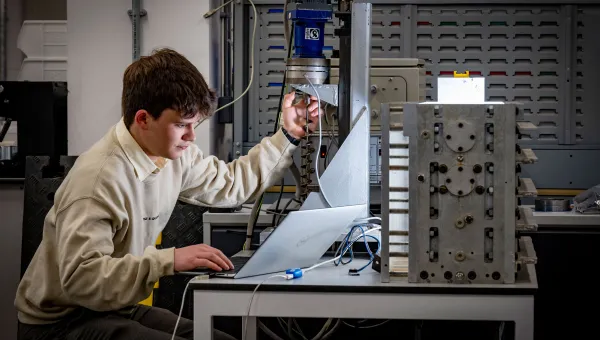
“Boldrewood campus has amazing facilities tailored to enhancing our learning experience.”
Course locations
This course is based at Highfield and Boldrewood.
Awarding body
This qualification is awarded by the University of Southampton.
Download the Course Description Document
The Course Description Document details your course overview, your course structure and how your course is taught and assessed.

Entry requirements
For Academic year
Scottish Qualification
Offers will be based on exams being taken at the end of S6. Subjects taken and qualifications achieved in S5 will be reviewed. Careful consideration will be given to an individual’s academic achievement, taking in to account the context and circumstances of their pre-university education.
Please see the University of Southampton’s Curriculum for Excellence Scotland Statement (PDF) for further information. Applicants are advised to contact their Faculty Admissions Office for more information.
Other requirements
You might meet our criteria in other ways if you do not have the qualifications we need. Find out more about:
- skills you might have gained through work or other life experiences (otherwise known as recognition of prior learning)
Find out more about our Admissions Policy.
Foundation year for engineering, physics, maths and geophysics
A foundation year will give you the skills and knowledge to progress to this course if you don't have the right qualifications for direct entry.
It could be the right option if you:
- have A levels, or equivalent international qualifications, in subjects other than the ones needed for direct entry
- have international qualifications in relevant subjects but not at A level equivalent
- have a BTEC Extended Diploma in a relevant subject
- are studying an Access course in a relevant subject
- are a mature student with relevant experience or study
You'll also need to show that you have strong maths skills.
Find full details on our Engineering, Maths, Physics, Geophysics Foundation Year page.
Foundation programmes for international students
A foundation programme will give you the language skills and subject knowledge you need if you're not qualified for direct entry to your chosen undergraduate course.
You'll progress to your chosen course after successfully completing the foundation programme.
Find out more about undergraduate foundation programmes for international students.
Got a question?
Please contact our enquiries team if you're not sure that you have the right experience or qualifications to get onto this course.
Email: enquiries@southampton.ac.uk
Tel: +44(0)23 8059 5000
Course structure
The first 2 years of the course are common to all our civil engineering courses. They consist of compulsory modules that will give you a solid grounding in civil engineering design and application.
Further modules in year 3 will cover urban design and architecture, and develop your knowledge of structures and geotechnics.
Module options in the fourth year allow you to tailor your degree according to your interests. You'll also study project economics and management, learning about how projects work in financial, economic, social and environmental terms.
You don't need to select your modules when you apply. Your academic tutor will help you to customise your course.
Year 1 overview
The first year provides a solid grounding in engineering science and design, with a focus on civil and environmental engineering.
Core modules cover:
- maths
- mechanics
- structures
- materials
- thermofluids
- design and computing
Through workshops and a design and manufacture project, we'll introduce key design skills, such as sketching, model-making and computing. These will also help you develop skills like:
- observation
- critical thinking
- team work
- communication
At the end of the year you'll take part in the Constructionarium, a week-long activity in Norfolk.
Year 2 overview
You'll further develop your core design and engineering skills.
You’ll study the Liveable Cities module, exploring the liveability in a city, with specific sessions including urban design, waste management, transport, energy, as well as site visits.
A group design project will build on your design skills from year 1 and learning from Liveable Cities. You’ll design a significant physical engineering change to a city, for instance a bridge or flooding scheme, and develop the deployment plan.
You'll also study topics that include:
- maths and statistics
- structural analysis and design
- materials
- soil mechanics
- hydraulics
A group design project will help you build on the design skills introduced in year 1.
Year 3 overview
You’ll be introduced to urban design, and you'll gain a deeper understanding of structures and geotechnics.
An architectural design module builds on abilities gained in your first 2 years. You'll discover and experiment with individual design methodologies and processes in a real-world setting. This module enables you to work in a similar environment to a professional design office - something that will help you develop the working and communication practices that exist within industry.
An individual research project will let you explore your own interests. In the past, students have considered why concrete floor slabs fail, or investigated the erosion and retreat of coastal cliffs. Some student projects are run in collaboration with top institutions, or can lead to publications in international peer-reviewed journals.
Year 4 overview
In your final year you will:
- study design, project management and teamwork, vital transferable skills for a successful graduate career
- take part in an architectural group design project where you’ll apply your knowledge to the design of a complex building or structure in an urban context
- undertake an architectural engineering project, where you’ll consider the social, economic, cultural, technical and environmental aspects of design
- study project economics and management, learning about how projects work in financial, economic, social and environmental terms
- choose from a wide range of specialist optional modules
Want more detail? See all the modules in the course.
Modules
The modules outlined provide examples of what you can expect to learn on this degree course based on recent academic teaching. As a research-led University, we undertake a continuous review of our course to ensure quality enhancement and to manage our resources. The precise modules available to you in future years may vary depending on staff availability and research interests, new topics of study, timetabling and student demand. Find out why, when and how we might make changes.
For entry in academic year 2027 to 2028
Year 1 modules
You must study the following modules in year 1:
An Introduction to Civil Engineering Design and Digital Skills
Civil Engineering Fundamentals
Mathematics for Engineering and the Environment
Mechanics, Structures and Materials
ThermoFluids
Year 2 modules
You must study the following modules in year 2:
City Infrastructure Design Project
Hydraulics
Liveable Cities
Mathematics for Engineering and the Environment Part II
Numerical Methods
Soil Mechanics
Structural Analysis
Structural Design
Year 3 modules
You must study the following modules in year 3:
Architectural and Engineering Design
Climate Change, Energy and Settlements
Geotechnical Engineering
Individual Project
Structural Stability and Finite Element Analysis
Urban Design
Year 4 modules
You must study the following modules in year 4:
Architectural Engineering Project
Architectural Group Design Project
Project Economics and Management
You must also choose from the following modules in year 4:
Advanced Finite Element Analysis
Advanced Geotechnical Engineering
Advanced Structural Engineering
Composites Engineering Design and Mechanics
Earthquake Engineering and Seismic Design of Steel Buildings
Energy Performance Assessment of Buildings
Energy Resources and Engineering
Transport Management and Safety
Transport, Energy and the Environment
Waste Resource Management
Learning and assessment
The learning activities for this course include the following:
- lectures
- classes and tutorials
- coursework
- individual and group projects
- independent learning (studying on your own)
Course time
How you'll spend your course time:
Year 1
Study time
Your scheduled learning, teaching and independent study for year 1:
How we'll assess you
- coursework, laboratory reports and essays
- design and problem-solving exercises
- individual and group projects
- oral presentations
- written exams
Your assessment breakdown
Year 1:
Year 2
Study time
Your scheduled learning, teaching and independent study for year 2:
How we'll assess you
- coursework, laboratory reports and essays
- design and problem-solving exercises
- individual and group projects
- oral presentations
- written exams
Your assessment breakdown
Year 2:
Year 3
Study time
Your scheduled learning, teaching and independent study for year 3:
How we'll assess you
- coursework, laboratory reports and essays
- design and problem-solving exercises
- individual and group projects
- oral presentations
- written exams
Your assessment breakdown
Year 3:
Year 4
Study time
Your scheduled learning, teaching and independent study for year 4:
How we'll assess you
- coursework, laboratory reports and essays
- design and problem-solving exercises
- individual and group projects
- oral presentations
- written exams
Your assessment breakdown
Year 4:
Academic support
You’ll be supported by a personal academic tutor and have access to a senior tutor.
Course leader
Stephanie Gauthier is the course leader.
Careers and employability
The employability and enterprise skills you'll gain from this course are reflected in the Southampton skills model. When you join us you'll be able to use our skills model to track, plan, and benefit your career development and progress.
Download skills overview
Work experience opportunities
Choosing to do work experience is a great way to enhance your employability, build valuable networks, and evidence your potential. Learn about the different work and industry experience options at Southampton.
Careers services and support
We are a top 20 UK university for employability (QS Graduate Employability Rankings 2022). Our Careers, Employability and Student Enterprise team will support you. This support includes:
- work experience schemes
- CV and interview skills and workshops
- networking events
- careers fairs attended by top employers
- a wealth of volunteering opportunities
- study abroad and summer school opportunities
We have a vibrant entrepreneurship culture and our dedicated start-up supporter, Futureworlds, is open to every student.
Your career ideas and graduate job opportunities may change while you're at university. So it is important to take time to regularly reflect on your goals, speak to people in industry and seek advice and up-to-date information from Careers, Employability and Student Enterprise professionals at the University.
Fees, costs and funding
Tuition fees
Fees for a year's study:
- UK students pay £10,050.
- EU and international students pay £33,500.
What your fees pay for
Your tuition fees pay for the full cost of tuition and standard exams.
Find out how to:
Accommodation and living costs, such as travel and food, are not included in your tuition fees. There may also be extra costs for retake and professional exams.
Explore:
Bursaries, scholarships and other funding
If you're a UK or EU student and your household income is under £36,200 a year, you may be able to get a University of Southampton bursary to help with your living costs. Find out about bursaries and other funding we offer at Southampton.
If you're a care leaver or estranged from your parents, you may be able to get a specific bursary.
Get in touch for advice about student money matters.
Scholarships and grants
You may be able to get a scholarship or grant to help fund your studies.
We award scholarships and grants for travel, academic excellence, or to students from under-represented backgrounds.
Support during your course
The Student Hub offers support and advice on money to students. You may be able to access our Student Support fund and other sources of financial support during your course.
Funding for EU and international students
Find out about funding you could get as an international student.
How to apply
What happens after you apply?
We will assess your application on the strength of your:
- predicted grades
- academic achievements
- personal statement
- academic reference
We'll aim to process your application within 2 to 6 weeks, but this will depend on when it is submitted. Applications submitted in January, particularly near to the UCAS equal consideration deadline, might take substantially longer to be processed due to the high volume received at that time.
Equality and diversity
We treat and select everyone in line with our Inclusion and Respectful Behaviour Policy.
Got a question?
Please contact our enquiries team if you're not sure that you have the right experience or qualifications to get onto this course.
Email: enquiries@southampton.ac.uk
Tel: +44(0)23 8059 5000
Related courses
Civil Engineering with Architectural Design (MEng) is a course in the Civil engineering subject area. Here are some other courses within this subject area: