Run a real-life analysis of an unknown chemical using an infrared spectrometer. Load a sample, collect its spectrum in less than a minute and decode the pattern to identify the functional groups in your mystery sample.
Have a go
The Spectroscopy in a Suitcase activity has been redesigned from an A level outreach workshop into an interactive practical experience. You have the chance to run a real-life analysis of unknown chemicals using an infrared spectrometer.
Load a sample onto the instrument, lock it into place and turn on the infrared beam. Watch the results appear in less than a minute and see if you can decode which functional groups are present in your mystery sample.
Learn how wavelengths in the infrared region of the electromagnetic spectrum can be used to make bonds within chemical compounds vibrate. This helps scientists discover what structures they have made in the laboratory.
Questions to explore
- Do you notice anything unusual about the graph you have created?
- Are the peaks in your graph sharp or broad, and does this change your results?
- What happens to the infrared pattern if there are many similar carbon–carbon bonds in benzene rings in your sample?
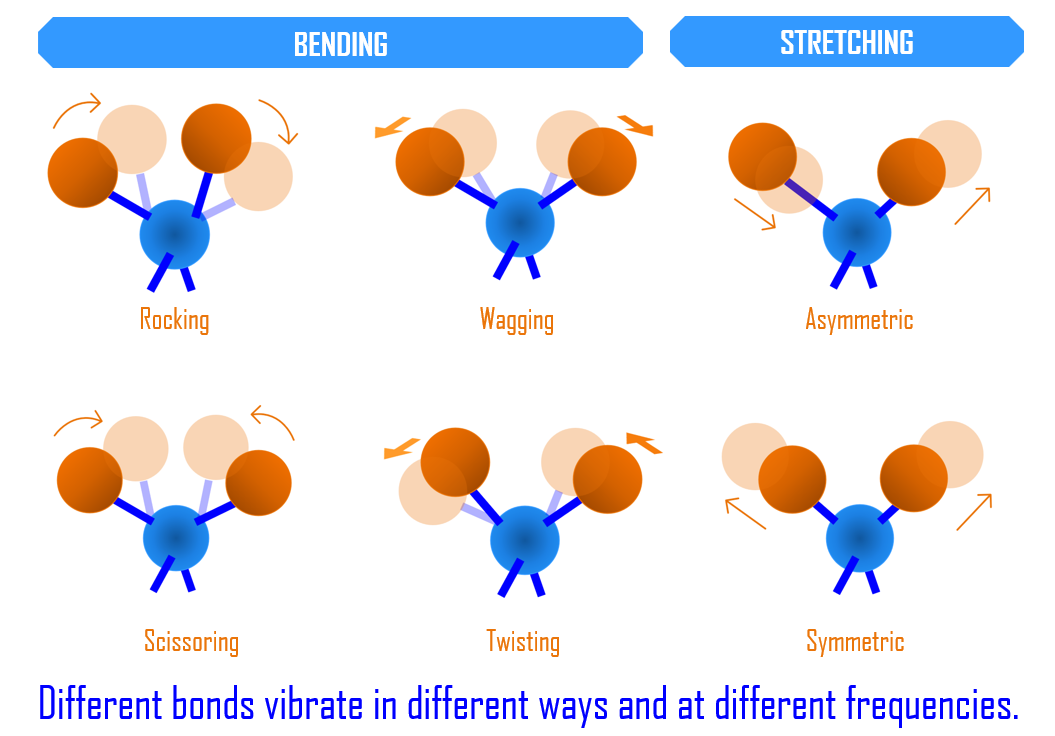
- Can you explain different types of molecular vibration using your arms as bonds and your hands as elements?
- What would happen if your arms, representing bonds, were longer?
- What would happen if your hands, representing elements, were heavier?
What’s going on
An infrared spectrometer uses the infrared (IR) region of the electromagnetic spectrum. Infrared was originally described as “radiant heat”. In 1800, William Herschel noticed an unexpected rise in temperature beyond the red part of visible light while measuring different colours. This marked the first observation of infrared radiation.
Infrared waves have frequencies between approximately 300 billion and 430 trillion hertz. Their wavelengths range from sizes comparable with a needle point to those comparable with a human hair.
Bonds vibrate in many different ways when a molecule is above absolute zero. When an infrared frequency matches the natural vibrational frequency of a bond, energy is absorbed and the amplitude of the vibration increases. This is called resonance.
Different types of bonds have different vibrations. These vibrations are affected by:
- type of vibration: bending vibrations are lower energy and have lower wavenumbers than stretching vibrations
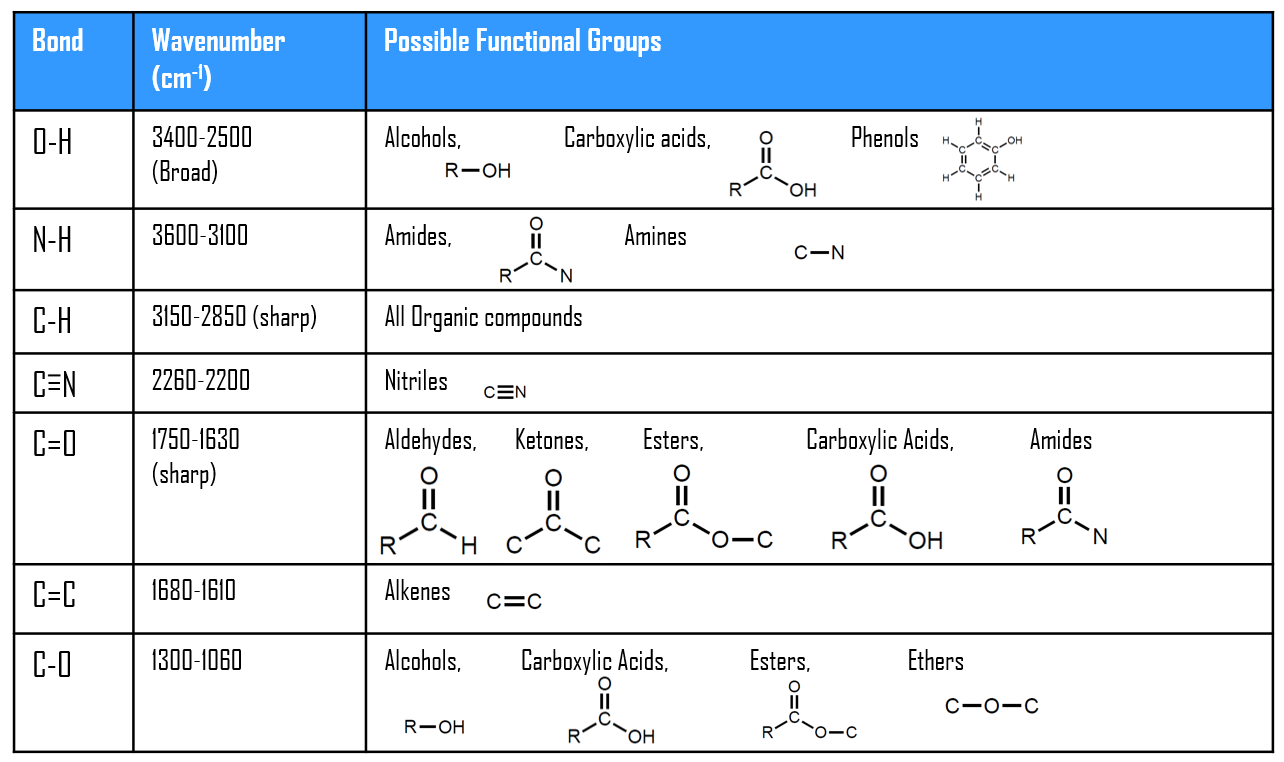
- strength of the bond: triple bonds are stronger than single bonds and absorb at higher wavenumbers
- mass of the atoms: heavier atoms vibrate more slowly and at lower frequencies than lighter atoms
The infrared spectrometer exposes a sample to a range of infrared frequencies and detects which radiation the sample absorbs. This reveals the kinds of bonds present. The result is commonly measured using wavenumber in cm⁻¹. Wavenumber is the inverse of wavelength and is therefore proportional to the energy and frequency of the vibrating bond.