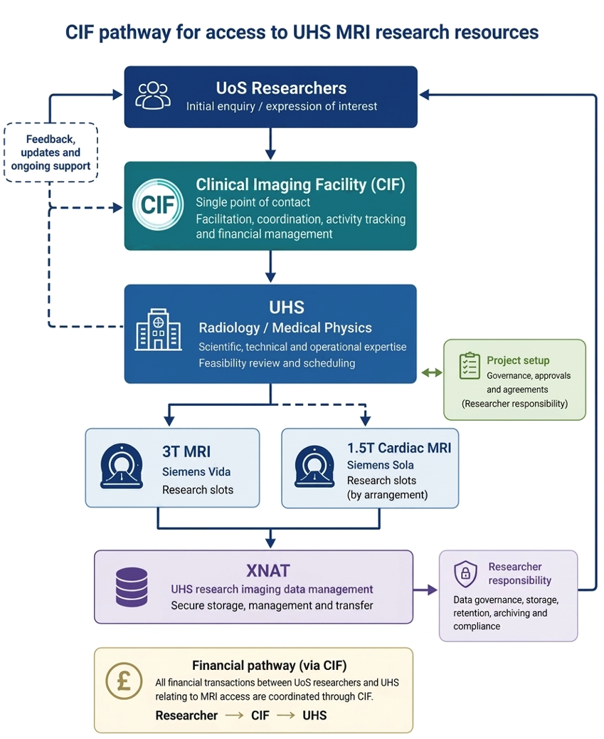
The Siemens 3 Tesla (3T) Vida MRI scanner (installed in 2024) offers advanced imaging across a broad range applications. The UHS MRI radiology team supports a wide range of structural, functional, and quantitative MRI techniques. You'll be able to make detailed investigations of anatomy, physiology, and pathology in both healthy volunteers and patient cohorts.
University research sessions currently run:
Tuesday 8am – 1pm
Thursday 3pm- 8pm
Saturday 8am – 1pm (if required)
if you're a UoS researcher wanting access to this MRI facility, please submit an initial expression of interest form:
Download the intial expression of interest form (ODT 68.94KB)
Once studies are approved UHS colleagues will provide access to the Calpendo booking system.
Key features and benefits
UHS 3T MRI research service
- effective multi-modality acquisitions, with several datasets in one scan
- advanced MRI techniques/sequences (see technical specification)
- experience in advanced neuro, musculoskeletal, oncology, psychology and other mechanistic and disease focused MR imaging
- access to a dedicated UHS cardiac MRI scanner (Siemens 1.5T Sola) may be feasible with prior arrangement
- healthy volunteers and patient cohorts
- dedicated UHS research imaging data management infrastructure (XNAT)
- wider links to other research groups and analysis expertise
Technical specification
- 3T MRI currently running software version XA60
- 70 cm bore
- 45 mT/m imaging gradients (XQ) with 200 T/m/s max slew rate
- all imaging coils available including 32 and 64 channel head coils and a neonatal head coil
- wide range of techniques/sequences including
- high resolution (~1mm isotropic) volumetric data, functional MRI, diffusion MRI (including multi-shell DTI), perfusion quantification, angiography, MR spectroscopy, iron and fat quantification, T1 and T2/T2* mapping, dynamic/real-time imaging
- multi-nuclear spectroscopy capability (additional hardware required)
- functional MRI AV system (Nordic Neuro Lab)
- MR compatible 40” LCD monitor, with In room viewing device
- MR image and stimulus synchronization device: SyncBox
- stimulus presentation and workflow software: nordicAktiva
- patient response collection device: Response grips
- stimulus presentation PC