Project overview
Acoustic detection of the Invasive Asian Hornet (Vespa velutina)
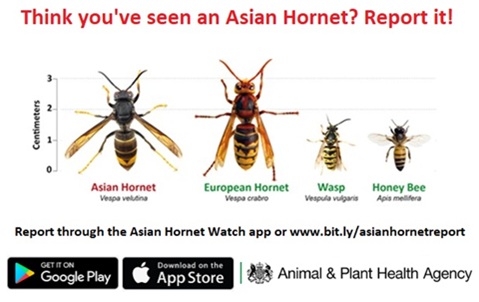
The Asian, or yellow-legged, hornet (Vespa velutina) is an invasive species in the United Kingdom (UK) and across Europe. It is a highly efficient predator, preying on a wide range of insects, including European honeybees and other key pollinators. Accidentally introduced to Europe in 2004, the species was first detected in the UK in 2016. In the absence of effective native predators, V. velutina continues to spread rapidly, posing a significant threat to native biodiversity, agriculture, and public safety.
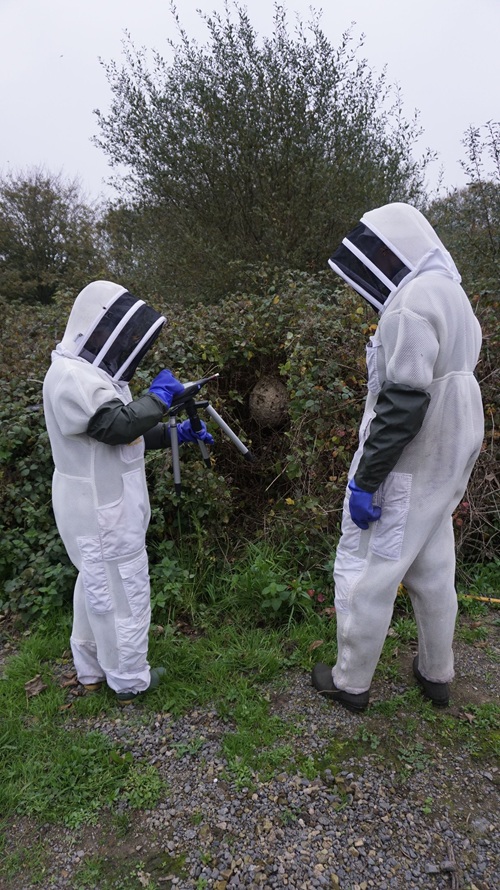
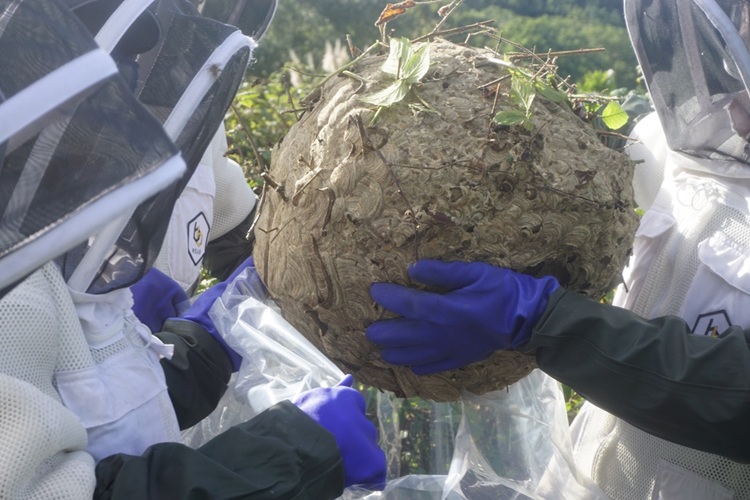
Locating and destroying secondary nests is a crucial step in preventing the spread and establishment of this species. A single overwintered queen can establish a secondary nest capable of producing hundreds of future queens, enabling rapid, exponential population growth. However, identifying these nests is challenging due to their variable placement and effective camouflage in trees, dense vegetation, or commonly within bird boxes and house eaves. Even when hornet activity has been identified, locating a nest can take 2–3 days, which is valuable time during which predation pressure on local pollinators and beehives continues.
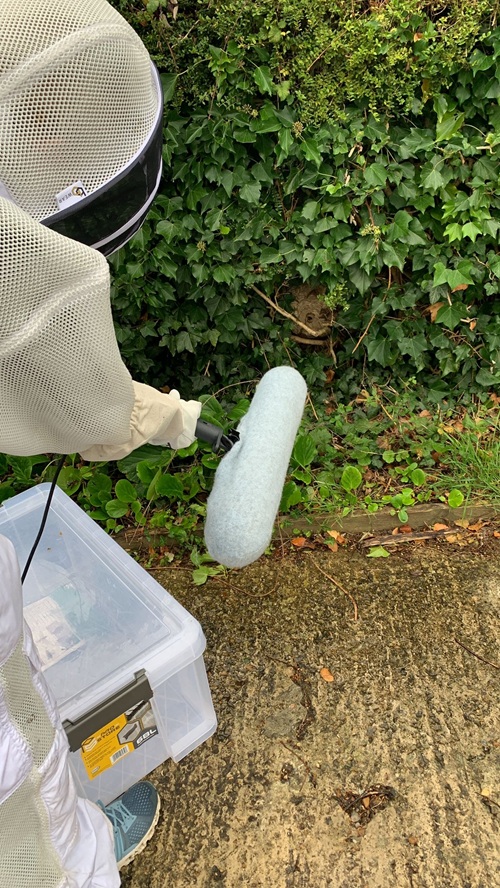
This PhD research investigates whether V. velutina exhibits a distinctive acoustic “signature” derived from wingbeat frequencies that can be differentiated from those of similar native Hymenoptera species. Comparator species include the European hornet (Vespa crabro) and the European honeybee (Apis mellifera). Acoustic measurements are being collected through extensive completed and ongoing fieldwork to analyse sound pressure levels (SPL), frequency spectra, and temporal acoustic profiles of individual insects and active nests.
This research determines whether V. velutina produces a consistent and identifiable acoustic signature that can be reliably distinguished from native species. In addition, the study evaluates the maximum effective detection range for both individuals and nests under real-world conditions. Together, these findings contribute to the development of acoustic-based technologies capable of improving the speed, accuracy, and reliability of secondary nest detection.
Ultimately, this work seeks to enable earlier and safer nest location and destruction, reducing the likelihood of V. velutina becoming permanently established in the UK. By advancing non-invasive acoustic monitoring techniques, the project has the potential to significantly enhance current biosecurity and pollinator protection strategies.
 |  |  |
Media coverage and collaborations
This research has been featured in national and international media, including collaborations with academic teams from the Universities of Ghent, Exeter, and Nottingham Trent University.
Selected media coverage includes:
- BBC News & Radio 4
'Unique sound' of Asian hornets' nests discovered
An uncomfortable transition? The buzz about Asian hornets. Cosmic ray neutrons and soil moisture
- BBC South
- The Guardian
Asian hornet’s unique buzz may hold secret to containing invasive species
- The Telegraph
New hope for honeybees following breakthrough in tracking predators
- The Independent
Experts issue warning over Asian hornets as sightings rise
- University of Southampton
Asian hornets have a unique sound – and that could be the key to controlling their spread
Additional features include EurActiv, Natural World Fund, The Cool Down, CBS As It Happens, and the Sunday Express.
Project team and funding
The project is led by Professor Paul White and Professor Tom Cherrett, with Sophie Gray as the PhD researcher.
Adrian Dwyer serves as the external supervisor, with a background in software and commercialising early-stage technologies ranging from medical imaging to autonomous vehicles. A keen beekeeper and a member of the Bournemouth and Dorset Beekeeping Association (BDBKA), Adrian has been closely involved throughout the project and has played a key role in facilitating early field research and fundraising.
This project is part-funded by the CB Dennis Trust, with additional funding and support from Bournemouth and Dorset South Beekeepers’ Association (BADS).
Fieldwork has been facilitated by:
- Alastair Christie and the Environmental Department of the Government of Jersey,
- John De Carteret and the volunteers of the Jersey Asian Hornet Group (JAHG), and
- Peter Davies and the National Bee Unit (NBU).
If you spot an Asian hornet, you should report it to the UK Centre for Ecology and Hydrology .
Information on how to identify Asian hornets is on The British Beekeepers’ Association’s website.