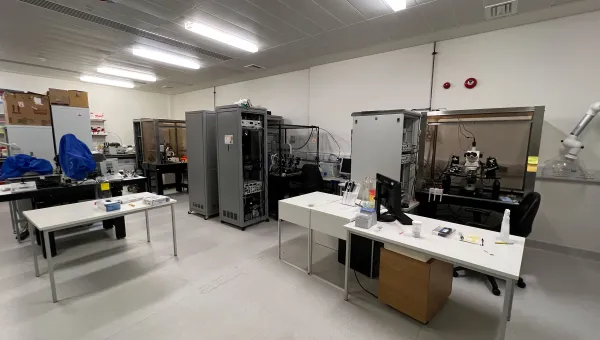
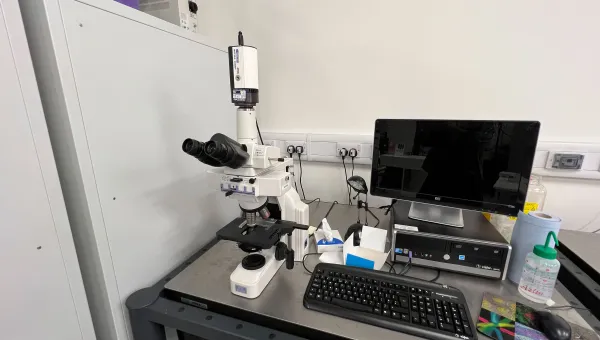
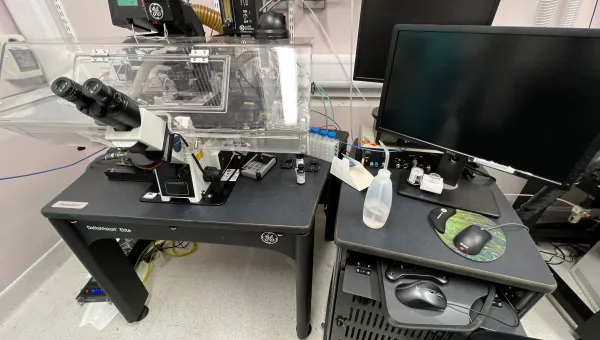
Our confocal microscopes provide high magnification and high resolution imaging.
The principle difference between confocal microscopy and conventional widefield fluorescence microscopy is that images are comprised of stacks of sections of a discrete thickness. These can be used for 3D microscopy.
Sections of a known thickness are also superior for making quantitative measurements such as protein expression. Confocal microscopes are also slightly higher resolution than conventional widefield microscopes, and provide a sharper, higher SNR image.
white light laser providing a continuous choice of excitation wavelengths into NIR (485-790 nm)
405 nm CW laser
448 nm CW laser
5 x “Power HyD” GaAsp detectors, allowing up to 5 channel simultaneous imaging when used with additional NIR capability
“super-resolution” confocal to 120 nm resolution.
Objectives:
10x, 0.4, N.A.
20x, 0.75, N.A.
40x, 1.25, N.A., Glycerol with motorised correction collar
63x, 1.4, N.A., Oil
“TauSense” uses fluorescence lifetime detection for additional fluorophore separation, or distinct gating of overlapping signals into separate channels dependent on their lifetime, for example autofluorescence.
Changes in a fluorophores nano-environment can also be measured using fluorescence lifetime e.g. FRET of interacting molecules, pH etc.
Features
transmitted light
DIC
hardware autofocus
simultaneous fluorescence acquisition
sequential fluorescence acquisition
mark and find
motorised stage with Tile Scan (stitch multiple FOV together)
time-lapse
photo-kinetics
FLIM
NIR Imaging
lambda-scan/spectral channel un-mixing
2 x Leica SP8 AOBS Laser Scanning Confocal Microscopes
Modality and resolution
CLSM - 200 nm
DIC - 250 nm
Objectives
Magnification, numerical aperture and immersion
10x, 0.5, air
20x, 0.7, air
40x, 1.3, oil
63x, 1.3, glycerol
Specimen format
standard glass slide
35 mm coverslip bottom dish
coverslip bottom chamber-slide
optical bottom multi-well plate
Detectors
confocal 1: 2 x PMT (photomultiplier tube), 1 x “HyD” GaAsP detector
confocal 2: 1 x PMT, 2 x “HyD” GaAsP detector
Lasers/filters
Excitation laser λ
405 nm (nano meters)
458 nm
476 nm
488 nm
496 nm
514 nm
561 nm
594 nm
633 nm
Emission filters
3 x Spectral Detectors. Any λ/Bandwidth from 400-800 nm.
Fluorescence acquisition
simultaneous fluorescence acquisition of up to 3 channels
sequential fluorescence acquisition is unlimited
Other features
transmitted light
differential interference contrast (DIC)
time lapse
photo-kinetics
3D imaging
3D specimen penetration is less than 100 μm.
The microscope does not have hardware autofocus. It has environmental temperature and gas control and a motorised stage with tile scan (stitch multiple FOV together).
It also offers mark and find and lambda-scan and spectral channel un-mixing.