

About
The string theory and holography group has a wide range of research interests spanning theoretical physics, ranging from the fundamental structure of string theory and quantum field theory through to black holes, quantum information and cosmology.
The holographic principle relates gravitational theories to quantum theories without gravity in one less dimension and the development of holography is a key part of the group’s research portfolio. Holography is key to the conceptual understanding of fundamental physics and is an important tool in addressing longstanding questions around the quantum physics of black holes and early universe cosmology. Development of string theory and holography frequently requires the development of novel mathematics, particularly in areas related to geometry.
Learn about the group's events by visiting our seminar page.
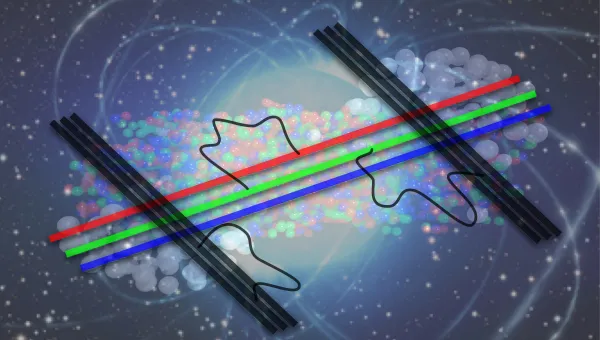
Shining a light on neutron stars with string theory
Southampton research is pushing forward the frontiers of our understanding of the fundamental laws of nature by revealing insights into the interiors of neutron stars.
People, projects, publications and PhDs
People

I have wide research interests across many areas of theoretical physics, from quantum field theory to string theory, and from black holes to the holographic nature of our Universe and the origin of space and time.
Related research institutes, centres and groups
-

Applied Mathematics and Theoretical Physics
We focus on mathematical modelling and mathematical physics, and investigate everything from neutron stars to superfluids. -
Gravity
Research conducted by the Southampton Gravity group focuses on gravitational waves, general relativistic spacetimes around black holes, and the properties of ultra-dense matter in neutron stars, such as superfluidity and superconductivity of nuclear and quark matter. -
Mathematical Modelling
The modelling group focuses on mathematical modelling across science and engineering, including physics (from the physics of quanta and strings to that of liquid crystals), chemistry (modelling lithium-ion batteries and solar cells), engineering (controlling sound direction), biology, medicine and healthcare (from stem cell population dynamics to medical imaging and healthcare models).