

Lauren Deeth-Kelt (BEng Engineering, 2026) switched from art history to electrical engineering – a decision that has transformed her career.
After graduating in 2016 with a degree in art history, Lauren spent several years working in temporary roles while searching for something more meaningful and sustainable.
“The turning point for me came in 2020, when I started weighing up careers in other fields,” says Lauren. “Engineering stood out; I had a maths A level, and enjoyed analysing and building things, so it felt like good challenge.”
Find your place; find your people
“It felt intimidating starting again as a mature student, aged 29,” reflects Lauren. “At first, I wasn’t interested in being part of the community because I didn’t think I’d relate much to the other students. My plan was to retrain, get through it as quickly as possible, and start earning again.”
Luckily that mindset didn’t last long, and Lauren soon found her people.
“I think what I’ve enjoyed most of all about my time at Southampton has been my community,” says Lauren. “I found a really close group of friends and quickly started to feel that I belonged.”
At first, getting up to scratch with technical skills after time out of study was challenging.
“My maths skills were a bit rusty, and I wasn’t used to studying for long hours,” says Lauren. “I also had self-doubts about being in such a technical field.”
But this was counterbalanced by the skills Lauren had gained during her years of working; she was organised and good at communicating with the lecturers and other students. As Lauren leaned on those transferable skills, she caught up technically and started to enjoy the course.
“I loved the labs. We had multiple labs a week in first year on a huge variety of topics. Preparing for these could be tough, but I loved the challenge, and it was incredibly satisfying to gain hands-on experience,” Lauren says.
Say yes to everything
"One of my best decisions was saying yes to the many opportunities and applying for as many funding opportunities as I could,” says Lauren.
"In my first year, I won the Ada Lovelace scholarship and an Institution of Engineering and Technology future talent award. I also took part in the ENGAGE scholarship programme during the summer of my first year, working with a research group focused on smart electronic materials and systems.”
Lauren even went on to win a prize in the Student Enterprise Junction’s 100 Big Ideas competition for an engineering idea she pitched as a startup.
Initially, applying for these awards was purely practical, to help fund her studies, but in the end, they played an important role in building her confidence, Lauren recalls:
“I remember getting the email about the future talent award so clearly – I’d just done badly on a test and was convinced I was about to fail everything. Receiving an award like that was a validation that changing careers had been the right decision.
Lauren took part in outreach events, inspiring young girls to consider careers in engineering by doing talks in primary schools, opportunities that added to her skillset while making a difference.
Sparking an interest
The following summer, Lauren had the chance to do a project on high-voltage engineering, which really sparked her interest.
“I trained on specialist equipment in the Tony Davies High Voltage Lab, learned both practical and theoretical skills, and then knew I really wanted to be part of that environment,” Lauren reflects.
This led to an opportunity to pursue a project in the High Voltage Lab in collaboration with Network Rail that combined commercial testing and research.
“Getting access to a facility like the Tony Davies High Voltage Lab was a huge draw – there are only a few like it in the country,” says Lauren.
Lauren’s project focused on testing equipment designed to keep electric trains safe. Overhead lines that power trains typically carry 25,000 volts, but when faults or lightning strikes occur, that voltage can surge dramatically, sometimes up to 200,000 volts.
By recreating these extreme conditions in a controlled lab environment, Lauren and her research colleagues were able to test whether electrical arcs could jump between infrastructure and trains – a potentially dangerous scenario.
The results helped work out safe distances between the train and the electrical equipment and inform decisions about whether parts of the rail network can be electrified without costly structural changes.
Award-winning research
Lauren’s project is part of a wider programme of work, led by the University of Southampton, that has saved the UK government millions of pounds by avoiding unnecessary infrastructure changes across the rail network.
In collaboration with other departments, this body of work contributed to the University receiving a Queen Elizabeth Prize for Education – the highest national institutional honour. Lauren was part of the delegation that went to St James’s Palace to receive the award in February 2026.
“I have been very lucky that my work happened to line up with the huge collaborative effort that led to this award. It was a pretty surreal experience going to the Palace, as well as a huge honour,” says Lauren “It did make me laugh getting the train to London, given what the prize was being awarded for. Thank goodness my train was on time or that would have been embarrassing!”
Following the success of her project, Lauren has secured a full-time role as a Research Engineer in the High Voltage Laboratory, where she continues to work on both commercial and research initiatives.
Doctoral dreams
Unexpectedly, soon after starting her role, a new opportunity emerged: the chance to undertake a PhD at Southampton alongside her role.
“Even when I was studying arts, I always wanted to do research,” Lauren reflects. “I once applied for a PhD looking at climate change in art. When I first thought about retraining, a PhD didn’t feel like a possibility anymore – so being offered one was incredible.”
Set to begin in summer 2026, Lauren’s research will explore more efficient cooling methods to extend the lifespan and increase the capacity of high-voltage cables, with the aim of reducing costs and improving sustainability.
“I couldn’t have predicted everything that led me here, but I’ve always wanted to make a meaningful contribution, and now I finally feel like I am: instead of my original aim of working on climate change in art, I’m working on solutions to climate change in engineering.”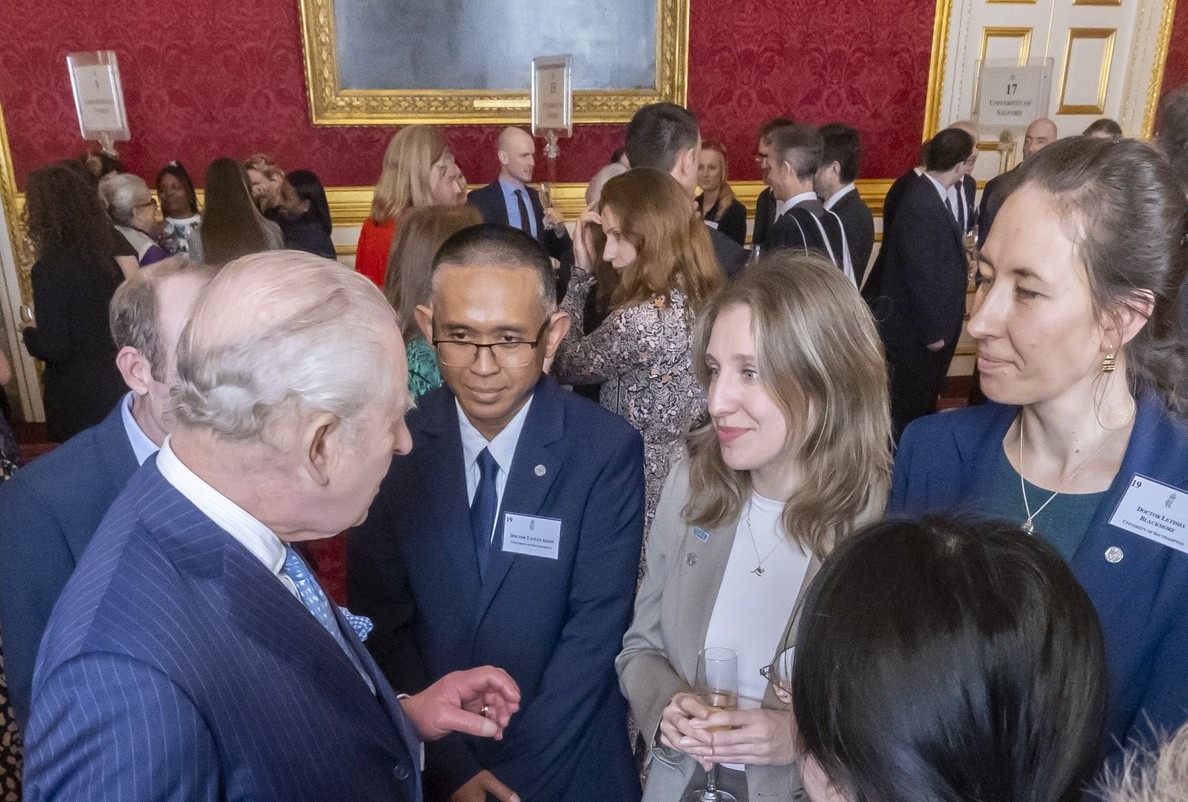
Lauren meeting King Charles at St James's Palace, as part of the delegation from the University to receive the Queen Elizabeth Prize for Education