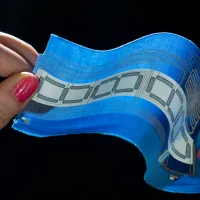
Clothes that can monitor our health and fitness, improve patient outcomes, and enhance our entertainment experiences are already being developed at Southampton, a pioneer in e-textile innovation. Our researchers’ participation in a flagship £10m project is set to take e-textile development to the next level.
Led by Steve Beeby, Professor of Electronic Systems and Devices, our experts in electronics, sustainability and textiles are working alongside colleagues at the University of Glasgow on a five-year project to address three challenges: making the electronics in textiles wireless and imperceptible, ensuring they withstand everyday wear and tear and washing, and making them sustainable.
This is the first time researchers in electronics, sustainability, and textiles have joined forces from the beginnings of the design process, so everything we develop will take all needs into account from the early stages. That includes effective electronics, practical textiles, and all-round sustainability.
Professor Stephen Beeby
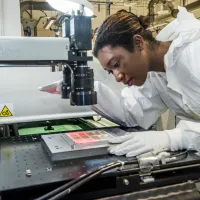
Steve’s team has already developed a bespoke machine that can coat standard textile yarn with smart functional electronic materials. They are looking to commercialise the machine, which has already generated a huge amount of interest.
While Steve and his team are leading on textile manufacture and sustainability, academics at the University of Glasgow are leading on the wireless technology development.
Dr Mahmoud Wagih, Reader in Electronic and Nanoscale Engineering at the University of Glasgow, explained: “We will look at how to integrate electronics within fabrics wirelessly and invisibly, so they are imperceptible to the user. At the same time, we need to develop a means of separating the two for a sustainable end-of-life.”
A more sustainable world
Sustainability is at the heart of the project. “Everything we develop will be underpinned by sustainability,” said Ian Williams, Professor of Applied Environmental Science at Southampton.
“Textiles is the second most polluting industry in the world, after the petrochemical industry, and discarded electronics are also an environmental challenge. We are combining these two different industries, and we will do this in a sustainable manner by using eco-friendly and natural materials, and reusable and recyclable electronics.”
Stream of innovation
Steve is recognised as a pioneer in the field of electronic materials, having been awarded a prestigious Chair in Emerging Technologies by the Royal Academy of Engineering. The award provides funding to support disruptive innovations with the potential to considerably benefit society and the UK economy. “It fully acknowledges and reaffirms Southampton’s place as the UK-leader in the e-textiles domain,” Steve commented.
His research team has created prototypes demonstrating the promise of the technology, including smart bandages that treat chronic and infected wounds, and smart insoles for diabetics. The electronic insoles are designed for people with diabetes who are at risk of pressure sores and ulcers on their feet due to nerve damage and poor circulation. While providing cushioning and pressure relief, the prototype wireless smart insoles monitor wear and tear and pressure points electronically.
Current projects include a textiles-based skin sensor that monitors skin hydration. It can be used to give a quantified measure of skin health, in particular for eczema.
Patients who can currently only be evaluated at clinic every 16 weeks will be able to take the sensor home and regularly report results back remotely, improving patient outcomes and helping pharmaceutical companies with improved data.
Professor Stephen Beeby
Steve is also working on improving motion sensors, commonly used to develop animation films, in virtual reality games, and in sports science to improve athletes’ technique. His textile technology will allow the sensors to be ‘invisibly’ incorporated into garments, without the need to strap on cumbersome boxes, cables and batteries. The technology will also have medical application, for measuring joint angles during rehabilitation.