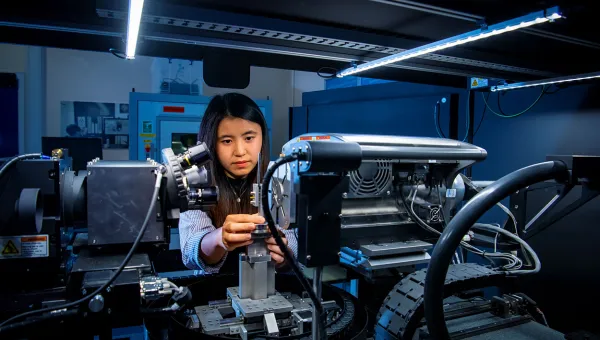
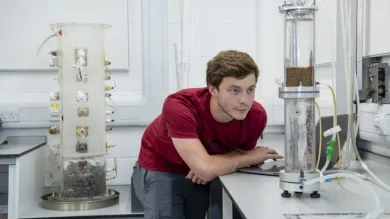
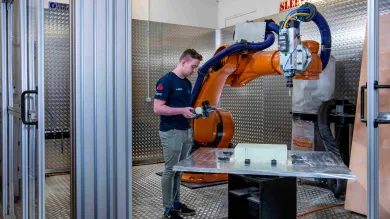
MSc Propulsion and Engine Systems Engineering explores the performance and reliability of rocket motors, jet engines and compressors.
Our master’s courses combine the traditional aspects of mechanical engineering with interdisciplinary subjects so you can specialise in a career you want. Our international centre for research and teaching is recognised across the world.
Our propulsion engineering degree explores the design, monitoring and analysis of propulsion and engine systems.
You’ll learn to analyse and design advanced electrical systems, and study subjects like gas turbines, internal combustion and, electrical and hybrid engines. You’ll have the opportunity to study optional modules in areas you want to learn more about, including:
condition monitoring
engine tribology
noise control
environmental aspects
batteries
fuel cells
spacecraft propulsion
As part of this UK master’s in propulsion engineering you’ll complete a research project, you can choose to base yours on a range of topics such as engine materials, combustion modelling and electrical motors.
You’ll learn from academics who are leading their fields and teaching the latest in technological advancements. Studying at Southampton gives you access to a global network of companies, shared facilities and specialist expertise to enhance your learning.
We regularly review our courses to ensure and improve quality. This course may be revised as a result of this. Any revision will be balanced against the requirement that the student should receive the educational service expected. Find out why, when, and how we might make changes.
Our courses are regulated in England by the Office for Students (OfS).
Course lead
This course is led by Dr Joseph Lifton, Lecturer in Mechatronics at the University of Southampton. Learn more by visiting Dr Lifton’s staff profile.
Related pathways
We offer 3 other pathways on this Advanced Mechanical Engineering degree. Your other options are in:
This master's programme is accredited by the Institution of Mechanical Engineers (IMechE) as meeting the academic requirement for Further Learning, for Chartered Engineer registration. Candidates must hold a BEng/BSc undergraduate first degree that is accredited for Chartered Engineer (CEng) registration to comply with full CEng registration requirements.
If English is not your first language, you must show that you can use English to the level we require. Visit our English language pages to find out which qualifications we accept and how you can meet our requirements.
If you are taking the International English Language Testing System (IELTS), you must get at least the following scores:
IELTS score requirements
overall score
6.5
reading
6.0
writing
6.0
speaking
6.0
listening
6.0
If you do not meet the English language requirements through a test or qualification, you may be able to meet them by completing one of our pre-sessional English programmes before you start your course.
Pre-masters
If you don’t meet direct entry requirements, you can apply to complete a Pre-Master's programme through our partnership with OnCampus.
If you don't have the exact entry requirements, but you have significant work experience in this sector we’ll assess your relevant professional experience, your subject knowledge and your aptitude for learning.
Your application will be considered on individual merit and you may be asked to attend an interview.
Got a question?
Please contact us if you're not sure you have the right experience or qualifications to get onto this course.
Our master’s degree in propulsion and engine systems engineering runs for 12 months. The first 8 months are mainly spent studying taught modules. Your lectures will be divided into two 12-week periods, referred to as semesters 1 and 2, both ending with exams.
Each semester you’ll study key topics and choose specialist modules that interest you. Our optional modules cover topics like spacecraft propulsion, materials, energy efficiency and acoustics.
Your final 4 months are spent on your research project, you’ll be able to choose from a range of topics to base yours on such as, combustion modelling, electrical motors and engine noise control.
The modules outlined provide examples of what you can expect to learn on this degree course based on recent academic teaching. As a research-led University, we undertake a continuous review of our course to ensure quality enhancement and to manage our resources. The precise modules available to you in future years may vary depending on staff availability and research interests, new topics of study, timetabling and student demand. Find out why, when and how we might make changes.
The learning activities for this course include the following:
lectures
classes and tutorials
practical work
individual and group planning exercises
knowledge share
one-to-one tutorials
Assessment
We’ll assess you through:
written exams
oral presentations
coursework in the form of:
problem solving exercises
lab reports
design exercises
essays
individual and group projects
research project
Dissertation
You’ll complete your research project and dissertation in the final 4 months of the course, with some preparation in semester 2.
It should bring together the skills you’ve learned and demonstrate your knowledge in at least one subject area.
You’ll need to source information, demonstrate critical analysis and evaluation, and presentation skills. The project must contain your own original ideas and explore a problem that requires the application of new research.
Academic Support
You’ll have your own personal academic tutor and also have access to our team of administrators who are a key point of contact for advice and information.
Careers and employability
Employability skills
This degree will allow you to develop and evidence subject-specific and targeted employability skills. This includes the required skill set for a range of future careers, further study, or starting your own business.
The skills you can expect to focus on and gain from this course include:
Research
Critical thinking
Self-management
Confidence
Communication
Creativity
Problem solving
Resilience
The employability and enterprise skills you'll gain from this course are reflected in the Southampton skills model. When you join us you'll be able to use our skills model to track, plan, and benefit your career development and progress.
Job prospects for MSc Advanced Mechanical Engineering Science graduates
£37k
Average professional salary
89%
In a skilled profession or further study
97%
Graduate employment rate
Source
*Example graduate job titles and job prospect statistics taken from The Graduate Outcomes Survey, which gathers information about the activities and perspectives of graduates 15 months after finishing their course.
Work experience opportunities
Choosing to do work experience is a great way to enhance your employability, build valuable networks, and evidence your potential. Learn about the different work and industry experience options at Southampton.
We are a top 20 UK university for employability (QS Graduate Employability Rankings 2022). Our Careers, Employability and Student Enterprise team will support you. This support includes:
work experience schemes
CV and interview skills and workshops
networking events
careers fairs attended by top employers
a wealth of volunteering opportunities
study abroad and summer school opportunities
We have a vibrant entrepreneurship culture and our dedicated start-up supporter, Futureworlds, is open to every student.
Your career ideas and graduate job opportunities may change while you're at university. So it is important to take time to regularly reflect on your goals, speak to people in industry and seek advice and up-to-date information from Careers, Employability and Student Enterprise professionals at the University.
Your tuition fee covers the full cost of tuition and any exams. The fee you pay will remain the same each year from when you start studying this course. This includes if you suspend and return.
Accommodation and living costs, such as travel and food, are not included in your tuition fees. There may also be extra costs for retake and professional exams.
Dean of Faculty of Engineering and Physical Sciences Global Talent Award
Up to 5 scholarships of £10,000 are available to international students starting an eligible full-time, on-campus postgraduate taught programme in the Faculty of Engineering and Physical Sciences.
Other nationalities need to apply by Wednesday 18 August 2027, midday UK time.
We advise applying early as applications may close before the expected deadline if places are filled.
Application assessment fee
There is no application assessment fee for postgraduate courses starting in 2027.
Academic Technology Approval Scheme (ATAS)
If you're an international student you'll need approval from the UK's Academic Approval Scheme before you can study this course.
The ATAS certificate is required for certain sensitive postgraduate subjects.
Supporting information
When you apply you’ll need to submit a personal statement explaining why you want to take the course.
You’ll need to include information about:
your knowledge of the subject area
why you want to study a postgraduate qualification in this course
how you intend to use your qualification
References are not required for this programme.
Please include the required paperwork showing your first degree and your IELTS English language test score (if you are a non-native English speaker) with your application. Without these, your application may be delayed.
What happens after you apply
You'll be able to track your application through our online Applicant Record System.
We receive a high volume of applications for this course. This means you may not receive a response to your application for up to 12 weeks.
Unfortunately, due to number of applications we receive, we may not be able to give you specific feedback on your application if you are unsuccessful.
Propulsion and Engine Systems Engineering (Advanced Mechanical Engineering Science) (MSc) is a course in the
Mechanical engineering
subject area.
Here are some other courses within
this subject area: