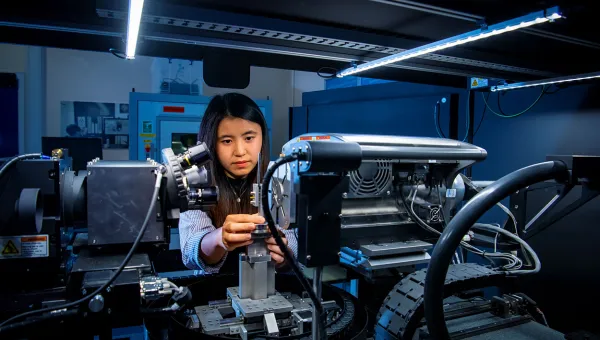
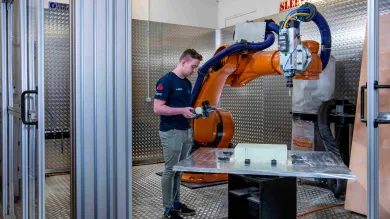
On our robotics and autonomous systems master's programme, you'll build a comprehensive foundation of knowledge in the key principles and practical applications of intelligent robotic systems.
You'll develop the specialist knowledge and technical skills required to design, build, and deploy robotics and autonomous systems across a wide range of sectors.
During your time on our MSc Robotics and Autonomous Systems course, you'll study core modules in:
robotics fundamentals
modelling and dynamics
sensing and data interpretation
planning and control
You'll also explore the societal, ethical, and regulatory dimensions of robotics, and gain hands-on experience with real robotic systems through structured laboratory work and group design challenges.
Through optional modules, you may then be able to tailor your learning to areas of interest such as:
technical areas, including advanced control, computer vision, and machine learning
application domains, including maritime, automotive, aeronautical, and space
As part of this course, you'll complete an individual research project, under the supervision of an academic aligned with your interests. Many projects will be industry-informed, meaning you'll apply your knowledge to real-world challenges and strengthen your professional and research skills. You'll also have an opportunity to build your professional network through our dedicated MSc conference.
This course has been designed to accommodate students from a range of academic and professional backgrounds who wish to specialise in robotics and autonomous systems, including those looking to reskill or change careers.
With your master's in robotics and autonomous systems, you'll be prepared for a career in the fast-evolving fields of robotics, automation, AI and intelligent systems development across a range of industries.
As well as equipping you with advanced technical expertise, practical experience and professional recognition, our MSc Robotics and Autonomous Systems programme also provides a strong foundation for you to progress your studies to doctoral level.
Flexible study
If you prefer, you can apply to study this course as:
a Postgraduate Certificate (PGCert) - you'll usually study for around 15 weeks and will not need to complete a research project.
a Postgraduate Diploma (PGDip) - you'll usually study for around 30 weeks and will not need to complete a research project.
Your modules and fees may vary if you choose a different study option.
We regularly review our courses to ensure and improve quality. This course may be revised as a result of this. Any revision will be balanced against the requirement that the student should receive the educational service expected. Find out why, when, and how we might make changes.
Our courses are regulated in England by the Office for Students (OfS).
Course lead
This course is co-led by Professor Blair Thornton, Professor of Marine Autonomy, and Dr Christine Evers, Associate Professor in Computer Science.
Blair previously held an EPSRC Innovation Fellowship for robotics and artificial intelligence systems for ocean research. His research interests include:
Christine has also previously held an EPRSC Fellowship to advance her work on acoustic signal processing and scene analysis for socially assistive robots. Her research interests include:
To study our MSc Robotics and Autonomous Systems course, you'll need a 2:1 degree or equivalent international qualification in a closely related discipline.
Related disciplines include:
mechatronic engineering
computer science
electrical or electronic engineering
mechanical engineering
aerospace engineering
automotive engineering
maritime engineering
physics
mathematics
We'll consider qualifications in a related subject area on a case-by-case basis.
English language requirements
If English is not your first language, you must show that you can use English to the level we require. Visit our English language pages to find out which qualifications we accept and how you can meet our requirements.
If you are taking the International English Language Testing System (IELTS), you must get at least the following scores:
IELTS score requirements
overall score
6.5
reading
6.0
writing
6.0
speaking
6.0
listening
6.0
If you do not meet the English language requirements through a test or qualification, you may be able to meet them by completing one of our pre-sessional English programmes before you start your course.
Pre-masters
If you don’t meet direct entry requirements, you can apply to complete a Pre-Master's programme through our partnership with OnCampus.
Our full-time MSc Robotics and Autonomous Systems programme runs over a 12-month period. The first 8 months are primarily focused on the taught modules, delivered over two 12-week semesters, followed by examinations at the end of each semester.
To ensure you're equipped with the necessary foundational knowledge, there is a compulsory introductory module which will bring you up to speed with key concepts in robotics, including:
kinematics and dynamics
probabilistic methods
control
basic programming
It also introduces students to research methodologies, group working and academic skills, to support their success throughout MSc Robotics and Autonomous Systems.
The final 4 months are dedicated to the MSc research project, with preparatory activities beginning in Semester 2 to ensure a smooth transition into full-time project work. Students are encouraged to start their initial project planning and background research before the Semester 2 examinations to maximise the time available for development and experimentation.
The modules outlined provide examples of what you can expect to learn on this degree course based on recent academic teaching. As a research-led University, we undertake a continuous review of our course to ensure quality enhancement and to manage our resources. The precise modules available to you in future years may vary depending on staff availability and research interests, new topics of study, timetabling and student demand. Find out why, when and how we might make changes.
You'll learn through a variety of teaching methods throughout our MSc Robotics and Autonomous Systems course.
Teaching methods include:
lectures
tutorials
individual and group projects
assignments
practical exercises
You'll be encouraged throughout this robotics and autonomous systems course to contribute your own professional experiences and thoughts to the learning of the whole class, through a free exchange of ideas.
You'll be tested on your knowledge of robotics and autonomous systems through a combination of written examinations and assessed coursework, including:
problem solving exercises
assignments
laboratory reports
individual and group projects
in-depth studies of selected topics
Through these assessments, you'll show that you can rationally use taught material and have a fundamental understanding of the subject matter. You'll receive feedback on your progress for all submitted work.
Dissertation
On our full-time MSc Robotics and Autonomous Systems course, you'll undertake a research project, culminating in a written dissertation.
Your project and dissertation may focus on any of the areas covered by the programme, giving you the opportunity to integrate and apply the knowledge and skills developed throughout your studies.
You'll conduct independent research, critical analysis and creative problem-solving, with an emphasis on originality and innovation. You may also complete some experimental, computational, or applied industry-based work as part of your project.
You'll have support from academic staff and access to our advanced robotics labs and computing facilities when working on your project.
Academic Support
You'll be taught by an experienced team whose expertise and knowledge are closely matched to the content of the modules on MSc Robotics and Autonomous Systems.
The team includes:
senior academics
professional practitioners with industry experience
demonstrators
technical officers
You'll also have access to a personal tutor to assist with organisational and personal matters.
Careers and employability
The employability and enterprise skills you'll gain from this course are reflected in the Southampton skills model. When you join us you'll be able to use our skills model to track, plan, and benefit your career development and progress.
Choosing to do work experience is a great way to enhance your employability, build valuable networks, and evidence your potential. Learn about the different work and industry experience options at Southampton.
We are a top 20 UK university for employability (QS Graduate Employability Rankings 2022). Our Careers, Employability and Student Enterprise team will support you. This support includes:
work experience schemes
CV and interview skills and workshops
networking events
careers fairs attended by top employers
a wealth of volunteering opportunities
study abroad and summer school opportunities
We have a vibrant entrepreneurship culture and our dedicated start-up supporter, Futureworlds, is open to every student.
Your career ideas and graduate job opportunities may change while you're at university. So it is important to take time to regularly reflect on your goals, speak to people in industry and seek advice and up-to-date information from Careers, Employability and Student Enterprise professionals at the University.
Your tuition fee covers the full cost of tuition and any exams. The fee you pay will remain the same each year from when you start studying this course. This includes if you suspend and return.
Accommodation and living costs, such as travel and food, are not included in your tuition fees. There may also be extra costs for retake and professional exams.
There are 11 Spärck AI Scholarships available, covering full tuition fees and a yearly living allowance of £20,780 inline with UKRI stipend rates. These scholarships are open to UK and International students applying to study an eligible postgraduate course.
Find out more about the Spärck AI Scholarship, including eligibility, and how to apply.
Dean of Faculty of Engineering and Physical Sciences Global Talent Award
Up to 5 scholarships of £10,000 are available to international students starting an eligible full-time, on-campus postgraduate taught programme in the Faculty of Engineering and Physical Sciences.
The deadline to apply for this course is Wednesday 1 September 2027, midday UK time.
We advise applying early as applications may close before the expected deadline if places are filled.
International students
The deadline to apply for this course is Wednesday 18 August 2027, midday UK time.
We advise applying early as applications may close before the expected deadline if places are filled.
Application assessment fee
There is no application assessment fee for postgraduate courses starting in 2027.
Supporting information
When you apply you’ll need to submit a personal statement explaining why you want to take the course.
You’ll need to include information about:
your knowledge of the subject area
why you want to study a postgraduate qualification in this course
how you intend to use your qualification
You'll also need to submit two academic references.
Please include the required paperwork showing your first degree and your IELTS English language test score (if you are a non-native English speaker) with your application. Without these, your application may be delayed.
You may also be asked to provide:
a degree transcript
a personal statement
What happens after you apply
You'll be able to track your application through our online Applicant Record System.
We will aim to send you a decision 6 weeks after you have submitted your application.
If we offer you a place, you will need to accept the offer within 30 working days. If you do not meet this deadline, we will offer your place to another applicant.
Unfortunately, due to number of applications we receive, we may not be able to give you specific feedback on your application if you are unsuccessful.