
About this course
This course is not open to applicants for 2026/27 entry. It will be open for the 2027/28 academic year. Find similar degrees by browsing our course finder.
Study MSci Earth Sciences at Southampton and explore the processes that shape our planet – from plate tectonics and climate systems, to environment change and the evolution of life on Earth.
This Earth Sciences degree combines interdisciplinary scientific study with advanced research training. You’ll study at the Waterfront campus, part of Southampton's National Oceanography Centre, and learn in an active research environment. This means you'll work alongside scientists in fields across geology, geophysics, oceanography and environmental geoscience.
Throughout this Earth Sciences course, you’ll explore how Earth’s physical, chemical and biological systems interact. You’ll examine major environmental and geological challenges, including climate change, natural hazards, sustainability and the management of natural resources.
This Earth science degree gives you flexibility to shape your studies around your interests as you progress. You can specialise in areas such as geology, environmental geoscience or geophysics, or combine subjects to build a broader understanding of Earth systems.
You’ll learn through lectures, laboratory classes, fieldwork, data analysis and research-led teaching. Alongside scientific knowledge, you’ll develop practical and technical skills in:
- geological and environmental fieldwork
- laboratory investigation and analytical techniques
- geographic information systems (GIS)
- remote sensing and environmental monitoring
- scientific programming and computational analysis
- quantitative data interpretation
- research design and scientific communication
Fieldwork is an important part of the course and helps you apply your learning in real geological and environmental settings.
A key difference between this integrated master's programme and our BSc Earth Sciences course is the focus on advanced research experience. In your final year, you’ll complete a substantial research project, either independently or with an industry partner. You'll have access to specialist facilities, and work with experts from the School of Ocean and Earth science and beyond.
You’ll also study advanced topics and develop higher-level analytical and investigative skills through specialist training and research-focused modules.
By the time you graduate, you’ll have the scientific knowledge, practical experience and independent research skills needed for careers in:
environmental consultancy
geoscience
sustainability
energy, policy and research
climate science
You'll also have the option to progress to further postgraduate study.
We regularly review our courses to ensure and improve quality. This course may be revised as a result of this. Any revision will be balanced against the requirement that the student should receive the educational service expected. Find out why, when, and how we might make changes.
Our courses are regulated in England by the Office for Students (OfS).
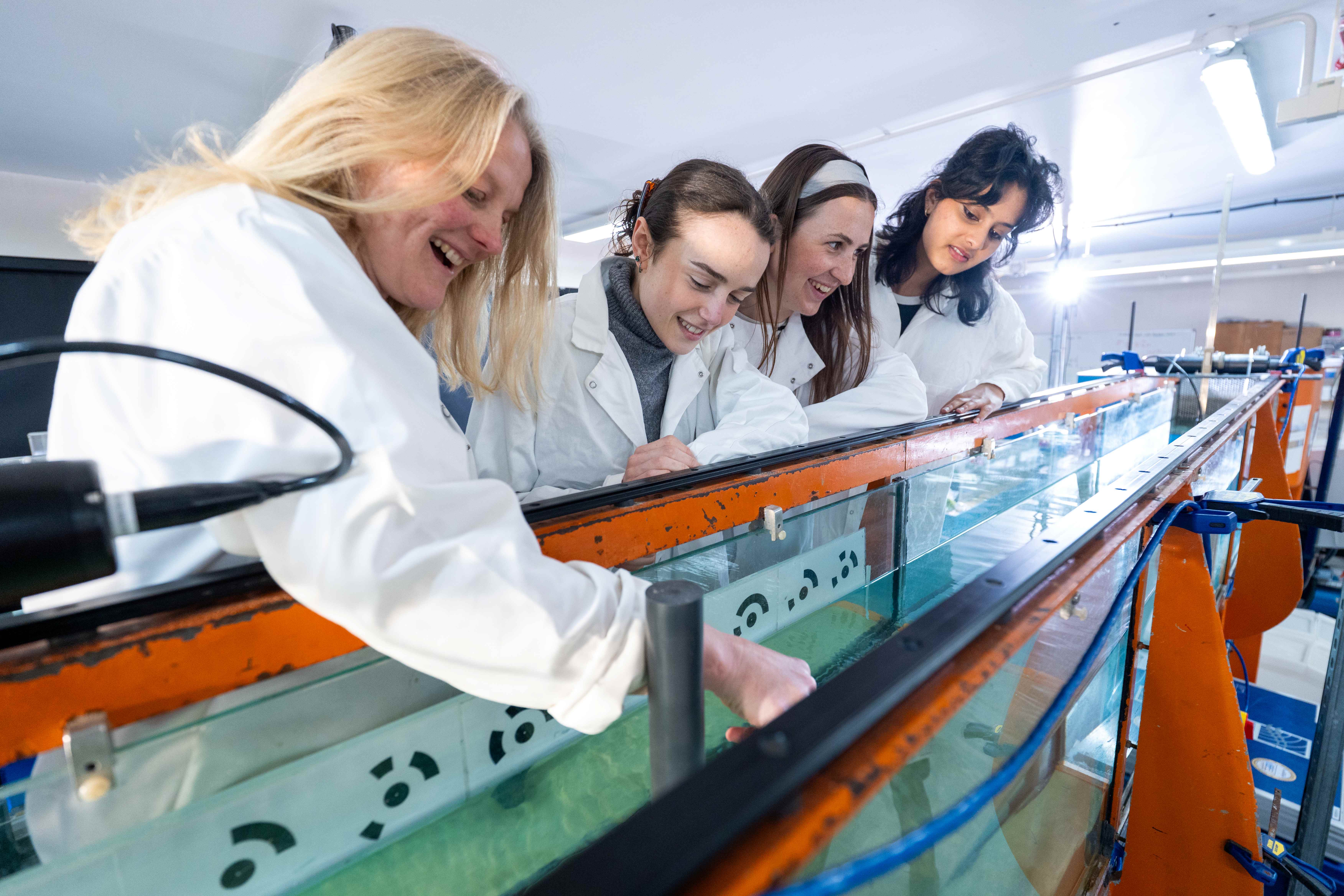
Study Earth Sciences
Learn more about this subject area
Course location
This course is based at Waterfront campus (National Oceanography Centre Southampton).
Awarding body
This qualification is awarded by the University of Southampton.
Download the Course Description Document
The Course Description Document details your course overview, your course structure and how your course is taught and assessed.
Entry requirements
For Academic year 202728
A-levels
ABB including two accepted sciences (minimum of grade B)
A-levels additional information
Acceptable science subjects are Biology, Chemistry, Physics, Mathematics, Computer Science, Psychology, Statistics, Environmental Science, Environmental Studies, Geography and Geology
A-levels with Extended Project Qualification
If you are taking an EPQ in addition to 3 A levels, you will receive the following offer in addition to the standard A level offer: BBB including two accepted science subject (minimum of grade B) and grade A in the EPQ.
A-levels contextual offer
We are committed to ensuring that all applicants with the potential to succeed, regardless of their background, are encouraged to apply to study with us. The additional information gained through contextual data allows us to recognise an applicant's potential to succeed in the context of their background and experience. Applicants who are highlighted in this way will be made an offer which is lower than the typical offer for that programme: Grades BBB
International Baccalaureate Diploma
Pass, with 32 points overall with 16 points at Higher Level, including 5 in two Higher Level accepted science subjects.
International Baccalaureate Diploma additional information
Acceptable science subjects are Biology, Chemistry, Physics, Mathematics, Computer Science, Psychology, Statistics, Environmental Science, Environmental Studies, Geography and Geology
International Baccalaureate contextual offer
We are committed to ensuring that all learners with the potential to succeed, regardless of their background, are encouraged to apply to study with us. The additional information gained through contextual data allows us to recognise a learner’s potential to succeed in the context of their background and experience. Applicants who are highlighted in this way will be made an offer which is lower than the typical offer for that programme.
International Baccalaureate Career Programme (IBCP) statement
Offers will be made on the individual Diploma Course subject(s) and the career-related study qualification. The CP core will not form part of the offer. Where there is a subject pre-requisite(s), applicants will be required to study the subject(s) at Higher Level in the Diploma course subject and/or take a specified unit in the career-related study qualification. Applicants may also be asked to achieve a specific grade in those elements. Please see the University of Southampton International Baccalaureate Career-Related Programme (IBCP) Statement for further information. Applicants are advised to contact their Faculty Admissions Office for more information.
BTEC
RQF BTEC
D in the BTEC Extended Certificate + AB at A-Level, to include two accepted science subject.
We do not accept the BTEC National Diploma/ BTEC National Extended Diploma without two AB grades in accepted science A Levels
We are committed to ensuring that all learners with the potential to succeed, regardless of their background, are encouraged to apply to study with us. The additional information gained through contextual data allows us to recognise a learner’s potential to succeed in the context of their background and experience. Applicants who are highlighted in this way will be made an offer which is lower than the typical offer for that programme.
Additional information
Acceptable A Level science subjects are Biology, Chemistry, Physics, Mathematics, Computer Science, Psychology, Statistics, Environmental Science, Environmental Studies, Geography and Geology
QCF BTEC
D in the BTEC Subsidiary Diploma + AB at A-Level, to include two accepted science subjects.
We do not accept the BTEC Diploma/BTEC Extended Diploma without two AB grades in accepted science A Levels.
BTEC contextual
We are committed to ensuring that all learners with the potential to succeed, regardless of their background, are encouraged to apply to study with us. The additional information gained through contextual data allows us to recognise a learner’s potential to succeed in the context of their background and experience. Applicants who are highlighted in this way will be made an offer which is lower than the typical offer for that programme.
Access to HE Diploma
60 credits with 45 credits at Level 3, of which 30 credits must be at Distinction and 15 at Merit
Access to HE additional information
A core science Access to HE Diploma must be studied.
Access Offer Contextual
We are committed to ensuring that all learners with the potential to succeed, regardless of their background, are encouraged to apply to study with us. The additional information gained through contextual data allows us to recognise a learner’s potential to succeed in the context of their background and experience. Applicants who are highlighted in this way will be made an offer which is lower than the typical offer for that programme.
Irish Leaving Certificate
Irish Leaving Certificate (first awarded 2017)
H2, H3, H3, H3, H3, H3 including two science subjects
Irish certificate additional information
Acceptable science subjects are Biology, Chemistry, Physics, Mathematics, Computer Science Psychology, Statistics, Environmental Science, Environmental Studies, Geography and Geology
Irish Offer Contextual
We are committed to ensuring that all learners with the potential to succeed, regardless of their background, are encouraged to apply to study with us. The additional information gained through contextual data allows us to recognise a learner’s potential to succeed in the context of their background and experience. Applicants who are highlighted in this way will be made an offer which is lower than the typical offer for that programme.
Scottish Qualification
Offers will be based on exams being taken at the end of S6. Subjects taken and qualifications achieved in S5 will be reviewed. Careful consideration will be given to an individual’s academic achievement, taking in to account the context and circumstances of their pre-university education.
Please see the University of Southampton’s Curriculum for Excellence Scotland Statement (PDF) for further information. Applicants are advised to contact their Faculty Admissions Office for more information.
Cambridge Pre-U
D3, M2, M2 to include two accepted science subjects
Cambridge Pre-U additional information
Acceptable science subjects are Biology, Chemistry, Physics, Mathematics, Computer Science Psychology, Statistics, Environmental Science, Environmental Studies, Geography and Geology
Cambridge Pre-U's can be used in combination with other qualifications such as A Levels to achieve the equivalent of the typical offer, where D3 can be used in lieu of A Level grade A or grade M2 can be used in lieu of grade B.
Cambridge Pre-U Offer Contextual
We are committed to ensuring that all learners with the potential to succeed, regardless of their background, are encouraged to apply to study with us. The additional information gained through contextual data allows us to recognise a learner’s potential to succeed in the context of their background and experience. Applicants who are highlighted in this way will be made an offer which is lower than the typical offer for that programme.
Welsh Baccalaureate
AB from two accepted science A levels and B from the Advanced Skills Baccalaureate Wales
Welsh Baccalaureate additional information
Acceptable science subjects are Biology, Chemistry, Physics, Mathematics, Computer Science Psychology, Statistics, Environmental Science, Environmental Studies, Geography and Geology
Where this offer is satisfied by including grades achieved in either Biology, Chemistry or Physics, a Pass in the practical.
Welsh Baccalaureate contextual offer
We are committed to ensuring that all learners with the potential to succeed, regardless of their background, are encouraged to apply to study with us. The additional information gained through contextual data allows us to recognise a learner’s potential to succeed in the context of their background and experience. Applicants who are highlighted in this way will be made an offer which is lower than the typical offer for that programme.
T-Level
Not accepted for this course.
Other requirements
GCSE requirements
Applicants must hold GCSE English language (or GCSE English) and Mathematics at minimum grade 4/C.
Find the equivalent international qualifications for our entry requirements.
English language requirements
If English is not your first language, you must show that you can use English to the level we require. Visit our English language pages to find out which qualifications we accept and how you can meet our requirements.
If you are taking the International English Language Testing System (IELTS), you must get at least the following scores:
IELTS score requirements
- overall score
- 6.5
- reading
- 6.0
- writing
- 6.0
- speaking
- 6.0
- listening
- 6.0
If you do not meet the English language requirements through a test or qualification, you may be able to meet them by completing one of our pre-sessional English programmes before your course starts.
GCSE requirements
Most courses require GCSE English Language (or GCSE English) and GCSE Mathematics at grade 4/C or above, or an equivalent qualification accepted by the University. Please check the ‘UK students’ tab for this course’s specific requirements.
You might meet our criteria in other ways if you do not have the qualifications we need. Find out more about:
- skills you might have gained through work or other life experiences (otherwise known as recognition of prior learning)
Find out more about our Admissions Policy.
Mature applicants
We welcome applications from learners of all ages. Students who are aged 21 and over at the start of their undergraduate course are defined as mature by the University of Southampton. We take a holistic assessment of the application looking for academic ability and commitment to study. Typical entry requirements, which may vary from discipline to discipline, includes for example, evidence of recent formal academic qualifications or professional qualifications, relevant work experience or volunteering. You may also be invited to attend an interview with an Admissions Tutor. For some degree programmes, there may also be a Professional, Statutory and Regulatory Body (PSRB) requirement. We accept many different academic qualifications. For more information, please contact the Admissions Team.
Got a question?
Please contact our enquiries team if you're not sure that you have the right experience or qualifications to get onto this course.
Email: enquiries@southampton.ac.uk
Tel: +44(0)23 8059 5000
Course structure
This Earth Sciences degree combines core scientific training with increasing flexibility as you progress through the course. You’ll build a broad understanding of Earth systems in the early years before tailoring your studies towards specialist areas and advanced research.
Year 1 overview
Your first year introduces the scientific foundations needed to study Earth Sciences.
You’ll explore:
- dynamic processes on Earth, including the formation of rocks and minerals, and plate tectonics
- how Earth and ocean systems and environments function, and the processes controlling them
- the relationships between life on Earth, the biogeochemical processes essential to support life and the evolution of Earth systems through time
- putting theory into practice through laboratory and fieldwork
- foundational scientific literacy and research skills
You’ll also begin developing core practical and analytical skills through laboratory work, data interpretation and field-based learning.
Year 2 overview
In year 2, you’ll deepen your understanding of Earth processes and begin to shape your own pathway through the course.
Core modules focus on topics such as:
- how to identify, monitor and map geohazards (including earthquakes, tsunamis, volcanoes, landslides, and climate change) and assess their risk
- the geochemical processes that operate within the Earth and ocean system
- the importance of sediments in a range of environmental settings
- advanced fieldwork and geological research skills
You’ll then choose from a range of optional modules that may include:
- structural geology, and the techniques used when working with structural data
- the science of climate change, and its impacts on Earth and ocean systems
- palaeobiology and evolution
- measurement, analysis and modelling of oceans and coasts
- sustainability, Sustainable Development Goals, and environmental policy
- the quantitative skills used by modern ocean, climate and Earth scientists, including geographic information systems (GIS), remote sensing, modelling, and Artificial Intelligence (AI)
- geophysics and exploration methods
This flexibility allows you to begin specialising while still maintaining a broad interdisciplinary understanding of Earth Sciences.
Year 3 overview
Year 3 focuses on applying your knowledge to more complex scientific and environmental problems.
You’ll study how Earth resources contribute to the transition towards a more sustainable future and undertake your choice of substantial mapping or research training projects.
You can also choose from a wide range of specialist modules covering areas such as:
- the application of the geoscience principles you’ve learned to solve environmental and engineering problems
- volcanic and mantle processes, with an optional residential field class in Tenerife
- hands-on geophysical surveying, including on-site field training in South Wales
- the evolution of the Earth, and Earth systems modelling
- climate change in the past, present and future, from physical and human perspectives
- ocean and biogeochemical processes
- the sustainable management of Earth’s resources
- environmental hazards, pollution and radioactivity
- the computational data analysis techniques used in ocean and Earth science
- seafloor exploration and surveying using our purpose-built survey vessel
Some optional modules include residential fieldwork and practical surveying activities.
Year 4 overview
The final year of the MSci Earth Sciences course is designed around advanced research and specialist scientific training. This year's modules feature more content focused around cutting-edge research and real-work application, often delivered by guest lecturers.
You’ll complete either an advanced independent research project or an industry-partnered project, investigating a complex Earth science problem using advanced analytical approaches.
Alongside your project, you’ll study contemporary scientific topics and specialist analytical methods through advanced modules.
Depending on your choices, you may study areas such as:
- practical skills from field survey through to advanced techniques in exploration geophysics
- the relationships between climate change, geological processes and human interaction with the Earth
- coastal processes and change, and engineering in and managing dynamic environments
- the knowledge and practical skills to tackle the big challenges related to the planet, including climate change, sustainable resource management and exploration, and carbon capture
- ocean processes and biogeochemical cycles
This final stage of the course prepares you for research-intensive careers, specialist scientific roles and doctoral study.
Want more detail? See all the modules in the course.
Modules
The modules outlined provide examples of what you can expect to learn on this degree course based on recent academic teaching. As a research-led University, we undertake a continuous review of our course to ensure quality enhancement and to manage our resources. The precise modules available to you in future years may vary depending on staff availability and research interests, new topics of study, timetabling and student demand. Find out why, when and how we might make changes.
For entry in academic year 2027 to 2028
Year 1 modules
You must study the following modules in year 1:
Coevolution of Life and Earth
Dynamic Earth
Earth Materials
Earth and Ocean System
Fieldwork for Geoscientists
How to be Scientifically Literate
Introduction to Environmental Biogeochemistry
Year 2 modules
You must study the following modules in year 2:
Geochemistry of the Ocean and Earth System
Geohazards
Key Skills and Fieldwork for Geologists
Sediment in the Environment
You must also choose from the following modules in year 2:
Exploration Geophysics and Remote Sensing
Global Climate Change: Science, Impacts and Policy
Global Sustainability Challenges
Igneous and Metamorphic Petrology
Monitoring Coastal and Estuarine Environments
Ocean Data Analysis and Modelling
Palaeobiology
Physics of the Ocean
Quantitative Skills in Earth System Science
Structural Geology and GIS
The Oceans in a Changing Climate
Year 3 modules
You must study the following module in year 3:
You must also choose from the following modules in year 3:
Biogeochemical Cycles in the Earth System
Coastal Sediment Dynamics
Computational Data Analysis for Ocean and Earth Scientists
Earthquake and Volcano Seismology
Environmental Radioactivity and Radiochemistry
Environmental and Engineering Geology
Geophysical Field Methods
Human and Social Adaptation to Climate and Weather Hazards
Independent Mapping Project
Large Scale Ocean Processes and Climate
Legal and Policy Landscapes
Ocean and Earth Science Research Training
Palaeoclimate Change
Seafloor Exploration and Surveying
Sustainable Resource Management
The Evolving Earth
Volcanic and Mantle Processes
Year 4 modules
You must study the following modules in year 4:
Advanced Analytical Methods for Earth and Environmental Scientists
Contemporary Topics in Ocean and Earth Science
You must also choose from the following modules in year 4:
Advanced Exploration Geophysics
Advanced Independent Research Project
Advanced Industry-Partnered Research Project
Biogeochemical Cycles in the Earth System
Carbon Storage in the Sub-Surface Environment
Climate and Climate Change
Coastal Morphodynamics
Coastal Sediment Dynamics
Computational Data Analysis for Ocean and Earth Scientists
Earthquake and Volcano Seismology
Environmental Radioactivity and Radiochemistry
Geotechnics for Geoscientists
Seafloor Exploration and Surveying 2
The Ground Beneath Our Feet: The Geological History of the last 2 Million Years
Learning and assessment
The learning activities for this course include the following:
- lectures
- classes and tutorials
- coursework
- individual and group projects
- independent learning (studying on your own)
Academic support
You’ll be supported by a personal academic tutor and have access to a senior tutor.
Course leader
Richard Stockey is the course leader.
Careers and employability
The employability and enterprise skills you'll gain from this course are reflected in the Southampton skills model. When you join us you'll be able to use our skills model to track, plan, and benefit your career development and progress.
Download skills overview

Work experience opportunities
Choosing to do work experience is a great way to enhance your employability, build valuable networks, and evidence your potential. Learn about the different work and industry experience options at Southampton.
Careers services and support
We are a top 20 UK university for employability (QS Graduate Employability Rankings 2022). Our Careers, Employability and Student Enterprise team will support you. This support includes:
- work experience schemes
- CV and interview skills and workshops
- networking events
- careers fairs attended by top employers
- a wealth of volunteering opportunities
- study abroad and summer school opportunities
We have a vibrant entrepreneurship culture and our dedicated start-up supporter, Futureworlds, is open to every student.
Your career ideas and graduate job opportunities may change while you're at university. So it is important to take time to regularly reflect on your goals, speak to people in industry and seek advice and up-to-date information from Careers, Employability and Student Enterprise professionals at the University.
Fees, costs and funding
Tuition fees
Fees for a year's study:
- UK students pay £10,050.
- EU and international students pay £33,900.
What your fees pay for
Your tuition fees pay for the full cost of tuition and standard exams.
Find out how to:
Accommodation and living costs, such as travel and food, are not included in your tuition fees. There may also be extra costs for retake and professional exams.
Explore:
Bursaries, scholarships and other funding
If you're a UK or EU student and your household income is under £36,200 a year, you may be able to get a University of Southampton bursary to help with your living costs. Find out about bursaries and other funding we offer at Southampton.
If you're a care leaver or estranged from your parents, you may be able to get a specific bursary.
Get in touch for advice about student money matters.
Scholarships and grants
You may be able to get a scholarship or grant to help fund your studies.
We award scholarships and grants for travel, academic excellence, or to students from under-represented backgrounds.
Support during your course
The Student Hub offers support and advice on money to students. You may be able to access our Student Support fund and other sources of financial support during your course.
Funding for EU and international students
Find out about funding you could get as an international student.
How to apply
What happens after you apply?
We will assess your application on the strength of your:
- predicted grades
- academic achievements
- personal statement
- academic reference
We'll aim to process your application within 2 to 6 weeks, but this will depend on when it is submitted. Applications submitted in January, particularly near to the UCAS equal consideration deadline, might take substantially longer to be processed due to the high volume received at that time.
Equality and diversity
We treat and select everyone in line with our Inclusion and Respectful Behaviour Policy.
Got a question?
Please contact our enquiries team if you're not sure that you have the right experience or qualifications to get onto this course.
Email: enquiries@southampton.ac.uk
Tel: +44(0)23 8059 5000