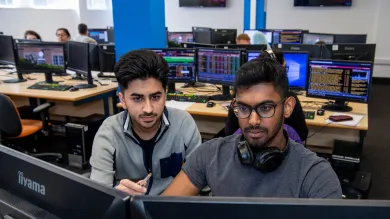
Develop the artificial intelligence and data skills shaping the finance industry with our master's in financial technology (FinTech) and AI.
This master's degree brings together finance, financial technology and applied AI, and prepares you for the rapid transformation of financial services through AI, data-driven methods and digital innovation.
You’ll build a strong understanding of key financial theories and concepts. You’ll also gain practical knowledge of computational methods and AI used in financial technology.
AI and machine learning are embedded throughout this FinTech degree, not just offered as add-ons. This means you'll graduate with applied AI competence at a professional standard, ready to contribute to the ongoing transformation of banking, investment and financial services.
Learn by doing with real financial data and AI tools
You don't need prior programming experience to apply for this FinTech and AI master's degree course. Whether your background is in finance, economics, management, engineering or science, you'll build programming and data skills step by step with structured support.
Teaching is practical and skills-led from the start. Through computer laboratory sessions, guided workshops and project-based learning, you'll work with real financial data, develop practical AI skills, and learn how to assess the risks, limitations and governance issues of AI in financial decision-making.
You'll also build knowledge and skills in:
Python, financial modelling and AI-supported workflows in finance
AI and machine learning for banking, investment, portfolio management and risk analysis
financial data platforms, including Bloomberg and LSEG Workspace
model risk, data quality, governance and regulatory issues in AI-driven finance
dissertation and project work linked to real-world financial challenges
Graduate ready for high-demand careers
AI isn't the future of finance – it's the present, and employers are increasingly expecting candidates to work confidently with analytics and AI tools from day one.
Industry evidence from organisations such as the World Economic Forum, the Institute of Chartered Accountants in England and Wales (ICAEW) and the Financial Services Skills Commission has informed the course curriculum.
This means our master's in financial technology and AI prepares you for graduate roles in:
financial technology and innovation
AI and data analytics in financial services
digital banking and transformation
banking and investment analytics
portfolio management and asset pricing
financial risk and model risk analysis
data and AI consulting in financial services
We regularly review our courses to ensure and improve quality. This course may be revised as a result of this. Any revision will be balanced against the requirement that the student should receive the educational service expected. Find out why, when, and how we might make changes.
Our courses are regulated in England by the Office for Students (OfS).
Course lead
This course is led by Dr Manuel Nunes, Lecturer in Banking and Finance and Deputy Director of the Centre for Digital Finance at the University of Southampton Business School.
He is also a researcher in finance and financial technology, specialising in the application of artificial intelligence and machine learning to asset pricing and portfolio management in financial markets.
We do not accept graduates of the following subjects:
language studies: degrees that focus on learning a language or how to translate, such as business English, applied English or translation, are not acceptable. However, this restriction does not apply to English and English literature degrees of the kind taught in the UK.
art, design and vocational Studies: degrees that focus on learning a particular form of art, craft or vocation. These include degrees in art, graphic design, photography, television broadcasting, script writing, or performance/dance.
English language requirements
If English is not your first language, you must show that you can use English to the level we require. Visit our English language pages to find out which qualifications we accept and how you can meet our requirements.
If you are taking the International English Language Testing System (IELTS), you must get at least the following scores:
IELTS score requirements
overall score
6.5
reading
6.0
writing
6.0
speaking
6.0
listening
6.0
If you do not meet the English language requirements through a test or qualification, you may be able to meet them by completing one of our pre-sessional English programmes before you start your course.
Pre-masters
If you don’t meet direct entry requirements, you can apply to complete a Pre-Master's programme through our partnership with OnCampus.
If you don't have the exact entry requirements, but you have significant work experience in this sector we’ll assess your relevant professional experience, your subject knowledge and your aptitude for learning.
Your application will be considered on individual merit and you may be asked to attend an interview.
Got a question?
Please contact us if you're not sure you have the right experience or qualifications to get onto this course.
This is a full-time, 1-year course, running from September to the following September. The first 9 months involve taught study, divided into 2 semesters.
You will study 5 compulsory modules that build a strong foundation across topics such as:
AI in finance
digital money and banking
financial technology
computational finance
financial risk management
responsible AI
You can tailor your studies to your career interests by choosing 2 optional modules in semester 1 and 1 optional module in semester 2.
In the final 3 months of the course, you will complete an individual research project as part of your dissertation.
The modules outlined provide examples of what you can expect to learn on this degree course based on recent academic teaching. As a research-led University, we undertake a continuous review of our course to ensure quality enhancement and to manage our resources. The precise modules available to you in future years may vary depending on staff availability and research interests, new topics of study, timetabling and student demand. Find out why, when and how we might make changes.
On MSc Financial Technology (FinTech) and AI, you will learn through a mix of teaching methods that combine academic foundations with practical application.
Interactive lectures: these introduce the key concepts that underpin finance, AI and financial technology.
Guided computer laboratory sessions and workshops: these help you apply these ideas to real financial data using tools such as Python.
Seminars, case studies, group work and project-based activities: these help you develop practical problem-solving, teamwork and communication skills.
Independent study is also an essential part of the course. Your learning is research-led, and your dissertation is supervised by an academic with expertise at the intersection of finance, technology and AI.
Assessment
Assessment on the programme combines coursework and examinations, with a strong emphasis on practical finance tasks.
Depending on your modules, you may complete individual projects, reports, presentations, group challenges and written exams, with a maximum of one in-person exam per semester across the compulsory modules.
Practice activities and formative feedback help you prepare for formal assessment throughout the course.
Dissertation
You'll also complete a dissertation based on an independent research project. This gives you the opportunity to apply the methods, techniques and skills developed during the taught part of the programme to a topic of your choice.
This project is shaped by industry engagement, helping to ensure that dissertation topics reflect current priorities and challenges in financial technology and AI. Where feasible, projects will be undertaken in collaboration with industry partners.
Academic Support
You'll be taught by active researchers in the fields of:
digital finance
AI applications in financial services
banking
risk management
The programme has direct links to the Centre for Digital Finance (CDF) and the Centre for Empirical Research in Finance and Banking (CERFIB). While on the course, you can benefit from workshops and seminars featuring visiting speakers from financial institutions, FinTech firms, consultancies and regulatory bodies.
Careers and employability
The employability and enterprise skills you'll gain from this course are reflected in the Southampton skills model. When you join us you'll be able to use our skills model to track, plan, and benefit your career development and progress.
Choosing to do work experience is a great way to enhance your employability, build valuable networks, and evidence your potential. Learn about the different work and industry experience options at Southampton.
We are a top 20 UK university for employability (QS Graduate Employability Rankings 2022). Our Careers, Employability and Student Enterprise team will support you. This support includes:
work experience schemes
CV and interview skills and workshops
networking events
careers fairs attended by top employers
a wealth of volunteering opportunities
study abroad and summer school opportunities
We have a vibrant entrepreneurship culture and our dedicated start-up supporter, Futureworlds, is open to every student.
Your career ideas and graduate job opportunities may change while you're at university. So it is important to take time to regularly reflect on your goals, speak to people in industry and seek advice and up-to-date information from Careers, Employability and Student Enterprise professionals at the University.
Your tuition fee covers the full cost of tuition and any exams. The fee you pay will remain the same each year from when you start studying this course. This includes if you suspend and return.
Accommodation and living costs, such as travel and food, are not included in your tuition fees. There may also be extra costs for retake and professional exams.
75th Anniversary Global Postgraduate University of Southampton Business School Excellence Scholarship
75th Anniversary Postgraduate Taught Business School Excellence Scholarships provide £5,000 towards tuition fees for new international students from eligible countries starting a full-time, on-campus, 1-year postgraduate taught programme in Southampton Business School.
The deadline to apply for this course is Wednesday 1 September 2027, midday UK time.
We advise applying early as applications may close before the expected deadline if places are filled.
International students
The deadline to apply for this course is Wednesday 18 August 2027, midday UK time.
We advise applying early as applications may close before the expected deadline if places are filled.
Application assessment fee
There is no application assessment fee for postgraduate courses starting in 2027.
Supporting information
When you apply you’ll need to submit a personal statement explaining why you want to take the course.
You’ll need to include information about:
your knowledge of the subject area
why you want to study a postgraduate qualification on this course
how you intend to use your qualification
References are not required for this programme.
Please include the required paperwork showing your first degree and your IELTS English language test score (if you are a non-native English speaker) with your application. Without these, your application may be delayed.
What happens after you apply
You'll be able to track your application through our online Applicant Record System.
We will aim to send you a decision 6 weeks after you have submitted your application.
If we offer you a place, you will need to accept the offer within 30 working days. If you do not meet this deadline, we will offer your place to another applicant.
Unfortunately, due to number of applications we receive, we may not be able to give you specific feedback on your application if you are unsuccessful.
Financial Technology (FinTech) and AI (MSc) is a course in the
Business, accounting, finance and marketing
subject area.
Here are some other courses within
this subject area: