Key facts
-
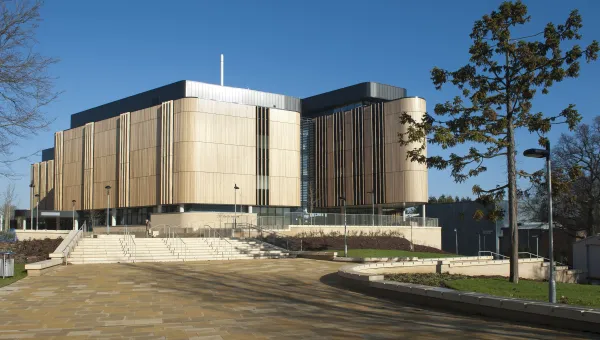
Purpose-built life science building
with outstanding laboratories and facilities with the latest equipment.
-
Strong links with business and industry
We join forces with local authorities, government and sectors from food to pharmaceuticals.
Overview
About the School of Biological Sciences
Our research in the areas of molecular and cellular bioscience, biomedical sciences, ecology and the environment focuses on real-world issues.
The impact of our work goes far beyond the laboratory and includes:
- creating wildlife corridors to protect jaguars in Belize
- harnessing the antimicrobial properties of copper
- developing the latest vaccines
We share our passion for discovery, and inspire and nurture the bioscientists of the future. Collaborating with other disciplines and universities, we use our expertise to support our industry and community partnerships.
We're based in a £50 million life science building, which is home to a wide range of research facilities.
Research culture and environment
Our ambition is to deliver outstanding research. We are an open and collaborative research community, where everyone's ideas find a platform for discussion. This inclusive approach is key to our research activity and ensures we remain at the forefront of biosciences.
Our research community is organised around 6 themes:
- molecular and precision bioscience
- plants and food security
- cell and developmental biology
- ecology and evolution
- microbiology
- neuroscience
Our research students work in a supportive environment alongside academics, postdoctoral fellows and research technicians. We are committed to the implementation of the Concordat. This is a UK agreement to support the career development of all researchers.
The Biological Sciences Postgraduate Society offers students opportunities for learning, networking and socialising.
The South Coast Biosciences Doctoral Training Partnership (SoCoBio DTP) demonstrates our commitment to the training and development of postgraduate researchers. This is a Biotechnology and Biological Sciences Research Council funded DTP. It offers a 4-year research training programme, which provides students with the skills they need to develop into future bioscience leaders.
We have a committed team of technicians, who support all aspects of our research, from using facilities to day-to-day running of laboratories. We are signatories to the Technician Commitment. This means that we develop the careers of our technicians to the same level as our other other staff and students.
Research facilities
Our school is a hub for cutting edge laboratories and research facilities for researchers in biological sciences. We also support the wider University, local and corporate communities. The facilities are independently operated and provide specialised research equipment supported by dedicated technical expertise.
Fellowships
We welcome applications from researchers interested in applying for funding for independent fellowships.
Eligible schemes
Our support package helps researchers develop competitive fellowship applications to a wide range of schemes, including the following. Contact us for advice about schemes not listed here:
- BBSRC Discovery Fellowships
- ERC Starting, Consolidator or Advanced Grants
- MRC Career Development Awards
- NERC Independent Research Fellowships
- NIHR Advanced Fellowships
- The Royal Society University Research Fellowships
- The Royal Society Dorothy Hodgkin Fellowship
- UKRI Future Leader Fellowships
- Wellcome Trust Early Career Awards or Career Development Awards
Support for applicants
We match applicants with a departmental host, who will provide:
- help with applications, including support letters and costings
- introductions to potential collaborators
- introductions to existing fellows
- a tour of our department and facilities
Support for research fellows
Successful applicants enter our formal fellowship scheme, which offers:
- training
- access to the latest equipment
- protected time away from teaching and administrative duties
- opportunities to enter PhD studentship and research grant competitions
- opportunities to move into a permanent academic role
Moving into a permanent role when a fellowship ends (proleptic appointments)
Sometimes a research fellow will wish to move into a permanent academic role with us when their fellowship ends. This is called a proleptic appointment.
How research fellows move to a permanent role
- During the fellowship, we'll set the objectives the research fellow must meet to move to a permanent role.
- After 18 months, the school will review progress against objectives.
- If the research fellow meets their objectives, they can apply for a permanent role.
- As part of the application process, we'll ask them to give a research talk to colleagues, complete a teaching exercise, and undergo a panel interview.
Get in touch to discuss a fellowship application
Whatever stage you're at with your application, we'd love to hear from you.
- Email our fellowships champion, Dr Emily Gwyer Findlay: e.gwyerfindlay@soton.ac.uk.
- Email our head of research, Professor Diego Gomez Nicola: d.gomez-nicola@soton.ac.uk.
Equality, diversity and inclusion (EDI)
Our EDI committee, chaired by our EDI champion Dr Judith Lock and deputy chair Dr Daniel Stabler, has members from across our school. We include academic, technical, administrative and research staff, along with undergraduate and postgraduate students.
Our continued ambitions are to develop and implement policies to ensure equality, by addressing inequalities that may result from protected characteristics. Our aim is to make things better for everyone by recognising and celebrating our diversity. We renewed our silver SWAN award in February 2022 which recognised our work on gender equality.
We have received funding for projects from Faculty of Environmental and Life Sciences EDI awards. These projects have focussed on:
- return from long-term leave, including maternity leave and long-term sickness, led by Judith Lock
- development of a digital display for our foyer, led by Jorn Cheney
Digital display case study
As a school, we are committed to empowering our students and other biologists to feel seen, heard, represented and valued at the University. One of our key initiatives is to increase the visibility of under-represented scientists.
We ran a case study which found that although we are a relatively diverse school, many of our students don’t see their cultural heritage or background reflected in our postgraduate and faculty communities. As a result, we are developing a digital display for our foyer.
The display aims to increase awareness about EDI in biological sciences. It will highlight:
- current role models
- historical figures that have moved the field forward
- past and present challenges to increasing diversity
- the benefits that increased diversity has brought to biological sciences
- networks, conferences and events from both national and international sources
- books on issues of EDI in science, technology, engineering and mathematics (STEM)
External Advisory Board
The role of the Advisory Board is to assist the School of Biological Sciences to ensure the success in education, research and enterprise programmes to deliver impact locally and globally.
The Board does not play a formal role in the governance structures of the University. The Board comprises individuals with appropriate and complementary expertise, experience and networks who provide advice, where appropriate, on:
- The School research and enterprise strategic plan and its development and alignment to the University Strategy and wider context.
- The School education strategic plan for both undergraduates and postgraduates and alignment to the University Strategy and wider context.
- The recruitment, retention and development of a diverse and globally engaged staff community.
- The progression of students after graduation and the creation of an engaged alumni community.
- The Board will monitor progress against and advise on interventions to achieve planned targets and KPIs which are aligned to the University Strategy.
Membership
-
Hilary Mavor (Chair)
Hilary Mavor is Global Marketing Director for Bio-Rad Life Sciences’ Antibody and Cell Biology Division. A biochemistry graduate from the University of Birmingham, she has held roles in sales, product management, and marketing at leading firms including GE Healthcare, The Automation Partnership, Genetix (Danaher), and Promega. Her experience spans life science reagents and instrumentation marketing, including at a top London PR agency. Hilary now leads marketing and product management teams with a strong focus on product development and marketing communications.
-
Dr David Barlow
David Barlow began his career at Southampton in 1974 as a Zoology graduate, later earning a PhD and becoming an Honorary Research Fellow in Neurophysiology. His groundbreaking work in microscopic biomedical photography led to collaborations on major TV series, including Life on Earth, The Living Body, and BBC’s The Human Body, earning him the Lennart Nilsson Award and an Emmy. Renowned for scientific simulations and special effects, David continues microscopy research and is creating an archive of cellular events for future scientists.
-
Professor Julian Burke
Professor Julian Burke recently served as Chief Scientific Officer and Senior Vice President at Danaher Corporation, where he provided strategic direction for the Life Sciences division (including Beckman, Cytiva, Leica and Sciex) and led investment activity across more than 35 companies. He founded and successfully floated Genetix plc on the London Stock Exchange, a company that developed instruments for biotherapeutic protein discovery and software for tissue diagnostics. He has also held a Professorship in Biochemistry at the University of Sussex, where he taught molecular genetics and conducted research in molecular neurobiology. Professor Burke has authored over 200 publications and holds eight patents. He is currently advising several biotech start‑ups and consulting for Bain Capital and KKR.
-
Dr Fergus Earley
After Bsc., PhD., and post-doctoral research at the University of Southampton, Fergus had a long career at Syngenta, a leading global company developing crop improvement and crop protection technologies. He retired in 2022 as a Senior Science and Technology Fellow, and has since been an external consultant in the industry. His career brought very broad experience of chemistry and the life sciences as well as demanding managerial and project management roles. He has led many collaborations with universities and industry, and served on doctoral training advisory boards and government funding bodies.
-
Dr Julian Foster
Julian Foster earned his PhD in applied toxicology at the University of Aston before working in research and the pharmaceutical industry. From 1994 to 2023 he taught A level Biology and EPQ at Peter Symonds’ College, leading various projects such as a Biology Extension group and various outreach initiatives including a collaboration with the University of Southampton in which A level students attempted to identify novel bacteriophages. He helped prepare students for the Biology Olympiad exams and for university interviews in medicine and other competitive subjects. He ran the college’s Biology contribution to the HE+ program in partnership with Trinity college, Cambridge and University of Southampton undergraduates and staff.
-
Dr Alasdair Robertson
Alasdair Robertson is a cell biologist with over 15 years’ experience in life science research and commercialisation. He is currently engaged as an independent consultant advising clients on aspects of business strategy, operations and product development. He previously co-founded SAL Scientific Limited, a provider of cell biology products and services to pharma/biotech customers, leading the business for a decade from initial start-up through to its eventual sale to Advanced Instruments.
-
Dr Ayodeji A Asuni
Dr Ayodeji Asuni, Head of Preclinical Fluid Biomarker and Occupancy at Lundbeck, is a neurobiologist with a Biochemistry degree and PhD in Neuroscience from King’s College London. He has over 15 years’ experience in academia and industry, focusing on drug discovery for brain diseases including Migraine, Alzheimer's disease and neuroimmune mechanisms in CNS disorders. Ayodeji pioneered tau-targeted immunotherapy for Alzheimer’s disease, now translated to clinical trials. He has authored mutiple patents, and 58 publications with 2,800+ citations, and continues mentoring Master and PhD students while advancing translational neuroscience research.
-
Laura Read
Laura Read is Chief Executive of Marwell Wildlife, a Hampshire-based conservation and education charity operating Marwell Zoo. Marwell runs global and UK programmes to protect threatened species and ecosystems through community engagement, education, and innovation, and has partnered with the University of Southampton on the MRes in Wildlife Conservation for over a decade. With a BSc in Biological Sciences from Warwick and a background in leadership roles, Laura also chairs Southampton Forward and sits on the Hampshire Prosperity Partnership Board, championing nature and culture in regional development.
Our courses
-
BSc
Biochemistry
Typical offer: ABB
UCAS course code: C700
Duration: 3 years
-
MSci
Biochemistry
Typical offer: AAB
UCAS course code: C701
Duration: 4 years
-
BSc
Biology
Typical offer: ABB
UCAS course code: C100
Duration: 3 years
-
MSci
Biology
Typical offer: AAB
UCAS course code: C101
Duration: 4 years
-
BSc
Biomedical Sciences
Typical offer: ABB
UCAS course code: B940
Duration: 3 years
-
MSci
Biomedical Sciences
Typical offer: AAB
UCAS course code: B991
Duration: 4 years
-
MRes
Advanced Biological Sciences
Typical offer: 2:2 degree
Duration: 1 year
-
MRes
Big Data Biology
Typical offer: 2:2 degree
Duration: 1 year
-
MSc
Biodiversity and Conservation
Typical offer: 2:2 degree
Duration: 1 to 2 years
-
MRes
Evolution: From the Galapagos to the 21st Century
Typical offer: 2:1 degree
Duration: 1 year
-
MRes
Wildlife Conservation
Typical offer: 2:1 degree
Duration: 1 year
Contribute to research in the field of biological sciences by completing a PhD with us.
You can also explore our current research projects.
Our research community
Research groups bring specialists together to share knowledge within different themes. Our research is based around 6 themes. We also play a key role in the interdisciplinary National Biofilms Innovation Centre.
Research and enterprise
Learn more about our research and how our work has real-life impact.


Our people
Our research-led educational programmes inspire the next generation of biological scientists, with opportunities for them to contribute to the world class research within the school.
We’re a diverse and vibrant research community, and I find this deeply stimulating. Being able to focus on the very specific elements of my discipline, while observing other’s research helps me to think outside the box and be more creative.
Developing knowledge exchange and enterprise activity will enable our biological sciences research to become rooted within our local communities and businesses to co-operatively address the most relevant scientific questions.